Aussie Math Tutor NSW Free Tutor Assessment

The Crucial Role of Time Management in Exam Success

Learn how time management can boost your problem-solving efficiency and reduce stress. Don't miss out on these essential tips
Time management by student

Table of Contents

1. Maximizing Problem-Solving Efficiency

Math exams are notorious for their time constraints. By allocating a specific amount of time to each question, you ensure that you’re not spending an excessive amount of time on a single problem. This allows you to work through the entire exam, providing answers and partial solutions where possible, ultimately leading to a higher overall score.

2. Reducing Stress and Anxiety

Effective time management instills a sense of control and confidence in the exam room. When you have a structured plan in place, you’re less likely to succumb to panic or anxiety. This, in turn, leads to clearer thinking and better decision-making, enabling you to tackle even the most challenging problems with a calm and focused mindset.

3. Prioritizing High-Value Questions

Not all questions in a math exam carry the same weight. The questions at the beginning are easy, and the difficulty increases as the test progresses. Time management allows you to identify the easy questions and solve them quickly. This allows you to prioritize and give ample time to the high-value questions.


4. Allowing Time for Review

An often underestimated aspect of time management is allocating a few minutes at the end of the exam for review. This crucial step allows you to revisit your answers, check for errors, and ensure that you’ve addressed each question to the best of your ability. It’s an opportunity to catch any oversights or miscalculations that may have occurred in the initial rush.

5. Cultivating Problem-Solving Efficiency

Time management encourages you to approach problems strategically. It prompts you to consider the most efficient methods and techniques for each question, rather than resorting to trial and error. This not only saves time but also showcases your proficiency in mathematical problem-solving.

6. Developing Lifelong Skills

Beyond the confines of the exam room, effective time management is a skill that extends to various aspects of life. It’s a valuable asset in academics, professional endeavors, and personal projects. Learning to manage your time effectively now sets the foundation for a successful and organized future.


Conclusion

Time management is a game-changer. By strategically allocating your time, you can enhance problem-solving efficiency, reduce stress, and achieve higher scores. Practice these strategies regularly to boost your math exam performance!


A math tutor guiding a student during a lesson, with the question ‘Is Private Tutoring Really Needed? The Truth Sydney Parents Should Know,’ and the Aussie Math Tutor NSW logo displayed.

Is Private Tutoring Really Needed? The Truth Sydney Parents Should Know

Many Sydney parents ask — “Is private tutoring really necessary?”

With increasing academic pressure, intense NAPLAN competition, selective school ambitions, and gaps in school teaching, tutoring has become an essential support system. In suburbs such as Telopea, Dundas, Oatlands, Eastwood, and Carlingford, students rely on private maths tutoring to build confidence, close learning gaps, and achieve their best results.

Read More »
Maths tutoring during school holidays for NSW students

Should You Continue Maths Tutoring During the School Holidays?

School holidays should feel like holidays. Children should sleep in, play, travel, see friends and enjoy time away from school. But for a child who is already struggling with maths, switching maths off completely for several weeks can create another problem: when school starts again, some of the progress they worked so hard to build may no longer feel as secure. This is why I normally recommend maintaining light, consistent maths tutoring during school holidays, especially for students who already have learning gaps. It does not mean studying every day.

Read More »
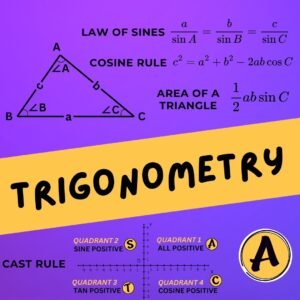
Trigonometry study graphic showing the Law of Sines, Cosine Rule, area of a triangle formula and CAST rule for NSW Year 9 and Year 10 maths students.

Trigonometry Guide for the NESA Maths Syllabus

Trigonometry is an important topic in the NESA Mathematics syllabus for NSW high school students. This guide explains SOH CAH TOA for right-angled triangles, the sine, cosine and tangent ratios, the cosine rule, the area rule, and the CAST rule for the four quadrants. It is designed to help students understand formulas, choose the correct method, and practise exam-style trigonometry questions.

Read More »
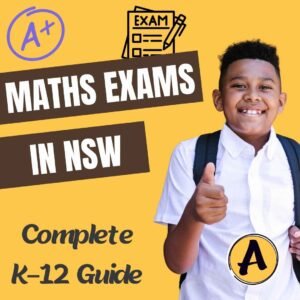
A smiling student wearing a white shirt and backpack gives a thumbs-up. The yellow and brown image includes graphic icons of an A+ stamp and a written test paper. The main text reads Maths Exams in NSW Complete K-12 Guide.

Maths Exams in NSW: Complete K–12 Guide

NSW students do not sit one statewide mathematics exam every school year. Instead, students complete a combination of national assessments, NSW diagnostic assessments, competitive placement tests, school-based mathematics exams and senior secondary assessments as they move from Kindergarten to Year 12.

The main maths-related assessments include Best Start Kindergarten, the Year 1 Number Screening Check, NAPLAN Numeracy, NSW Check-in assessments, the Opportunity Class Placement Test, the Selective High School Placement Test, school-based mathematics exams, Year 10 assessments connected with the Record of School Achievement (RoSA), the HSC Minimum Standard Numeracy Test, Year 11 school assessments, Trial HSC examinations and the formal HSC Mathematics examinations.

This guide explains what each assessment is, when students usually complete it, whether it is a formal exam or diagnostic assessment, and where students can find further NSW maths information and practice.

Read More »

Let's help your child with maths

Tell us what your child needs help with. We'll be in touch.