Year 6 Mathematics is generally the second year of Stage 3 Mathematics in NSW and is an important preparation year before students move into high school. Students continue strengthening core number skills while working with areas such as multiplication, division, fractions, percentages, measurement, perimeter, coordinates and probability.
Year 6 Maths is often more manageable than the jump students experience in Year 7. However, weaknesses in basic number operations can become much more important once high-school mathematics introduces algebra, indices, equations and other increasingly abstract concepts.
Test Your Year 6 Maths Skills
Reading a syllabus tells you which mathematical skills may be taught. A practice assessment can help identify which skills a student can actually complete independently.
Try the Free Year 6 Maths Test NSW . The full-year practice exam includes number operations, written multiplication, short division, fractions, factors and multiples, percentages, measurement, coordinates and probability.
NSW Mathematics does not require every school to teach every Stage 3 concept in an identical Term 1–4 order. Schools can sequence and revisit mathematical concepts according to their program and students' learning needs.
How does Year 6 Maths fit into the NSW curriculum?
Year 6 is generally part of Stage 3 Mathematics, which covers Years 5 and 6. NSW Mathematics is organised across the broad areas of Number and algebra, Measurement and space, and Statistics and probability.
Because Stage 3 spans more than one school year, the timing and depth of individual concepts can vary. This is why one Year 6 class may currently be concentrating on fractions while another may be working on measurement, coordinates or probability.
The topics on this page provide a broad Year 6 guide. A school's own assessment notification should be used to determine exactly what will be examined.
Official curriculum: NSW Mathematics K–10 Syllabus .
Common Year 6 Maths NSW Topics
The exact school sequence can vary, but the following areas are particularly useful when thinking about Year 6 mathematical development and preparation for high school.
Addition and Subtraction
- Written addition with larger whole numbers
- Written subtraction
- Regrouping or borrowing where required
- Estimating whether an answer is reasonable
- Applying addition and subtraction in word problems
These operations are usually among the more familiar Year 6 skills, but they still form an important foundation for multi-step problems.
Multiplication
- Multiplication facts and tables
- Multiplying a multi-digit number by one digit
- Two-digit multiplication
- Larger written multiplication where required
- Applying multiplication in word problems
46 × 7
38 × 24
246 × 35
A competent Year 6 student should progressively become more independent with written multiplication rather than relying on a calculator for these calculations.
Division and Short Division
- Basic division facts
- Short division
- Division with larger whole numbers
- Interpreting remainders
- Applying division to practical problems
In the Year 6 schoolwork commonly seen in tutoring, short division is more frequently used than traditional long division.
1,387 ÷ 6
A Year 6 answer may be expressed using a whole-number quotient and remainder rather than converting automatically to a decimal.
Factors, Multiples, HCF, LCM and Prime Factorisation
- Listing factors of a number
- Identifying multiples
- Finding common factors
- Highest Common Factor (HCF)
- Lowest Common Multiple (LCM)
- Expressing numbers as products of prime factors
Students sometimes know the vocabulary but confuse factors, multiples and prime factors. Understanding the application is more useful than memorising the definitions alone.
Factors of 12 include: 1, 2, 3, 4, 6 and 12 .
Prime factorisation of 12: 2 × 2 × 3 .
Fractions and Fraction Operations
- Equivalent fractions
- Simplifying fractions
- Adding fractions
- Subtracting fractions
- Multiplying fractions
- Dividing fractions
- Working with different denominators
Fraction operations are one of the most important Year 6 areas to strengthen before high school. Students who are unsure about multiplication tables, factors or multiples may find fraction work considerably harder.
AMT resources: Basics of Fractions · Adding & Subtracting Fractions · Multiplying & Dividing Fractions
Different Methods for Adding Fractions
Students do not always need to solve every fraction question using exactly the same written method. When appropriate, students can learn more than one correct approach.
Common-denominator / LCM method
Find a suitable common denominator, rewrite the fractions and then add or subtract the numerators.
Cross-multiplication shortcut
For two fractions, students can also learn the cross-multiplication approach provided they understand the process and simplify the final answer where necessary.
2/3 + 1/4
Using common denominators:
8/12 + 3/12 = 11/12
The aim is for the student to understand the mathematics well enough to choose an efficient correct method rather than simply memorising one procedure.
Percentages
- Understanding percentage as an amount out of 100
- Finding a percentage of a quantity
- Connecting simple fractions and percentages
- Solving practical percentage problems
Percentage questions do not always need to involve only easy values such as 10%, 25% or 50%. Stronger Year 6 students may also calculate percentages such as 38% or 70% of an amount.
Find 38% of 200.
38/100 × 200 = 76
AMT resource: Percentages Made Easy
Decimals
Students may encounter decimal concepts during Stage 3, but the exact timing and depth can vary between school programs.
- Decimal place value
- Comparing and ordering decimals
- Connections between fractions and decimals
- Decimal applications in money and measurement
AMT resource: Fractions and Decimals Conversion Guide
Order of Operations
- Brackets
- Multiplication and division
- Addition and subtraction
- Solving mixed-operation calculations in the correct order
BODMAS or order of operations is often relatively manageable for Year 6 students once the sequence of operations is understood.
AMT resource: BODMAS – Complete Guide
Measurement and Unit Conversions
- millimetres and centimetres
- centimetres and metres
- metres and kilometres
- millilitres and litres
- choosing appropriate measurement units
Students need to understand the relationship between units rather than simply attaching a zero without considering the direction of the conversion.
Perimeter and Composite Figures
- Finding the perimeter of regular shapes
- Finding the perimeter of irregular shapes
- Composite figures
- Calculating an unknown side before finding total perimeter
Composite figures are particularly useful for testing whether a student understands the diagram. Sometimes the missing side must be calculated before the perimeter can be found.
Basic Area
Depending on the school program, Year 6 students may also work with the area of familiar shapes such as:
- rectangles
- squares
- triangles
AMT resource: Essential Geometry Formulae
Coordinates and the Cartesian Plane
- Understanding the x-axis and y-axis
- Reading ordered pairs
- Plotting points
- Identifying all four quadrants
- Working with positive and negative coordinates
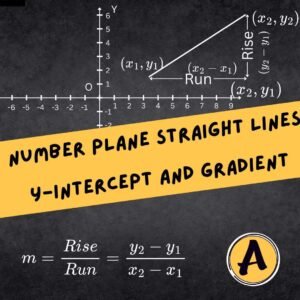
At this level, the focus is generally on accurately reading and plotting coordinates rather than the more advanced gradient and equation-of-a-line work students meet later.
AMT resource: Number Plane – Complete Guide
Probability
- certain, likely, unlikely and impossible events
- favourable outcomes
- total possible outcomes
- expressing simple probability as a fraction
Probability =
favourable outcomes ÷ total possible outcomes
Basic probability is often one of the more manageable Year 6 topics.
Foundation resource: Probability Guide
Complete the Free Year 6 Maths Test NSW to identify which areas are secure and which areas may need more practice before Year 7.
What do Year 6 students struggle with most in Maths?
The following observations are based on recurring difficulties seen while working with students rather than a claim that every Year 6 student will find the same topics difficult.
1. Operations with Fractions
Fractions are one of the biggest Year 6 difficulties. Students may understand what an individual fraction represents but become uncertain once they need to add, subtract, multiply or divide fractions.
Addition and subtraction become particularly difficult when the denominators are different because the student must first recognise the need for compatible denominators.
2. Division
Division is another major difficulty for many Year 6 students. Short division requires students to coordinate multiplication facts, subtraction and place value within one calculation.
If multiplication facts are not fluent, division can become considerably slower and more confusing.
3. Multi-Digit Multiplication
Basic multiplication can be reasonably manageable, but two-digit and larger written multiplication requires considerably more organisation.
Students need to manage place value carefully and understand why each partial product is positioned where it is.
4. Factors, Multiples, HCF, LCM and Prime Factors
These terms sound similar, which can make them easy to mix up. A student may be able to list multiplication facts but still not understand whether a question requires a factor, a multiple, HCF, LCM or prime factorisation.
Understanding when each concept is useful is more important than memorising the terminology alone.
5. Percentages
Simple percentage questions are usually manageable with practice, but some students become uncertain when the percentage is not an obvious value such as 10%, 25% or 50%.
6. Interpreting Word Problems
Sometimes the calculation itself is not the main difficulty. Students need to decide whether the situation requires multiplication, division, addition, subtraction, fractions or another mathematical process.
Which Year 6 Maths topics are often easier?
Year 6 does not need to feel overwhelmingly difficult. Many students are relatively comfortable with familiar number operations and introductory concepts once the method is clearly understood.
- Basic addition: usually one of the more familiar operations.
- Basic multiplication: generally manageable when multiplication facts are secure.
- BODMAS: often reasonably straightforward at Year 6 level.
- Basic probability: favourable outcomes over total outcomes is often understood quickly.
- Plotting coordinates: students often enjoy the visual nature of Cartesian-plane questions.
Do Year 6 students use calculators in Maths tests?
In the Year 6 school assessments commonly encountered through tutoring, students are generally expected to perform the calculations without a calculator.
Individual schools can set their own assessment conditions, so students should always check the instructions supplied for their particular task.
This deliberately helps identify whether multiplication, division, fractions and number operations are secure rather than allowing a calculator to hide an underlying gap.
Try the Free Year 6 Maths Test NSW .
How I assess a Year 6 student who is struggling with Maths
When a parent says that a Year 6 student is “weak in maths”, the problem is usually too broad to solve immediately. The first step is to determine where the mathematical foundation begins to break down.
A basic assessment can move through the core operations in a logical order:
Once the starting point is identified, learning can be customised around the skills the student actually needs rather than automatically repeating every Year 6 topic.
Year 6 enquiries are often broad at first. Parents may say that “my child is weak in maths”, that the student's performance has not been good, or that a school teacher has raised concerns about the student's progress.
A diagnostic approach helps turn that broad concern into a specific mathematical starting point.
How I teach Year 6 students who struggle with fractions
There is not always one useful written method for every fraction question. Students can benefit from understanding more than one correct approach and learning when each one is convenient.
Step 1: Check multiplication facts
Weak tables make it more difficult to recognise equivalent fractions and common multiples.
Step 2: Separate factors and multiples
Students need to understand that factors divide into a number, while multiples are generated by multiplying that number.
Step 3: Understand LCM
LCM becomes useful when finding a convenient common denominator for unlike fractions.
Step 4: Learn more than one correct fraction method
Students can practise the common-denominator/LCM method and, where appropriate, the cross-multiplication shortcut. They can then choose a correct method that makes sense for the particular question.
Step 5: Practise independently
Once the method is understood, students need repeated questions so they can perform the process without relying on a worked answer.
Supporting students who need more repetition
Some students, including some EAL/D students and students with additional learning difficulties, may need more repetition and a slower progression before a process becomes familiar.
One support method used in tutoring is a three-column worksheet:
As the student becomes more confident, the worked support can gradually be removed so the question is completed independently.
What does a Year 6 Maths test look like?
There is no single NSW-wide Year 6 school examination format. School assessments can include a mixture of multiple-choice questions and short written-answer questions, while the exact time, number of questions and topics depend on the individual school.
Follow the assessment notification supplied by the school. It should be treated as the main guide for examinable topics, test conditions and permitted materials.
Practise with a Year 6 Maths Exam
For broader revision, use the Free Year 6 Maths Test NSW . It combines number operations, fractions, multiplication, division, percentages, measurement, perimeter, coordinates and probability in one paper.
The practice test is deliberately non-calculator so that students and parents can see whether the underlying number skills are secure.
Is your child ready for Year 7 Maths?
Year 6 itself is often reasonably manageable. The larger challenge can appear when a student enters Year 7 without secure primary-school foundations.
Before high school, students should ideally be increasingly confident with the following skills:
Students may begin working with algebra, indices, equations, more advanced fractions, negative numbers, geometry and other concepts. Weak basic number skills can make those new topics considerably harder.
Students can use the Free Year 6 Maths Test NSW as a broad readiness check.
Then preview the Year 7 Maths NSW Syllabus Guide to see what changes in high school.
Students who want a further challenge can later attempt the Free Year 7 Maths Test NSW .
Year 6 Maths tutoring observations
In tutoring, students from both public and private schools can arrive with gaps in multiplication, division or fractions. School type by itself does not identify which mathematical skills an individual student understands.
For students around Telopea and nearby areas such as Dundas, Oatlands, Rydalmere, Ermington and Carlingford, an individual assessment is more useful than assuming the student's ability from their school or year level alone.
Free Year 6 Maths Resources
If one topic is causing the difficulty, start with that area instead of repeating every Year 6 topic at once.
What should parents do if a Year 6 student is weak in Maths?
Start by identifying the specific skill causing the difficulty. “Weak in maths” can mean very different things for different students.
A useful sequence is:
- Check basic addition and subtraction.
- Check multiplication facts and written multiplication.
- Check short division.
- Check factors, multiples and LCM.
- Check operations with fractions.
- Check percentage and measurement applications.
- Use mixed questions to see whether the student can recognise the required method independently.
If a student cannot add fractions with unlike denominators, immediately giving harder fraction questions may not solve the problem. The student may first need help with multiples and LCM.
The Free Year 6 Maths Test can be used as an initial broad check before deciding which topic requires more attention.
Is your child struggling with Year 6 Maths?
Year 6 difficulties often begin with a specific foundation rather than the entire mathematics syllabus. A student struggling with fractions may actually need help with multiplication facts or LCM first, while difficulty with division may come from weak multiplication recall.
Aussie Math Tutor NSW provides personalised maths tutoring designed to identify where the difficulty begins and then rebuild the skill progressively.
Year 6 Maths NSW – Frequently Asked Questions
Is Year 6 Maths part of Stage 3 in NSW?
Yes. Year 6 is generally the second year of Stage 3, which covers Years 5 and 6 Mathematics in NSW.
What are some important Year 6 Maths topics?
Important areas include addition, subtraction, multiplication, division, factors and multiples, fractions, percentages, measurement, perimeter, coordinates and probability. The exact sequence and depth can vary between school programs.
What do Year 6 students struggle with most in Maths?
This varies between students, but recurring difficulties seen in tutoring include operations with fractions, short division, multi-digit multiplication, factors and multiples, HCF and LCM, and percentage calculations.
Is there a free Year 6 Maths test for NSW students?
Yes. Students can complete the Free Year 6 Maths Test NSW to practise a broad range of Year 6 skills and identify areas that may need more revision.
Can Year 6 students use calculators in the AMT practice test?
No. The Aussie Math Tutor NSW Year 6 practice test is deliberately designed as a non-calculator assessment so that multiplication, division, fraction and number-operation skills can be assessed directly.
Do Year 6 students learn long division?
The schoolwork commonly seen in tutoring more often uses short division. Some students may also learn long division through their school, family or additional tuition. Follow the student's own school program for assessment preparation.
Do Year 6 students learn algebra?
Explicit symbolic algebra is not necessarily presented at the same depth in every Year 6 school program. Students still develop number relationships, patterns and reasoning that help prepare them for the more formal algebra introduced in secondary school.
Do Year 6 students learn decimals?
Decimal concepts can appear within Stage 3 learning, but schools can sequence and revisit concepts differently. Students should use their own school program when preparing for a specific test.
What fraction skills should a Year 6 student know?
Students should progressively become comfortable with equivalent fractions, simplifying fractions and the four operations: addition, subtraction, multiplication and division.
What should a Year 6 student know before Year 7?
Strong foundations in addition, subtraction, multiplication, short division, fraction operations, percentages, probability, measurement and composite perimeter problems can make the transition into Year 7 considerably easier.
How can I check whether my child is ready for Year 7 Maths?
Start with the readiness checklist on this page and then complete the Free Year 6 Maths Practice Test . Use any repeated mistakes to identify the topics that should be strengthened before high school.
Official NSW Mathematics References
Aussie Math Tutor NSW is an independent educational resource. For official and current NSW Mathematics curriculum information, refer directly to:
- NSW Curriculum – Mathematics K–10 Syllabus Overview
- NSW Curriculum – Mathematics K–10 Content
- NSW Department of Education – Mathematics K–6 Scope and Sequences
The Year 6 difficulty and tutoring observations on this page describe patterns encountered in tutoring and should not be interpreted as claims that every student or school follows the same program. Always use the student's current school information when preparing for a specific assessment.