How to Convert Fractions to Decimals (and Vice Versa) Easily

Struggling with fractions and decimals? This guide explains how to convert fractions to decimals and decimals to fractions with step-by-step methods, worked examples, and practice tips. Perfect for NSW students, parents, and tutors in Sydney preparing for NAPLAN, ICAS, ACER, Selective, and school exams.
Convert Fractions to Decimals and Vice Versa

Table of Contents

Practice Tests to Convert Fractions to Decimals and Decimals to Fractions:

Try our interactive practice tests to convert fractions to decimals and decimals to fractions, with instant answer checks and clear explanations to make learning easier and more effective.

① Convert Fractions ➜ Decimals (Easy & Medium)
② Convert Decimals ➜ Fractions (Easy & Medium)
③ MIX: Fractions ⇄ Decimals (Hard)

HOW TO CONVERT FRACTIONS TO DECIMALS?

Steps to Convert Fractions to decimals:

Divide the numerator by the denominator. This is the most direct way.

  • Example: 3/4 = 3 ÷ 4 = 0.75
  • Example: 5/8 = 5 ÷ 8 = 0.625


HOW TO CONVERT DECIMALS TO FRACTIONS?

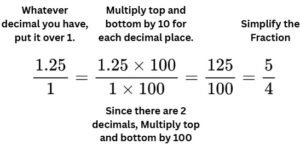
Steps to Convert a Decimal to a Fraction

  1. Write the decimal number over 1.

  2. Count the number of decimal places.

  3. Multiply the numerator and denominator by 10 for each decimal place.

  4. Simplify the fraction to its lowest terms.
Convert Decimals to Fractions

Understanding Fractions and Decimals

Fractions and decimals are two ways of showing numbers that are not whole.

  • Fractions have two parts:

    • The numerator (top number) shows how many parts you have.

    • The denominator (bottom number) shows the total number of equal parts in the whole.
      Example: In ¾, the numerator is 3 and the denominator is 4. This means 3 parts out of 4 equal parts.

  • Decimals show the same idea but in a base-ten system. They use a decimal point to separate whole numbers from parts.
    Example: ¼ as a decimal is 0.25 (because 1 ÷ 4 = 0.25).

Fractions and decimals are very important in real life. We use them in money, measurements, science, and many other areas. Knowing how to change one into the other makes calculations easier and more accurate.

Learning fractions, decimals, and how to Convert Fractions to Decimals and Vice Versa prepares you for more advanced math topics like ratios and percentages.

These skills help not just in school, but also in everyday tasks and many professions.


Why is Converting Between Fractions and Decimals Important?

Being able to change fractions into decimals (and decimals into fractions) is a very useful skill in everyday life.

  • Money and Finance: We use this skill when budgeting, managing expenses, or calculating interest. For example, prices or taxes may be written as fractions, but turning them into decimals makes the math easier and quicker.

  • School and Learning: Students often need to switch between fractions and decimals in maths. This builds a strong foundation for harder topics like algebra and calculus. It also makes problem-solving clearer and helps in tests and exams.

  • Work and Professions: Many jobs rely on this skill. Engineers and builders need it for accurate measurements. Cooks and bakers use it when adjusting recipes. Teachers use it to explain maths clearly.

✅ In short: Knowing how to convert fractions and decimals helps in school, at work, and in everyday situations like shopping or cooking.


Why People Shifted from Fractions to Decimals?

People started using decimals more often than fractions because decimals are easier for calculation and everyday use.

  • Simple to Use in Money: Our currency system works in base 10 (like $1.25). Writing this as a fraction (125/100) would be harder to calculate.

  • Faster Calculations: Adding, subtracting, multiplying, and dividing decimals is usually quicker than working with fractions.

  • Fits the Metric System: Science, engineering, and measurements use the metric system, which is based on powers of 10 — making decimals the natural choice.

  • Easy to Compare: It’s simpler to see that 0.75 is bigger than 0.65, while comparing fractions like ¾ and 13/20 takes extra steps.

  • Universal Use: Decimals work smoothly with percentages (like 0.25 = 25%), which are widely used in finance, statistics, and daily life.

👉 In short: People shifted to decimals because they are more convenient, align with our number system, and make calculations faster and clearer.
FAQs to Convert Fractions to Decimals (and Vice Versa)

What if the decimal never ends (like 0.333…)?

👉 We generally round up recurring decimals to 2 places and then use the same method for Converting Decimals to Fractions. Put it over 1, multiply by 100 for each decimal place, then simplify.

👉 Yes! Some end, some repeat, but all can be fractions.

👉 Fractions are useful in recipes and measurements. However, as numbers get larger and more complex, decimals are easier for calculations. Decimals are commonly used with money and percentages.

👉 Yes! 0.5 = ½. However, with recurring decimals, there can be a slight difference.

👉 It depends! But in general, calculations with decimals are easier and more straightforward. For example, adding fractions can get complicated and require multiple steps if the denominators are different — but that problem doesn’t happen with decimals.

We use fractions a lot when measuring things, like half a cup of flour. Decimals show up more with money and science.

👉 It depends! Kids usually start with fractions in the early years of school, while decimals are used more as they go higher in maths.

👉 Fractions and decimals form the core of mathematics. Both are important for real-life applications — from cooking and measuring (fractions) to handling money, percentages, and science (decimals). Learning both helps you switch between them easily and solve a wide range of problems with confidence.

Simple Interest Questions with detailed Explanations

The Comprehensive Guide on Simple Interest for Year 9

Our comprehensive guide on Simple Interest breaks down the key formula and its real-life uses. It offers interactive online math practice tests to help students master essential financial math skills. It’s perfect for Year 9 students in Sydney and students preparing for NAPLAN and other competitive tests.

Read More »
Year 3 Maths NSW Syllabus graphic with maths book, numbers, symbols and geometry diagrams for primary students

Year 3 Maths NSW Syllabus 2026: Parent Guide

Understand the Year 3 Maths NSW Syllabus for 2026 with this clear parent guide. Learn the key Stage 2 maths topics, including place value, addition, subtraction, multiplication, division, fractions, measurement, time, 2D and 3D shapes, data, chance and Year 3 NAPLAN numeracy preparation.

Read More »
Number plane Advance showing gradient, rise and run, and y-intercept on a graph

Number Plane: The Complete Guide with Easy Made Theory & Egs

The Cartesian Plane and Number Plane theory covers plotting points, quadrants, line equations, slope, distance, and midpoint formulas with step-by-step explanations and exercises. It also explains the relationships between parallel and perpendicular lines and how to draw a line from a given equation. For personalized tutoring, students can contact Aussie Math Tutor NSW via phone, WhatsApp, or email to book a session.

Read More »
How to Ace NSW OC and Selective Tests

How to Help Your Child Ace NSW OC & Selective Tests

To help your child succeed in the NSW OC & Selective Tests, focus on timed practice, balanced coverage across all subjects, and systematic mistake reviews. These three strategies, combined with official practice tests, will give them the confidence to perform at their best.

Read More »
Math Geometry Pie
Math Symbols
Maths tutor helping a student with schoolwork during a one-on-one tutoring session

Not sure whether maths tutoring is right for your child?

Book a free initial maths assessment to discuss your child’s current level, learning gaps and suitable next steps.

Years 1–10 • NSW syllabus-aligned • Face-to-face and online tutoring