
Free • Browser-based • Aussie Math Tutor NSW
Mental Maths Games for Kids: 7 Free Online Maths Games
Build number confidence through free mental maths games covering number bonds, times tables, division facts, arithmetic fluency, memory, number lines and early-years maths. The collection is designed for short, focused practice and gives children different ways to rehearse important number skills without turning every session into another worksheet.
Choose by skill
Explore All 7 Free Mental Maths Games
Each game has a different job. Start with the skill the child actually needs to strengthen, then move to a different game when they need variety or a new challenge.
 Early number facts
Addition & subtraction foundations
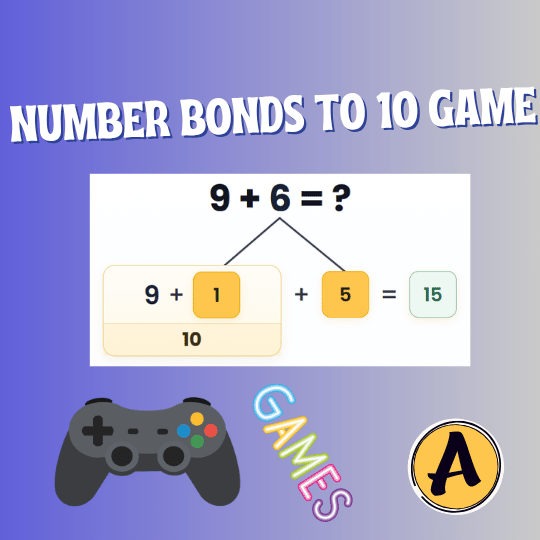
Number Bonds to 10 Game
Practise the pairs of numbers that make 10 and strengthen the relationship between addition and subtraction. A useful starting point for children who still need faster recall of small-number facts.
Play Number Bonds Times tables
Multiplication fluency
Multiplication Tables Game
Build times-table recall progressively and practise multiplication facts up to the 20 times table. Students can focus on the facts that need work instead of repeatedly practising only the tables they already know.
Play Multiplication Division facts
Multiplication–division connections
Division Game for Kids
Practise exact division facts, missing-number questions and fact-family thinking. The game begins without remainders so students can concentrate on seeing how multiplication and division connect.
Play Division Fluency challenge
Quick-fire arithmetic
Speed Arithmetic Game: Beat the Clock
Choose addition, subtraction, multiplication, division or mixed questions, then work through a 30, 60 or 90-second round. It is the collection's most direct speed-and-accuracy challenge.
Play Speed Arithmetic Memory + calculation
Recall, memory & attention
Matching Pairs Maths Game
Flip cards, solve the calculation and match it to the exact answer. Students can practise addition, subtraction, multiplication, division or mixed operations across adjustable challenge levels.
Play Matching Pairs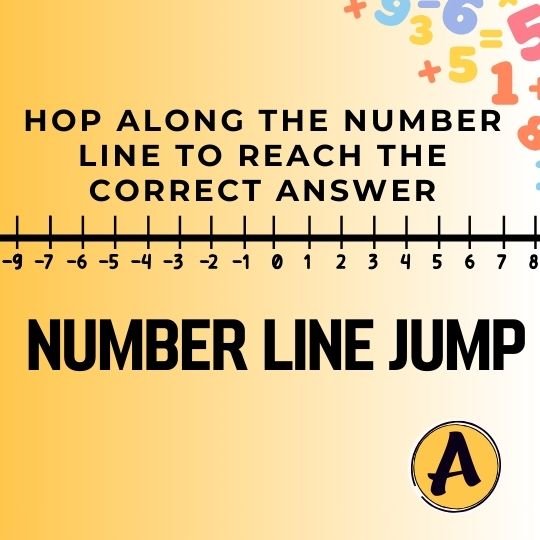 Number sense
Visual number relationships
Number Line Maths Game: Rocket Jump
Move a rocket to the target using efficient jumps. Addition, subtraction, mixed-direction and negative-number missions help students connect calculation with position, distance and direction on a number line.
Play Number Line Early years
Gentle early-years practice
Kindergarten Maths Games
A collection for younger learners developing early number, shape and ordering skills. The activities are designed without timer pressure, making this the most suitable place to begin when a child is still building confidence with foundational maths ideas.
Explore Kindergarten GamesNot sure where to start?
Which Mental Maths Game Should My Child Play?
Choose the starting point from the skill that needs work, not simply from the child's school year.
These are practical starting suggestions, not fixed curriculum placements. Use the level that matches the child's current understanding.
Practice with a purpose
What Mental Maths Practice Is Actually Building
Good mental maths is not only about answering faster. It is about recognising useful number relationships and choosing efficient strategies without depending on a calculator for every step.
Fluency with useful number facts
Number bonds, multiplication facts and related division facts reduce the amount of working memory needed for larger calculations. When basic facts are easier to retrieve, students can focus more attention on the structure of a problem.
- Recognise combinations that make 10.
- Recall multiplication facts more efficiently.
- Use known multiplication facts to solve related division facts.
- Move between addition, subtraction, multiplication and division with more confidence.
Flexible thinking, not just memorisation
The strongest mental strategies often involve breaking numbers apart, using known facts, judging distance on a number line or choosing a more efficient route. This is why the collection includes visual and strategic games as well as straightforward fact practice.
- Use number relationships instead of starting every calculation from scratch.
- Compare possible strategies before choosing one.
- Notice when an answer is unreasonable and check it.
- Explain how an answer was found, not only what the answer is.
NSW mathematics connection
How These Games Fit With NSW Maths Learning
The NSW Mathematics K–10 syllabus emphasises understanding and fluency alongside problem solving and reasoning. In the early stages, NSW outcomes include number relationships, combining and separating quantities, equal groups, multiplication and division; later learning extends those foundations into more flexible number strategies.
The NSW Department of Education also describes number sense and flexible mental strategies as important parts of additive and multiplicative thinking. These games are designed as supplementary practice: they can help rehearse a skill, but they do not replace explicit teaching, discussion, written methods or problem solving.
For the full NSW sequence, use the Aussie Math Tutor NSW syllabus and free practice hub.
Go beyond the game
Connect Mental Maths Games With Free Explanations and Practice
Games are most useful when students also understand the maths behind the answers. Use these free Aussie Math Tutor NSW resources when a skill needs more explanation or written practice.
NSW school-year guides
Find Maths Help for Your Child's School Year
Use the games for short practice, then open the relevant NSW year guide to see the broader maths learning for that stage.
Early primary
Upper primary
Secondary & assessment
For parents, tutors and homeschool families
A Simple Way to Use the Games Without Turning Maths Into Screen Time
Keep game practice short, purposeful and connected to a specific skill.
Use one game for one purpose
- If addition facts are slow, begin with Number Bonds rather than a mixed arithmetic game.
- If times tables are the gap, use Multiplication before moving into Division.
- If calculation is accurate but slow, try Speed Arithmetic only after the basic skill is secure.
- If a child benefits from visual movement, use the Number Line game and ask them to predict each jump first.
Talk about the strategy after playing
A score tells you how the round went; it does not tell you what the student understood. Ask one or two questions after a round: “How did you know?”, “Was there a faster way?”, or “Which fact helped you?”
Homeschool families can also use the games alongside the Homeschool Maths Tutoring NSW page and the broader NSW syllabus resources above.
When practice reveals a learning gap
Games Can Build Fluency. Confusion Still Needs Explanation.
If a child keeps guessing, avoids a particular operation or cannot explain the strategy behind an answer, repeating the same game may not fix the underlying gap. Aussie Math Tutor NSW provides personalised maths support for Years 1–10, with face-to-face tutoring around Telopea and online maths tutoring across NSW.
Questions from families
Mental Maths Games FAQs
Quick answers about choosing and using the free games on Aussie Math Tutor NSW.
Are all seven mental maths games free?
Yes. The games in this collection can be played free in a web browser. They are intended as accessible practice resources for students and families.
Do students need an account or login to play?
No account or login is required to open the games. Some games may save a best score or progress setting locally in the browser on the current device.
Which mental maths game should my child start with?
Start with the skill that is currently difficult. Number Bonds is a strong foundation for small-number addition and subtraction; Multiplication and Division target fact fluency; Number Line supports visual number relationships; Matching Pairs adds memory; Speed Arithmetic suits students who are already reasonably accurate and want a faster challenge.
Are these maths games suitable for NSW students?
Yes as supplementary practice. The collection focuses on number skills such as addition, subtraction, multiplication, division, number relationships and mental strategies that connect with NSW Mathematics learning. Use the NSW Maths syllabus hub for the broader curriculum sequence.
Can mental maths games help with NAPLAN numeracy?
They can support calculation fluency and number confidence, which are useful foundations for numeracy, but these games are not a complete NAPLAN preparation program. NAPLAN numeracy also assesses understanding, problem solving and reasoning across several areas of mathematics. See the Aussie Math Tutor NSW NAPLAN page for more targeted preparation.
How long should a child spend on a mental maths game?
Short, focused practice is usually more useful than playing until the child is tired or frustrated. One or two rounds, or roughly five to ten minutes, can work well as a warm-up or revision break. Stop earlier if accuracy drops or the child begins guessing.
Can homeschool families use these games?
Yes. They can be used as short practice activities within a broader homeschool maths program. Families remain responsible for planning learning that meets their registration and curriculum requirements; the games are supplementary resources rather than a complete curriculum.
Are the games a replacement for maths teaching or tutoring?
No. Games are useful for rehearsal, confidence and variety. A student who does not understand why a method works, repeatedly makes the same error or has an earlier learning gap may need direct explanation and guided practice.