Algebra Practice Test
Build confidence one level at a time. Start with basic linear equations, then progress through fractions, cross multiplication, variables on both sides, brackets and challenging algebra word problems.
- 8 progressive levels
- 50 practice questions
- Instant answer checks
- Hints and full working
Your answers and checked results are saved automatically in this browser.
Level 1
Basic Linear Equations Practice
10 questions · Foundation
0/10
Level 2
Fraction Equations and Cross Multiplication Practice
10 questions · Core skills
0/10
Level 3
Multi-Step Linear Equations Practice
5 questions · Core skills
0/5
Level 4
Algebra Word Problems Practice
5 questions · Applications
0/5
Level 5
Advanced Fraction Equations Practice
5 questions · Advanced
0/5
Level 6
Fractions with Variables on Both Sides Practice
5 questions · Advanced
0/5
Level 7
Brackets and Fractions Practice
5 questions · Advanced
0/5
Level 8
Challenging Algebra Word Problems Practice
5 questions · Challenge
0/5
Algebra Basics Explained
Use this guide to review the main algebra words, rules and techniques after completing the practice test. The explanations begin with pronumerals and expressions, then progress to substitution, like terms, brackets, factorising and equations.
What Is Algebra and Why Do We Use It?
Algebra is a branch of maths that uses letters, numbers and symbols to represent values and relationships. A letter can stand for an unknown number or a value that may change.
The letter x represents the unknown number. Algebra gives us an organised method for finding it instead of relying on guessing.
Algebra is useful for describing number patterns, solving real-life problems, writing formulas and showing how quantities are related.
What Topics Are Covered in Algebra?
Students gradually develop their algebra skills through topics such as:
- pronumerals, variables, constants and coefficients;
- algebraic expressions and equations;
- algebraic notation and powers;
- writing algebra from everyday language;
- substitution into expressions and formulas;
- number patterns and algebraic rules;
- like and unlike terms;
- simplifying algebraic expressions;
- expanding brackets;
- factorising expressions;
- linear and fraction equations;
- algebraic word problems.
Pronumerals, Variables, Constants and Coefficients
Pronumeral
A letter or symbol used to represent a number. In x + 5, the letter x is a pronumeral.
Variable
A pronumeral that can take different values. For example, the value of x may change in different questions.
Constant
A number whose value does not change. In 3x + 7, the number 7 is a constant.
Coefficient
The number multiplying a pronumeral. In 3x, the coefficient of x is 3.
Algebraic Expressions and Equations
An algebraic expression is made from numbers, pronumerals and operations such as addition, subtraction, multiplication and division.
An expression does not contain an equals sign. An equation states that two expressions have the same value and includes an equals sign.
Solving the equation means finding the value of x that makes the statement true.
For more equation examples, visit the simple linear equations guide and practice test.
Algebraic Notation
Algebraic notation is a shorter way to write multiplication, powers and division.
Indices are used when a factor is multiplied by itself repeatedly. Review the indices laws guide and practice questions for further examples.
Writing Algebraic Expressions From Words
Many algebra questions require you to translate everyday language into an expression.
- “Five more than a number” becomes x + 5.
- “A number divided by 3” becomes x/3.
- “Double a number and subtract 7” becomes 2x − 7.
- “Three less than four times a number” becomes 4x − 3.
“Five less than x” means x − 5, not 5 − x.
Algebraic Substitution
Substitution means replacing a pronumeral with a given value.
Therefore, the value of 4x + 1 is 13.
Students needing more examples can use the Year 7 algebra substitution guide and free practice questions.
Using Algebra to Describe Number Patterns
Algebra can describe how the terms in a number pattern are formed.
The rule is 2n + 1, where n is the position of the term and begins at 1.
n = 1: 2(1) + 1 = 3 n = 2: 2(2) + 1 = 5Like and Unlike Terms
Like terms have the same pronumeral raised to the same power. They can be added or subtracted by combining their coefficients.
Unlike terms cannot be combined. For example, 2x + 3y stays the same because x and y are different pronumerals.
Properties of Arithmetic in Algebra
Commutative property
The order can change when adding or multiplying.
a + b = b + a ab = baAssociative property
The grouping can change when adding or multiplying.
(a + b) + c = a + (b + c) (ab)c = a(bc)Distributive property
Multiply the term outside the brackets by every term inside.
a(b + c) = ab + acWhen several operations appear together, use the correct order of operations. The BODMAS guide and free worksheet explains the correct sequence.
Expanding and Factorising Expressions
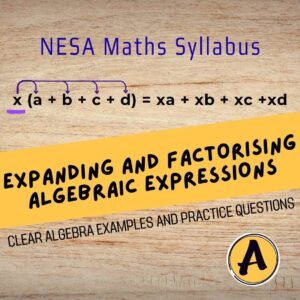
Expanding removes brackets by applying the distributive property.
Factorising is the reverse process. Identify a common factor and place the remaining terms inside brackets.
Algebraic Equations and Word Problems
To solve an equation, use inverse operations and perform the same operation on both sides. In a word problem, first decide what the unknown represents, write an equation and then solve it carefully.
Three times a number minus 5 equals 16.
3x − 5 = 16 3x = 21 x = 7Continue Learning
Still Finding Algebra Difficult?
Some students can follow worked examples but still become unsure when the equation changes. A free maths assessment can help identify whether the difficulty comes from number skills, fractions, algebraic notation or equation-solving steps.
View Free Assessment Times