Indices Laws Explained | Free Practice Questions & Tests

Indices (also called exponents or powers) might sound fancy, but they’re just a quick and clever way to show repeated multiplication. Instead of writing the same number over and over(2x2x2), indices help you keep things neat and easy(23). Think of them as the “superpower” of numbers — once you understand them, a whole world of advanced math becomes much easier to conquer!
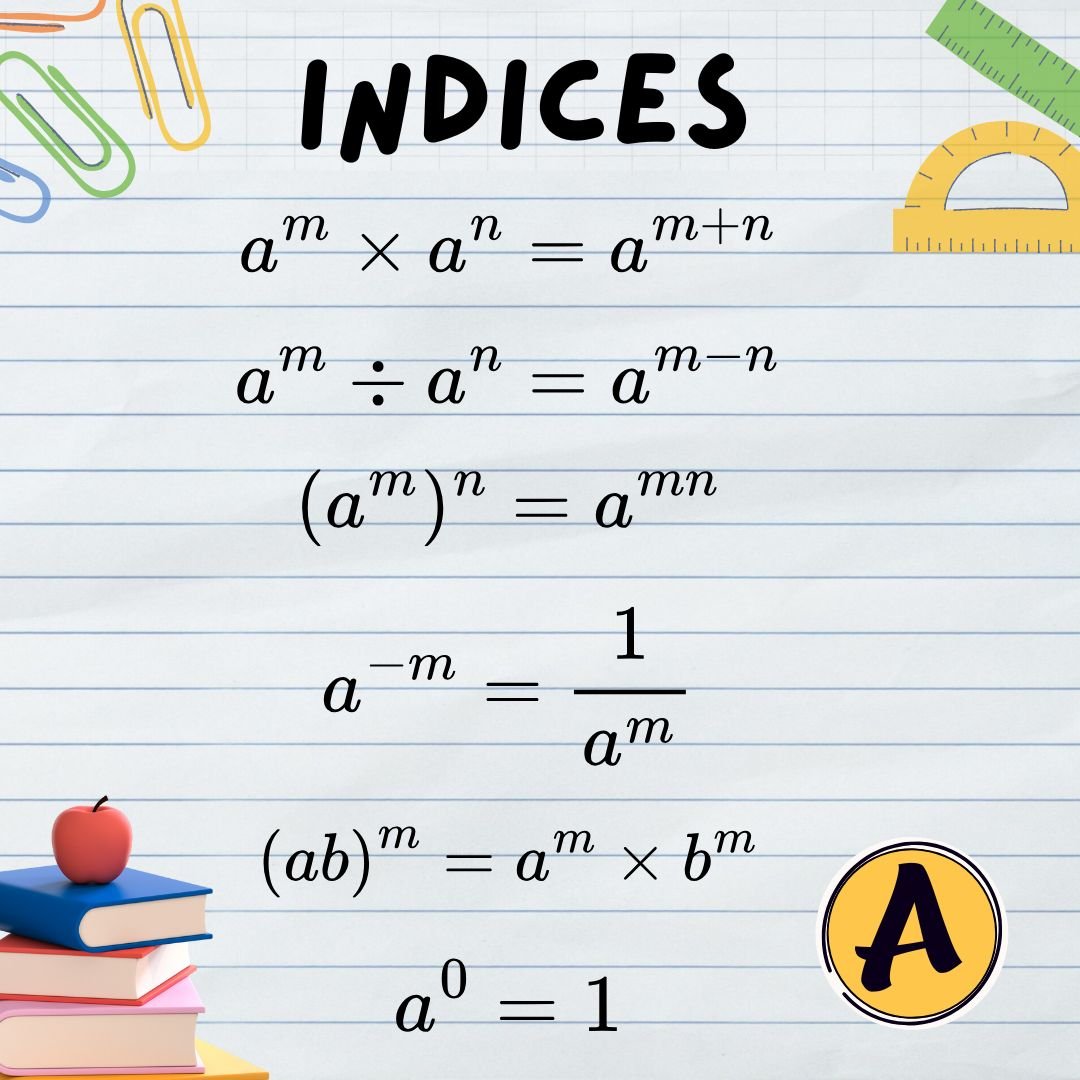
Indices laws formulae chart showing multiplication, division, powers and negative indices

Table of Contents

Interactive maths practice

Indices Practice Test

Build confidence one level at a time. Start by evaluating basic powers, then apply the index laws and finish with negative indices and challenging algebraic expressions.

  • 3 progressive levels
  • 30 practice questions
  • Instant answer checks
  • Hints and full working
0Attempted
0Correct
30Total questions
Overall progress0 of 30 correct
0 of 30 correct

Your answers and checked results are saved automatically in this browser.

Level 1 Indices — Easy 10 questions · Foundation 0/10

Tip: Calculate each power carefully. For a zero index, remember that any non-zero base raised to the power 0 equals 1.
  1. 23 = ?

    View hint and full working

    Hint: Remember: 2^3 means 2 multiplied by itself three times.

    Working
    23 = 2 × 2 × 2
    = 8
    Answer: 8
  2. 32 = ?

    View hint and full working

    Hint: The index 2 means multiply 3 by itself twice.

    Working
    32 = 3 × 3
    = 9
    Answer: 9
  3. 53 = ?

    View hint and full working

    Hint: Multiply 5 by itself three times.

    Working
    53 = 5 × 5 × 5
    = 125
    Answer: 125
  4. 102 = ?

    View hint and full working

    Hint: 10^2 means 10 × 10.

    Working
    102 = 10 × 10
    = 100
    Answer: 100
  5. 25 = ?

    View hint and full working

    Hint: Multiply 2 by itself five times.

    Working
    25 = 2 × 2 × 2 × 2 × 2
    = 32
    Answer: 32
  6. 43 = ?

    View hint and full working

    Hint: Multiply 4 by itself three times.

    Working
    43 = 4 × 4 × 4
    = 64
    Answer: 64
  7. 62 = ?

    View hint and full working

    Hint: Square 6 by multiplying it by itself.

    Working
    62 = 6 × 6
    = 36
    Answer: 36
  8. 72 = ?

    View hint and full working

    Hint: Square 7 by multiplying it by itself.

    Working
    72 = 7 × 7
    = 49
    Answer: 49
  9. 82 = ?

    View hint and full working

    Hint: Square 8 by multiplying it by itself.

    Working
    82 = 8 × 8
    = 64
    Answer: 64
  10. 170 = ?

    View hint and full working

    Hint: Any non-zero number raised to the power 0 equals 1.

    Working
    170 = 1
    Answer: 1

Level 2 Indices — Medium 10 questions · Index laws 0/10

Tip: Use the index laws: add indices when multiplying the same base, subtract when dividing, and multiply indices for a power of a power.
  1. (23)3 = 2__

    View hint and full working

    Hint: For a power of a power, multiply the indices.

    Working
    (23)3 = 23 × 3
    = 29
    The missing index is 9.
    Answer: 9
  2. (35 × 32) ÷ 36 = ?

    View hint and full working

    Hint: Add indices when multiplying, then subtract the index when dividing.

    Working
    (35 × 32) ÷ 36
    = 35 + 2 − 6
    = 31
    = 3
    Answer: 3
  3. (315 × 320) ÷ 39 = 3__

    View hint and full working

    Hint: Add the indices in the numerator, then subtract the index in the denominator.

    Working
    (315 × 320) ÷ 39
    = 315 + 20 − 9
    = 326
    The missing index is 26.
    Answer: 26
  4. ((1515)10) × 155 = 15__

    View hint and full working

    Hint: Multiply the indices for the power of a power, then add 5.

    Working
    (1515)10 × 155
    = 1515 × 10 × 155
    = 15150 + 5
    = 15155
    The missing index is 155.
    Answer: 155
  5. (9−5)10 = 9__

    View hint and full working

    Hint: Multiply the indices, including the negative sign.

    Working
    (9−5)10
    = 9-5 × 10
    = 9−50
    The missing index is −50.
    Answer: −50
  6. 212 ÷ 32 = ?

    View hint and full working

    Hint: When the powers are the same, divide the bases first.

    Working
    212 ÷ 32
    = (21 ÷ 3)2
    = 72
    = 49
    Answer: 49
  7. 125 ÷ 12−2 = 12__

    View hint and full working

    Hint: Subtracting a negative index is the same as adding.

    Working
    125 ÷ 12−2
    = 125 − (−2)
    = 127
    The missing index is 7.
    Answer: 7
  8. (2/7)38 × (7/2)38 = ?

    View hint and full working

    Hint: The two fractions are reciprocals and have the same power.

    Working
    (2/7)38 × (7/2)38
    = ((2/7) × (7/2))38
    = 138
    = 1
    Answer: 1
  9. 1252 ÷ 54 = ?

    View hint and full working

    Hint: Rewrite 125 as a power of 5 before applying the index laws.

    Working
    125 = 53
    1252 ÷ 54
    = (53)2 ÷ 54
    = 56 ÷ 54
    = 52
    = 25
    Answer: 25
  10. (15−5)10 × 155 = 15__

    View hint and full working

    Hint: Multiply the indices first, then add the index 5.

    Working
    (15−5)10 × 155
    = 15−50 × 155
    = 15-50 + 5
    = 15−45
    The missing index is −45.
    Answer: −45

Level 3 Indices — Hard 10 questions · Algebraic indices 0/10

Tip: Simplify one step at a time. Apply powers to every factor and write final answers using positive indices where required.
  1. Simplify: (23 × 2−5) ÷ 2−2

    View hint and full working

    Hint: Add indices when multiplying and subtract the denominator index when dividing.

    Working
    (23 × 2−5) ÷ 2−2
    = 23 − 5 − (−2)
    = 20
    = 1
    Answer: 1
  2. Simplify: (a4b−2)(a−3b5)

    View hint and full working

    Hint: Group matching bases and add their indices.

    Working
    a4 × a−3 = a4 − 3 = a
    b−2 × b5 = b3
    Therefore, the simplified expression is ab3.
    Answer: ab3
  3. Simplify: (3x2y−1)3

    View hint and full working

    Hint: Apply the outside power to the coefficient and to every pronumeral.

    Working
    (3x2y−1)3
    = 33x2 × 3)y^(-1 × 3
    = 27x6y−3
    = 27x6/y3
    Answer: 27x6/y3
  4. Simplify: (m0n5) ÷ (n2m−3)

    View hint and full working

    Hint: Use m^0 = 1, then subtract the indices of matching bases.

    Working
    m0 = 1
    n5 ÷ n2 = n3
    m0 ÷ m−3 = m0 − (−3) = m3
    Therefore, the simplified expression is m3n3.
    Answer: m3n3
  5. Simplify: (5p2q3)0

    View hint and full working

    Hint: Any non-zero expression raised to the power 0 equals 1.

    Working
    (5p2q3)0 = 1
    Answer: 1
  6. Simplify: (24)3 × 2−5

    View hint and full working

    Hint: Multiply the indices first, then add the index −5.

    Working
    (24)3 = 212
    212 × 2−5
    = 212 − 5
    = 27
    Answer: 27
  7. Simplify: (x−2y4) ÷ (x3y−1)

    View hint and full working

    Hint: Subtract the indices for each matching base, then rewrite negative indices positively.

    Working
    x-2 − 3 = x−5
    y4 − (−1) = y5
    x−5y5 = y5/x5
    Answer: y5/x5
  8. Simplify: ((a2b3) ÷ (a−1b5))2

    View hint and full working

    Hint: Simplify inside the brackets before applying the outside power.

    Working
    Inside the brackets:
    a2 − (−1) = a3
    b3 − 5 = b−2 = 1/b2
    So the expression inside is a3/b2.
    (a3/b2)2 = a6/b4
    Answer: a6/b4
  9. If (3x2)^a = 35x10, find a.

    View hint and full working

    Hint: Expand the left side and match the powers of 3 and x.

    Working
    (3x2)^a = 3^a x2a
    Compare with 35x10.
    a = 5 and 2a = 10
    Therefore, a = 5.
    Answer: a = 5
  10. Simplify: ((4m3n−2)2) ÷ (2m−1n3)

    View hint and full working

    Hint: Apply the square first, then divide coefficients and subtract matching indices.

    Working
    (4m3n−2)2 = 16m6n−4
    16m6n−4 ÷ 2m−1n3
    = 8m6 − (−1))n^(-4 − 3
    = 8m7n−7
    = 8m7/n7
    Answer: 8m7/n7

Indices Laws Explained: Easy Theory with Clear Examples

What are Indices in Math?

In mathematics, an index (the plural is indices) indicates how many times a base number is multiplied by itself. It’s written as a superscript to the right of the base number.


For example, in the expression 24, ‘2’ is the base and ‘4’ is the index (or exponent or power). This means you multiply 2 by itself 4 times: 24=.

Indices make maths faster, cleaner, and easier, especially when numbers and variables get large.


Why Do Students Learn Indices?

Indices are a key part of Year 8 algebra because they help students:

Once indices are understood properly, many algebra topics become much easier.

The Laws of Indices (Rules You Must Remember)

1. Multiplying Powers with the Same Base

Add the indices

When multiplying powers with the same base:

am × an = am+n

Example:
23 × 24 = 27

📌 Same base → ADD the powers

2. Dividing Powers with the Same Base

Subtract the indices

When dividing powers with the same base:

am ÷ an = am−n

Example:
57 ÷ 53 = 54

📌 Same base → SUBTRACT the powers

3. Power of a Power

Multiply the indices

When a power is raised to another power:

(am)n = am×n

Example:
(32)4 = 38

📌 Brackets with powers → MULTIPLY the indices

4. Power of a Product

Apply the power to every factor

When a product is raised to a power:

(ab)n = anbn

Example:
(2x)3 = 23x3

📌 The power applies to everything inside the bracket

5. Power of a Quotient

Apply the power to the numerator and denominator

(a/b)n = an / bn (b ≠ 0)

Example:
(3/5)2 = 9/25

6. Zero Index Rule

Any non-zero base raised to zero equals 1

a0 = 1 (a ≠ 0)

Examples:
70 = 1
1000 = 1

📌 Zero power → Answer is always 1

7. Negative Indices

Flip the base

A negative index means reciprocal:

a−n = 1 / an

Example:
2−3 = 1 / 23 = 1/8

📌 Final answers should always use positive indices

Indices Laws Explained: Writing Final Answers Correctly

In exams and textbooks:

  • Always use positive indices
  • Simplify fully
  • Avoid unnecessary brackets
  • Example:
    ❌ a−2b3
    ✅ b3 / a2

Common Mistakes Students Make with Indices

  • Adding indices when bases are different
  • Forgetting to apply powers to every term
  • Leaving answers with negative indices
  • Mixing up multiplication and division rules

Understanding the rules clearly helps avoid these errors.

Summary: Indices Rules at a Glance

Situation What to Do

  • Same base × Add indices
  • Same base ÷ Subtract indices
  • Power of a power Multiply indices
  • Product in brackets Power applies to all terms
  • Quotient in brackets Power applies top and bottom
  • Zero index Answer is 1
  • Negative index Write as a fraction

Why Mastering Indices Is Important

Indices appear in:

  • Algebra
  • Science formulas
  • Computer programming
  • Senior high school mathematics
  • Astronomy

Once students master indices, future maths topics become much easier and less stressful.

✅ Next Step for Students

After learning the theory, students should practise:

  • easy questions (basic powers)
  • medium questions (multiple laws)
  • hard questions (negative and fractional indices)

Practice builds confidence and accuracy.

What are the 7 rules of indices?

The rules of indices (also known as laws of indices) help simplify expressions involving powers. Here are the common ones:

  1. Multiplication Rule: When multiplying terms with the same base, add the indices.

    • Rule: am × an = am+n
    • Example: 23 × 22 = 25 = 32
  2. Division Rule: When dividing terms with the same base, subtract the indices.

    • Rule: am ÷ an = am−n
    • Example: 35 ÷ 32 = 33 = 27
  3. Power of a Power Rule: When raising a power to another power, multiply the indices.

    • Rule: (am)n = am×n
    • Example: (42)3 = 46 = 4096
  4. Power of a Product Rule: When a product is raised to a power, apply the power to each factor.

    • Rule: (ab)n = anbn
    • Example: (2×3)2 = 22×32 = 4×9 = 36
  5. Power of a Quotient Rule: When a quotient is raised to a power, apply the power to both numerator and denominator.

    • Rule: (a/b)n = an/bn (where b ≠ 0)
    • Example: (3/2)3 = 33/23 = 27/8
  6. Zero Index Rule: Any non-zero base raised to the power of zero is equal to 1.

    • Rule: a0 = 1 (where a ≠ 0)
    • Example: 50 = 1
  7. Negative Index Rule: A base raised to a negative power is equal to the reciprocal of the base raised to the positive power.

    • Rule: a−n = 1/an (where a ≠ 0)
    • Example: 2−3 = 1/23 = 1/8

Fractional Index Rule (Root Rule): am/n = (ⁿ√a)m = ⁿ√(am)

Example: 82/3 = (³√8)2 = 22 = 4

While often listed, some consider the core rules to be fewer, with others derived. The 7 above are commonly taught.

Recommended Books & Resources to Learn Indices

For deeper understanding and extra practice on indices, these textbooks and learning resources are highly recommended. They explain the theory, include worked examples, and align with the Australian curriculum:

A math tutor guiding a student during a lesson, with the question ‘Is Private Tutoring Really Needed? The Truth Sydney Parents Should Know,’ and the Aussie Math Tutor NSW logo displayed.

Is Private Tutoring Really Needed? The Truth Sydney Parents Should Know

Many Sydney parents ask — “Is private tutoring really necessary?”

With increasing academic pressure, intense NAPLAN competition, selective school ambitions, and gaps in school teaching, tutoring has become an essential support system. In suburbs such as Telopea, Dundas, Oatlands, Eastwood, and Carlingford, students rely on private maths tutoring to build confidence, close learning gaps, and achieve their best results.

Read More »
Math Geometry Pie
Math Symbols
Maths tutor helping a student with schoolwork during a one-on-one tutoring session

Not sure whether maths tutoring is right for your child?

Book a free initial maths assessment to discuss your child’s current level, learning gaps and suitable next steps.

Years 1–10 • NSW syllabus-aligned • Face-to-face and online tutoring