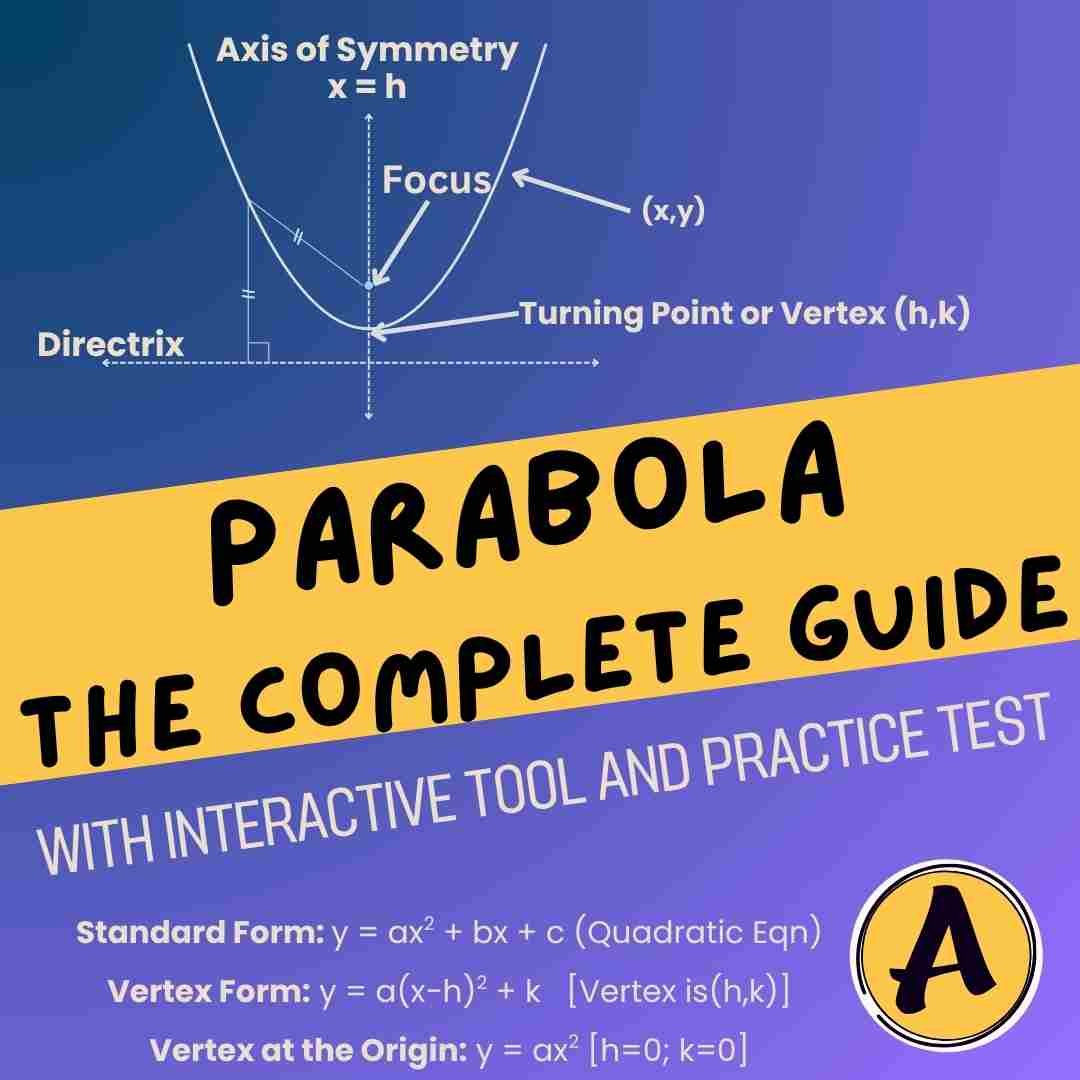
What is a Parabola? Understanding Quadratic Functions
Simply put, a parabola is the graph of a quadratic equation. It forms a symmetrical, U-shaped curve where every point is defined by its distance from a fixed point (the focus) and a fixed line (the directrix).
Aligned with the NSW NESA curriculum, our study of parabolas covers the essential skills required for success in Year 9 and 10. From calculating the vertex and axis of symmetry to sketching graphs using standard, factorised, and turning point forms, we break down everything you need to confidently tackle your school assessments.
Key Features of a Parabola: NESA-Defined Vertex, Intercepts, and Symmetry
To succeed in your Year 9 and 10 NESA assessments, you must move beyond simply sketching curves and develop a deep understanding of the algebraic mechanics behind them. This guide breaks down the essential skills you need to master:
Key features of a Parabola are
- Standard Form of the Equation: ax² + bx + c = 0, where a ≠ 0
- Vertex Form of the Quadratic Equation: a(x-h)² + k = 0, where a ≠ 0 and (h,k) is the turning point.
- Factorized form: y = a (x−r1) (x−r2); where r1 and r2 are the x-intercepts.
- Turning point or Vertex: Point where the parabola changes direction.
- Maximum: If a < 0, the parabola opens downward, so the vertex is the maximum point.
- Minimum: If a > 0, the parabola opens upward, so the vertex is the minimum point.
- Axis of Symmetry: The vertical line that cuts the parabola into two equal mirror-image halves. Formula: x= -b/2a
- x -intercepts: These are the points where the parabola crosses the x-axis (Substitute y = 0).
- y -intercept: These are the points where the parabola crosses the y-axis (Substitute x = 0)
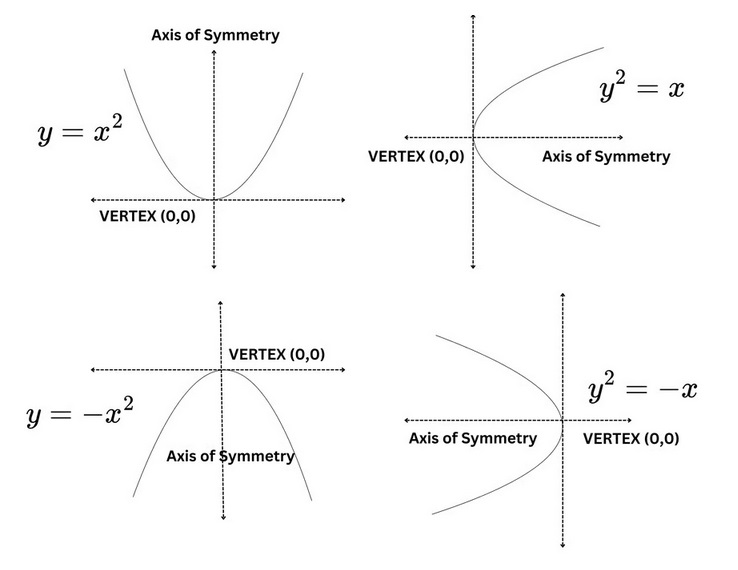
Different types of Standard Equations of a Parabola
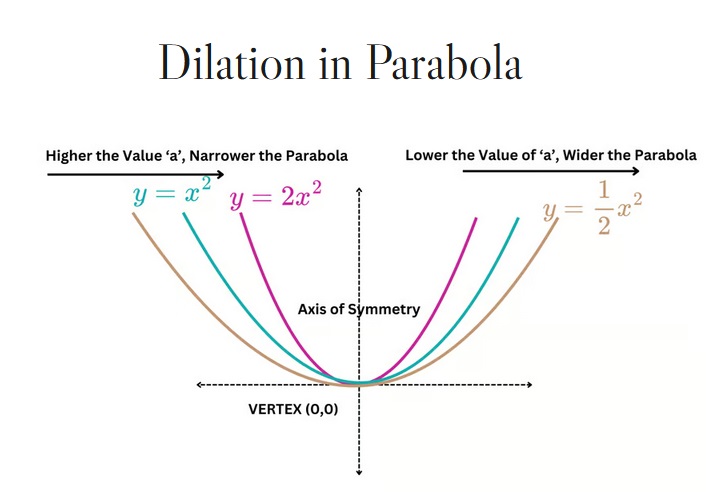
What is a Dilation in a Parabola?
In the dilation of a parabola, the larger the constant ‘a’, the narrower the parabola; and the smaller the constant ‘a’, the wider the parabola.
How to Sketch a Parabola?
In order to sketch a Parabola, follow these steps:
Step 1: Determine the kind of U-shaped curve is the Parabola. Refer to the Standard Equations of the Parabola.
If a>0, the parabola opens upwards (U-shaped).
If a<0, the parabola downwards (inverted U-shaped).
Step 2: Find the y-intercept/s for the equation by substituting x=0 in the given equation. If there are two different solutions of y, it means that the equation intercepts the Y-axis at two different points. There may not be any solution as the Parabola may not intercept the Y-axis.
Step 3: Find the x-intercept/s for the equation by substituting y=0 in the given equation. If there are two different solutions of y, it means that the equation intercepts the Y-axis at two different points. There may not be any solution as the Parabola may not intercept the X-axis.
Step 4: If there are two solutions of y, find the mid-point to determine the Axis of Symmetry. Else find the mid-point from the two solutions of x. This is one of the vertex point as the vertex lies on the axis of symmetry.
Step 5: Using the midpoint in Step No. 4, substitute that value in the main equation to find the other co-ordinate of the Vertex.
Example on how to Sketch a Parabola?
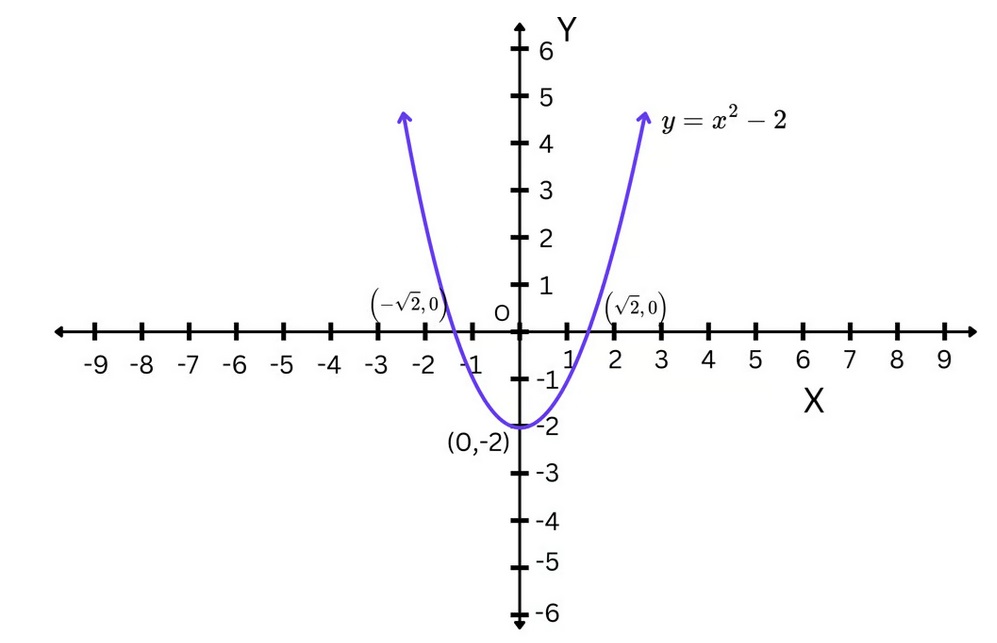
Draw the Parabola for the equation: y= x2 – 2
In order to sketch a Parabola, follow these steps:
Step 1: Determine the kind of U-shaped curve is the Parabola. Here, a=1 > 0. Hence, the parabola opens upwards (U-shaped).
Step 2: Find the y-intercept/s for the equation by substituting x=0 in the given equation.
Hence, y=x – 2; y= (0) – 2 = -2.
So, the y-intercept is at the point (0, -2). Since there’s only one solution for y, the parabola intersects the y-axis at one point.
Step 3: Find the x-intercept/s for the equation by substituting y=0 in the given equation.
Hence, y=x – 2 ; 0=x – 2; x = 2; There fore x= +-sqrt(2)
Therefore, There are parabola intercepts the parabola at two points: (+sqrt(2), 0) and ( -sqrt(2),0).
Step 4: Since there are two solutions of y, we find the mid-point to determine the Axis of Symmetry.
Hence, [sqrt(2) – sqrt(-2)]/2 = 0/2 = 0. Therefore, x=0, which is the equation for the Y-axis, is the Axis of Symmetry.
Step 5: Substitute x=2 in the main equation, we get y=-2. Hence, the Vertex is at (0,-2). Using the point, we will therefore plot the Parabola which is as follows: