If your child is in Year 5 and you want to understand what they are learning in maths, the most important thing to know is that NSW Mathematics is organised by stages as well as by school years. Year 5 sits within NESA Stage 3 Mathematics, which covers Years 5 and 6.
This means NSW schools may teach some Year 5 maths topics in a slightly different order. One school might introduce decimals earlier, while another may spend more time strengthening multiplication, division, fractions or problem solving first. That is normal because Stage 3 is taught across two years.Jump to Year 5 maths topics
What Year 5 Maths Covers in NSW
The NSW Year 5 maths syllabus is best understood as part of Stage 3 Mathematics. Stage 3 covers the later primary years and prepares students for more independent problem solving in Year 6 and high school.
The main syllabus areas are:
1. Number and algebra
Place value, operations, fractions, decimals, number patterns and problem solving.
2. Measurement and space
Length, perimeter, area, time, angles, shapes, symmetry, 3D objects and location.
3. Statistics and probability
Tables, graphs, data interpretation, chance language and simple probability ideas.
Year 5 maths also develops working mathematically. This means students learn to understand questions, choose methods, explain their thinking, check answers and communicate solutions clearly.
Number and Algebra in Year 5
Number and algebra is usually the biggest part of Year 5 maths. Students need to become more confident with larger numbers, mental strategies, written methods and multi-step problem solving.
Place value and larger numbers
Year 5 students continue building place value knowledge. They learn to read, write, compare, order, partition and round larger numbers. This is important because place value supports almost every other topic, including addition, subtraction, multiplication, division, decimals, measurement and money.
- Read and write larger whole numbers
- Compare and order numbers
- Partition numbers into thousands, hundreds, tens and ones
- Round numbers to estimate answers
- Use number lines to show position and size
Addition and subtraction
By Year 5, students are expected to use addition and subtraction more flexibly. They should be able to use mental strategies, written methods, inverse operations and estimation to check whether an answer makes sense.
A common difficulty at this stage is not the calculation itself, but choosing the correct operation in a word problem. That is why Year 5 practice should include both number drills and real problem-solving questions.
Multiplication, division, factors and multiples
Multiplication and division become everyday tools in Year 5. Students use times tables, arrays, equal groups, factors, multiples and division with remainders. They also start using multiplication and division to solve measurement, area and fraction problems.
- Recall multiplication facts more fluently
- Multiply larger numbers using efficient strategies
- Divide numbers and interpret remainders
- Understand factors and multiples
- Solve multiplication and division word problems
Fractions and decimals
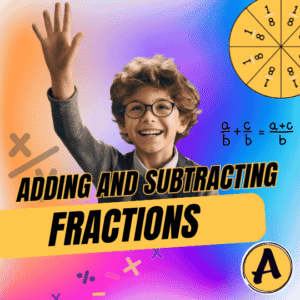
Fractions are one of the most important Year 5 topics. Students move beyond simple “parts of a whole” and begin comparing fractions, finding equivalent fractions, placing fractions on number lines and connecting fractions with decimals.
Decimals usually focus on tenths and hundredths. Students learn that decimals are another way to represent parts of a whole number, and they start comparing and ordering decimal numbers.
Parent tip:
If your child struggles with fractions, do not rush straight into harder fraction rules. First check whether they understand equal parts, number lines, times tables and division. These foundation skills make fractions much easier.
Number patterns and early algebra thinking
Year 5 students also explore number patterns and rules. This prepares them for algebra in high school. They may describe increasing or decreasing patterns, find missing numbers, continue sequences and explain the rule used to create a pattern.
Measurement and Space in Year 5
Measurement and space helps students use maths in practical situations. In Year 5, children work with units, shapes, angles, location and visual reasoning.
Length, perimeter and area
Students learn to measure and compare length using metric units. They also build stronger understanding of perimeter and area, especially for rectangles and simple shapes.
- Measure and compare lengths
- Use millimetres, centimetres, metres and kilometres
- Find the perimeter of simple shapes
- Understand area using squares and rectangles
- Connect area with multiplication
Time, duration and timetables
Time is a practical Year 5 skill. Students may work with am and pm, elapsed time, calendars, simple timetables and real-world duration problems.
This is often harder than parents expect because students need to combine reading skills, number skills and reasoning at the same time.
Angles, 2D shapes and symmetry
Geometry becomes more analytical in Year 5. Students identify and compare angles, recognise shape properties, investigate symmetry and describe transformations such as flips, slides and turns.
- Identify right, acute and obtuse angles
- Compare and order angles
- Describe properties of 2D shapes
- Recognise lines of symmetry
- Use mathematical language to describe position and movement
3D objects, nets and views
Students also learn about 3D objects, including prisms, cubes and rectangular prisms. They may match objects to nets, recognise different views and connect 2D shapes with 3D objects.
Statistics and Probability in Year 5
Statistics and probability helps students collect, read, interpret and question information. In Year 5, this usually includes tables, graphs, data displays and simple chance language.
Data, tables and graphs
Students learn to read and create data displays such as tables, tally charts, picture graphs and column graphs. More importantly, they learn to explain what the data shows.
- Read tables and graphs
- Compare values in data displays
- Answer questions using evidence from graphs
- Notice patterns, differences and trends
- Explain conclusions in words
Chance and probability
Students use everyday and mathematical language to describe chance. They may compare events using words such as impossible, unlikely, even chance, likely and certain.
At this stage, the goal is to build reasoning before using more formal probability notation in later years.
Year 5 Maths Practice Tests and Games
A strong Year 5 maths routine should include both structured practice and low-pressure revision. Practice tests help students build accuracy and exam confidence, while maths games help improve speed, recall and confidence.
Number practice
Use these for place value, addition, subtraction, multiplication, division and fractions.
Year 5 addition practice tests
Year 5 subtraction practice tests
Year 5 multiplication practice tests
Year 5 division practice tests
Topic practice
Create or link these as dedicated Year 5 topic pages over time.
Year 5 fractions practice test
Year 5 decimals practice test
Year 5 angles practice test
Year 5 data and graphs practice test
Maths games
Games are useful for recall, fluency and confidence.
Play Year 5 mental maths games
Number line maths game
Speed arithmetic game
How Year 5 Maths Connects to NAPLAN
Year 5 is a NAPLAN year, so parents naturally want to know whether the syllabus prepares students for the numeracy test. The simple answer is yes: strong curriculum learning is the best long-term NAPLAN preparation.
NAPLAN numeracy questions can include number, operations, fractions, decimals, measurement, geometry, data and problem solving. Students are not just tested on memory. They need to read questions carefully, choose the right method and work efficiently.
Healthy NAPLAN approach:
NAPLAN practice is helpful, but it should not replace normal maths learning. The best preparation is steady confidence across the Year 5 maths syllabus.
You can also use the official NAPLAN demonstration site to help your child become familiar with the online question style:
NAPLAN public demonstration site.
Simple Year 5 Maths Study Plan for Parents
A good Year 5 maths routine does not need to be stressful. Short, regular sessions are usually better than one long session once a week.
Session 1: Fluency
Times tables, mental maths, number bonds and quick recall.
Session 2: School topic
Practise the exact topic your child is learning in class.
Session 3: Word problems
Build problem-solving skills and confidence with multi-step questions.
Session 4: Game or review
Use a maths game, mixed quiz or short revision sheet.
What If My Child Is Struggling With Year 5 Maths?
If your child is finding Year 5 maths difficult, the best first step is to check the foundations. Many Year 5 struggles come from earlier gaps in place value, times tables, subtraction, division or fraction understanding.
For example, a child who is not confident with multiplication facts may also struggle with fractions, area, division, factors, multiples and word problems. Going back and strengthening these basics is often the fastest way forward.
What If My Child Is Already Confident?
If your child is already doing well, Year 5 is a great time to extend their thinking. Extension does not always mean rushing into high school work. It can also mean deeper reasoning, harder word problems, explaining methods clearly and connecting different topics.
Strong Year 5 extension might include challenging fraction problems, multi-step NAPLAN-style numeracy questions, interpreting graphs, explaining angle reasoning or solving real-world measurement problems.
Need extra support with Year 5 maths?
Aussie Math Tutor NSW helps students build confidence with clear explanations, step-by-step methods and NSW syllabus-aligned practice.
Year 5 Maths Syllabus NSW FAQs
Is Year 5 the same as Stage 3 in NSW?
Year 5 is part of Stage 3. Stage 3 covers Years 5 and 6, so schools may teach some concepts in a slightly different order while still following the NSW Mathematics syllabus.
What are the main Year 5 maths topics in NSW?
The main Year 5 maths topics include place value, addition, subtraction, multiplication, division, fractions, decimals, number patterns, measurement, time, area, angles, shapes, data, graphs and chance.
Does every NSW school teach Year 5 maths in the same order?
Not always. The NSW syllabus is stage-based, so teachers can sequence some content based on student needs, prior learning and school planning.
Is NAPLAN part of the Year 5 maths syllabus?
NAPLAN is an assessment, not the syllabus itself. However, Year 5 NAPLAN numeracy questions are linked to the kinds of maths skills students learn through the curriculum.
How can I help my child prepare for Year 5 NAPLAN numeracy?
Focus on steady curriculum learning first. Then add short practice sessions for number fluency, word problems, fractions, decimals, measurement, graphs and online question familiarity.
What should I do if my child is behind in Year 5 maths?
Start by checking the foundations: place value, times tables, subtraction, division and basic fractions. Many Year 5 problems become easier once these earlier skills are secure.
How much maths practice should a Year 5 student do at home?
Several short sessions each week usually work better than one long session. A simple routine could include mental maths, school-topic revision, word problems and one game or quiz session.
Official curriculum reference
You can view the official NSW Mathematics K–10 syllabus on the NSW Curriculum website:
NSW Mathematics K–10 Syllabus.
“`