School holidays should feel like holidays. Children should sleep in, play, travel, see friends and enjoy time away from school. But for a child who is already struggling with maths, switching maths off completely for several weeks can create another problem: when school starts again, some of the progress they worked so hard to build may no longer feel as secure.
This is why I normally recommend maintaining light, consistent maths tutoring during school holidays, especially for students who already have learning gaps. It does not mean studying every day. For many of my students, it may simply mean keeping their usual once-a-week session, using the quieter holiday period to revise, rebuild foundations and keep important skills active.
Why Can Stopping Maths Completely During the Holidays Be a Problem?
One of the most frustrating situations I see as a maths tutor happens after a long break.
A student comes back and looks at a topic that we worked on only a few weeks earlier. Instead of saying, "Yes, I remember this," they look at me as though they are seeing it for the first time.
They have not necessarily forgotten every idea. But their recall can become slower. Their confidence drops. Steps become mixed up. A method that was starting to become automatic suddenly needs to be explained again.
For a child who is already behind, this matters.
The school curriculum does not wait while the student catches up. The class begins the next topic. New homework arrives. New assessments are announced. Suddenly the tutor has two jobs: rebuild old knowledge and help the child understand the new topic at the same time.
A break from school should not automatically become a complete break from learning.
Research also supports keeping practice spread across time rather than doing all the work in one large block. A 2025 meta-analysis specifically looking at mathematics found that spaced maths practice improved retention compared with massed practice.
That does not prove that every child needs a private tutor every week of every holiday. There is no research showing that exactly one hour per week is the perfect amount for every student.
But it does support a very practical principle: a little maths spread across the break is usually more sensible than doing nothing for weeks and then trying to cram everything back in.
Holiday Maths Tutoring Should Not Feel Like Another School Term
When I tell parents that I prefer students to continue tutoring during school holidays, I am not suggesting that children should spend their holiday sitting at a desk every day.
Think about a normal school week.
A student may have five days of school, homework, assignments, tests, sport, other subjects, travel and tutoring.
During the holidays, most of that disappears.
If a child keeps one normal maths lesson during the week, that still leaves almost the whole week free for everything else.
In fact, holiday tutoring can often feel less stressful than tutoring during the school term because there is no urgent test tomorrow and no school homework that must be finished tonight.
School Holidays Can Be the Best Time to Fix the Maths Basics
During the school term, tutoring often has to follow what the school is teaching right now.
If the school is doing algebra and there is an algebra test coming up, we work on algebra. If next week is probability, probability becomes important. If the class moves into geometry, we need to help the student keep up with geometry.
The problem is that the real weakness may sit much further back.
A student may be struggling with algebra because multiplication is still slow. A percentage problem may actually be difficult because fractions and decimals are weak. A Year 8 geometry problem may be difficult because the student has forgotten Year 7 angle rules.
The holidays give us something the school term often does not: time to go backwards before we go forwards.
This is also consistent with the NSW Mathematics K–10 syllabus. NESA recognises that students learn at different rates and that teachers may sometimes need to work across stages. It specifically gives the example of Stage 4 students who need to revisit Stage 3 fractions, decimals and percentages before progressing.
Sometimes the quickest way to help a child move forward in maths is to first repair the skill that should have been secure one or two years earlier.
That is why holiday tutoring should not automatically mean racing ahead into next term. Very often, the best use of the break is strengthening the foundations that will make the next term easier.
What Should Students Work on During the Holidays?
The answer depends on the child's age, current level and learning gaps. There is no single holiday program that is right for every student.
Kindergarten to Year 3: Keep Early Number Skills Active
With younger students, I pay close attention to basic number confidence. Two areas that can quickly become shaky are number bonds to 10 and basic subtraction.
A child may finally understand that 7 + 3 = 10 or 8 + 2 = 10 without counting every number. They may be starting to subtract mentally instead of relying on their fingers for every question.
After a long period without practice, some children go back to slower methods. The maths has not disappeared completely, but the automatic recall has weakened.
Parents do not need to turn this into heavy homework. Our free mental maths games include number bonds, multiplication, division, arithmetic and early-number activities that children can use for short practice between lessons.
Years 4 to 6: Fractions Become a Major Foundation
Years 4 to 6 are extremely important because maths starts bringing several basic skills together.
Fractions are one of the biggest examples.
Students may need to understand:
- equivalent fractions
- simplifying fractions
- improper fractions and mixed numbers
- adding and subtracting fractions
- unlike denominators
- multiplying fractions
- dividing fractions
- fractions, decimals and percentages
- factors, HCF and LCM
I see these difficulties repeatedly.
A student may understand what a fraction is but still struggle badly when the denominators are different. Another student may know how to multiply fractions but forget how to simplify the final answer.
The danger is that these gaps do not stay in Year 5 or Year 6.
Fractions appear again in percentages, ratios, algebra, probability, trigonometry and many later topics.
Year 6 to Year 7: A Very Important Transition
The move from primary school to high school is one of the best times to check whether the foundations are actually secure.
Before Year 7 becomes busy, I would want a student reasonably comfortable with:
- multiplication and division
- fractions
- decimals
- percentages
- factors, HCF and LCM
- basic negative numbers
- multi-step problem solving
If these skills are weak, Year 7 algebra, ratios, percentages and equations can feel much harder than they need to.
Parents who want a clearer picture can use our free Year 7 Maths Test NSW. It covers number skills, fractions, algebra, geometry, data and probability and can help reveal which areas need more work.
Years 7 and 8: Geometry and Measurement Often Cause Problems
A very common weakness I see around Years 7 and 8 is geometry.
Students may have previously learned:
- corresponding angles
- alternate angles
- co-interior angles
- vertically opposite angles
- angles in a triangle
- area
- composite shapes
- surface area
- volume
But knowing that these rules exist is not the same as being able to recognise them quickly inside an unfamiliar question.
A student may look at parallel lines and a transversal and know that there is an angle rule somewhere, but not remember which one.
This is exactly the type of topic that benefits from calm revision during a holiday.
Students can also check their current level with our free Year 8 Maths Test NSW.
Year 8: Percentages Should Become Faster and More Connected
Another area I focus on is percentages.
A student may technically know how to calculate 15% of 200 but still use a long method every single time.
As students move into percentage increase, percentage decrease, simple interest, compound interest and depreciation, I want them to see the connection between the ideas.
For example, increasing an amount by 15% can be represented using a multiplier of 1.15, while decreasing it by 15% can use 0.85.
Understanding this makes later financial mathematics faster and clearer. Holiday lessons give us time to explain why these methods work rather than just memorising another formula.
What About OC and Selective School Preparation During the Holidays?
Years 4 to 7 can be especially important for families thinking about Opportunity Class or Selective High School entry.
These tests involve much more than routine calculations. Students need to read unfamiliar problems, use logic, recognise patterns and decide which mathematical idea is useful.
When this type of practice stops for a long time, students may need time to regain their rhythm, particularly with mathematical reasoning questions.
However, it is important to be accurate here.
The NSW Department of Education states that paid coaching is not necessary for the placement tests and warns against excessive coaching. Parents can access the Department's free Opportunity Class practice tests and Selective High School practice tests.
My point is not that children need to spend their whole holiday doing test papers. It is that if a student is already preparing, completely stopping every form of mathematical reasoning for weeks may make restarting harder.
Light practice, reviewing mistakes and keeping familiar with the style of questions can maintain continuity without turning the holiday into an exam camp.
Years 9 and 10: Students Need to See the Big Picture
By Years 9 and 10, I become much more serious about how a student understands maths.
At this stage, I do not want a student simply collecting formulas.
I want them to understand:
What does this formula do? When should I use it? How does this topic connect to the topics I learned before?
This matters because Years 9 and 10 build many of the foundations students will later need in senior mathematics.
The NSW Mathematics curriculum develops ideas across algebra, equations, linear and non-linear relationships, Pythagoras and trigonometry, geometry, area and volume, data and probability. You can explore these areas in our Year 10 Maths NSW syllabus guide or view the official NSW mathematics syllabuses.
Trigonometry: Knowing Formulas Is Not Enough
Trigonometry is a perfect example.
A student may know SOHCAHTOA.
Then they learn the sine rule. Then the cosine rule. Then bearings. Later they may meet trigonometric graphs, identities, radians and more advanced applications.
The problem is often not that the student has never seen the formulas.
The problem is that they look at a triangle and think:
"Which one am I supposed to use?"
Give a student a triangle with three known sides and ask them to find an angle. Some students immediately start searching their memory for every formula they know.
They are not missing information. They are missing the map.
During the holidays, we can slow down and teach the decision-making process:
- What information has the question given?
- What do we need to find?
- Is the triangle right-angled?
- Which sides and angles are known?
- Which method matches that information?
That is far more powerful than memorising another formula.
Quadratics and Parabolas: Students Need to See the Connection
Quadratics create the same problem.
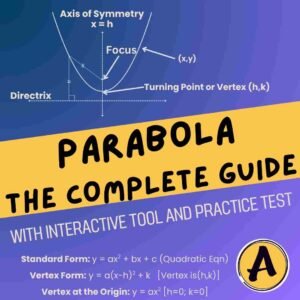
Students may learn factorising, completing the square, quadratic equations and parabolas at different times.
If every skill is stored in a separate mental box, a student can become completely confused when a question connects two of them.
Completing the square is a good example.
A student may learn how to complete the square as a procedure but never really understand why it matters.
Later, they are asked to write a parabola in vertex form and suddenly the earlier method has a purpose.
This is what I mean when I talk about giving students the big picture.
The aim is to move from:
"I remember a formula."
to:
"I understand what kind of problem this is and I know which tool I need."
Year 10, RoSA and Preparing for Senior Mathematics
By Year 10, families naturally start thinking more seriously about Years 11 and 12 and which mathematics course may suit the student.
The Record of School Achievement (RoSA) is a cumulative record of achievement for eligible students who leave school before completing the HSC. Stage 5 grades are based on evidence from school assessment work rather than one single statewide Year 10 examination.
This is worth understanding because Year 10 should not be treated as a year where students can simply switch off and worry about senior mathematics later.
If a student is considering more demanding senior maths, the foundations matter. Algebra, indices, equations, graphs, geometry and trigonometry do not suddenly begin in Year 11. They are built over several years.
Is a Two-Week Holiday Different From the Christmas Holidays?
Yes.
A normal NSW term break is much shorter than the long summer break. I would not claim that every student will lose significant maths knowledge during a two-week holiday. The research does not support a fixed rule like that.
But the decision also depends on the child.
If a student has been struggling for months and has finally started making progress with fractions or algebra, I would still ask:
Do we really gain anything by completely stopping the routine for two weeks?
For the Christmas and summer holidays, the case for maintaining some contact becomes stronger because the break is much longer.
School disappears. Homework disappears. Assessments disappear. And if tutoring disappears as well, a child may go several weeks with almost no structured maths at all.
That is the period where I most often worry about losing momentum.
This does not mean six weeks of heavy study. It means avoiding a complete academic switch-off when a child's maths is not yet secure.
Should Holiday Maths Focus on Catching Up or Getting Ahead?
My normal priority is simple:
Fix the weak foundation first. Then think about getting ahead.
If a Year 7 student still struggles with fractions, I would rather strengthen fractions than proudly tell a parent that we have started Year 8 algebra early.
If a Year 9 student cannot confidently choose between basic trigonometric methods, I would rather make that skill secure before rushing into another advanced topic.
Getting ahead can be useful for a student whose foundations are already strong. Some students genuinely enjoy extension and challenge.
But acceleration should not be used to hide weaknesses.
Mathematics builds on itself. A missing foundation does not disappear because the calendar moves to another school year.
Does Research Prove Every Child Needs Holiday Tutoring?
No, and I think parents deserve a truthful answer.
You may see claims online suggesting that every child loses a fixed number of months of learning during school holidays.
The research is not that simple.
Children vary. Some skills are more secure than others. The length of the break matters. The student's previous understanding matters.
What we can say with much more confidence is that spacing learning over time is better supported than cramming, and that a child with an identified learning gap has something useful to work on during the break.
That is why my recommendation is based on the child, not on a scary statistic.
When Does Taking a Break From Tutoring Make Sense?
There are genuine exceptions.
A student may need a pause when:
- they are genuinely exhausted after a very difficult term
- tutoring has become a constant source of distress or conflict
- the family is travelling and maintaining lessons is impractical
- the student is unwell
- there is no clear learning need and the child is already working confidently
Rest matters.
My recommendation for consistency should never be read as: "Every student must study every week no matter what."
But there is also a big difference between taking a genuine rest and switching maths off completely for a long period when the child already has major gaps.
If formal tutoring is paused, maths can still remain part of everyday life. The NSW Department of Education's holiday maths activities include ideas based on cooking, measurement, travel, shapes, estimating, time and other everyday situations.
What Does a Good Holiday Maths Session Actually Look Like?
It should usually feel calmer than a normal term-time session.
Depending on the student, we may use the lesson to:
- revise one weak foundation
- repair multiplication or division fluency
- revisit fractions
- mix older topics together
- review mistakes from the previous term
- strengthen percentages
- revisit geometry and angle rules
- practise mathematical reasoning
- connect algebra, graphs, quadratics or trigonometry
- prepare gently for the next school stage
There does not need to be heavy homework.
The purpose is not to recreate school.
The purpose is to make sure that when school returns, the student is not starting from cold.
The Question I Would Ask Every Parent Before Cancelling Holiday Tutoring
Do not ask only:
"Does my child deserve a break?"
Of course they do.
Ask a second question:
"Does my child need to stop using maths completely in order to enjoy that break?"
For a student who already struggles, my answer is often no.
One relaxed lesson in an entire week still leaves plenty of time for holidays, friends, games, sport, family, travel and rest.
And when school returns, I would much rather hear:
"I remember how to do this."
than:
"I think I learned this before, but I can't remember anything."
Free Ways to Keep Maths Active Between Lessons
Tutoring does not need to be the only maths a child does during the holidays.
Aussie Math Tutor NSW has a growing collection of free resources that parents and students can use at home:
- Free mental maths games for number bonds, multiplication, division and number fluency.
- NSW Maths Syllabus and Practice Test Hub for Years 1–10.
- Free Year 7 Maths Test NSW with diagnostic practice.
- Free Year 8 Maths Test NSW for students working through Stage 4 skills.
- Year 10 Maths NSW Syllabus Guide for parents and students approaching senior mathematics.
Not Sure What Your Child Has Forgotten?
Sometimes the topic your child is struggling with is not the real problem. An algebra difficulty may begin with multiplication. A percentage problem may begin with fractions. A Year 8 geometry problem may begin with an angle rule learned the year before.
A free maths assessment can help identify where the gap starts and what your child should work on next.
Book a Free Maths Assessment Explore Online Maths Tutoring NSWPersonalised maths support for Years 1–10. Online tutoring is available across NSW.
Frequently Asked Questions About Maths Tutoring During School Holidays
Should my child stop maths tutoring during the Christmas holidays?
If your child is already struggling or has important learning gaps, I generally prefer maintaining light, regular contact with maths rather than stopping for the whole summer break. The aim is not heavy study. It is maintaining skills, routine and confidence.
Will my child forget maths during the holidays?
Every student is different, so it would be wrong to say every child loses a fixed amount of maths knowledge. In my tutoring experience, however, students with skills that are not yet secure can return rusty and need substantial revision before moving forward.
Is one maths lesson per week enough during the holidays?
There is no research proving that exactly one lesson per week is the perfect amount for every child. For many of my students, keeping one normal weekly session is a practical way to maintain consistency while still leaving most of the holiday completely free.
Should holiday maths focus on revision or next term's work?
I normally prefer fixing weak foundations first. Once the student's basic skills are secure, extension or future topics can make sense.
Should Year 6 students revise maths before starting Year 7?
It can be very useful, especially if multiplication, division, fractions, decimals, percentages, factors or problem-solving are weak. These skills appear again throughout secondary maths.
Should OC and Selective students continue practising during school holidays?
The NSW Department of Education states that paid coaching is not required for placement tests and warns against excessive coaching. However, students who are already preparing can use light practice, official sample questions and review of mistakes to maintain familiarity without turning the holidays into an intensive exam program.
What should Year 9 and Year 10 students revise during holidays?
I would focus less on memorising more formulas and more on understanding connections. Algebra, graphs, quadratics, geometry and trigonometry become much easier when students know how to recognise which method a question needs.
Can maths games replace tutoring during a holiday?
For a student who is already secure and simply needs light practice, games and everyday maths can be useful. A child with significant learning gaps may still benefit from personalised teaching because the main issue is often not practice alone but understanding where the misunderstanding begins.
Final Thoughts for Parents
School holidays matter.
Children need rest, family time and a chance to enjoy being away from school.
But if your child is already finding maths difficult, I would think carefully before stopping every form of maths support for several weeks.
The progress your child has made has value.
The confidence they have started to build has value.
And the foundations they are slowly strengthening will be needed again when the school curriculum moves forward.
Keep the holiday. Keep the rest. But where your child still needs support, try to keep the maths connection alive too.
If you are unsure where your child currently stands, explore our Years 1–10 Maths Tutoring , try our free NSW maths resources , or book a free initial maths assessment to identify the most important gaps before they become next term's problems.