2D Shape Area Formulae Practice Questions
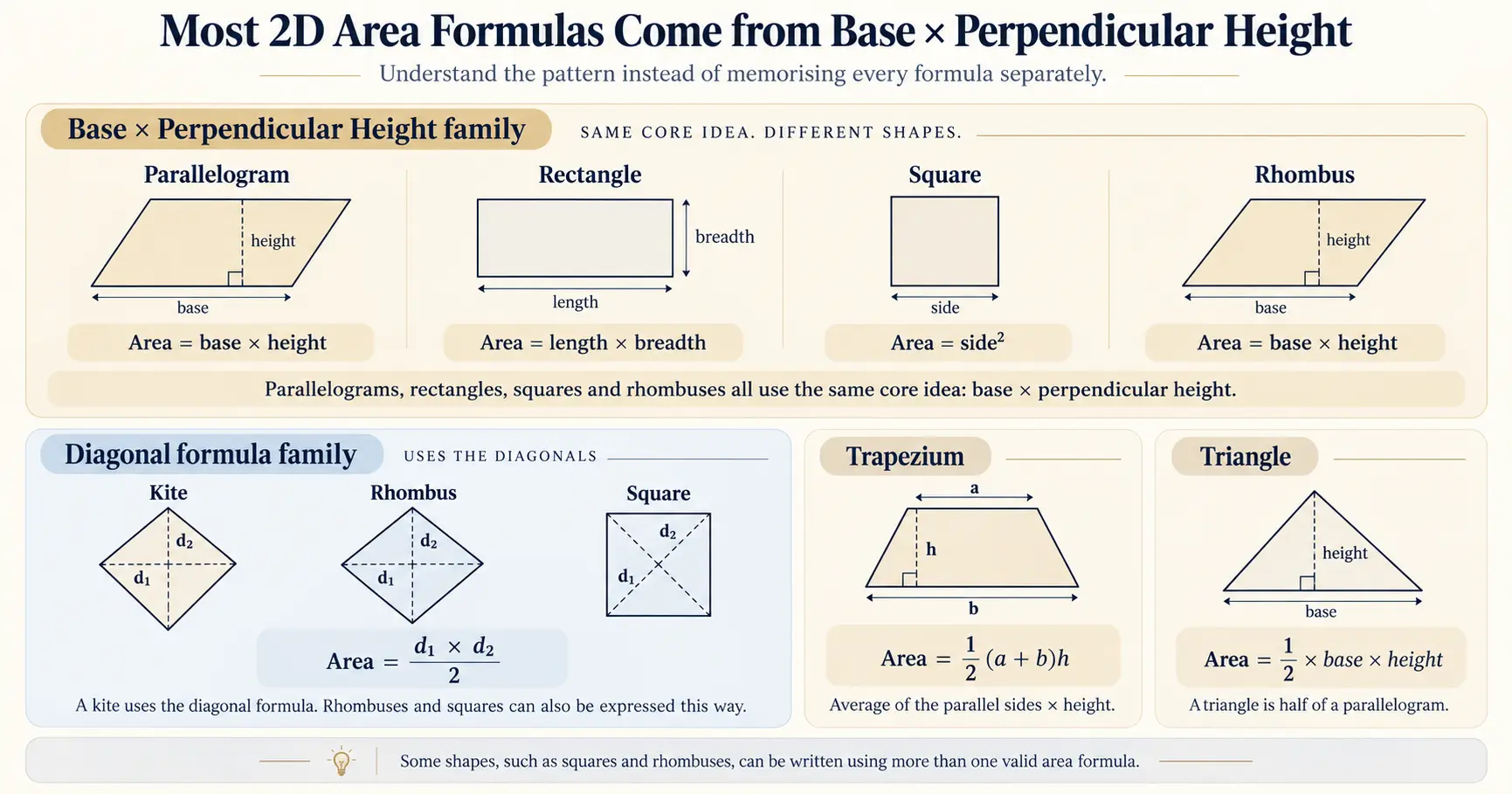
Practise the main area formulae without memorising them as unrelated rules. Start with base × perpendicular height, then see how the same idea connects to triangles, trapeziums, diagonals and circles.
- Base × height: parallelogram, rectangle, square and rhombus
- Diagonal formulae: square, rhombus and kite
- Derived area formulae: triangle and trapezium
- Circle area: radius, diameter and A = πr²
- 8 shape topics
- 56 practice questions
- 7 questions per topic
- Hints and full working
Your answers and checked results are saved automatically in this browser.
Topic 1
Parallelogram Area
7 questions · Base × perpendicular height
0/7
A parallelogram uses the core area idea directly: multiply the base by the perpendicular height. A = b × h
Topic 2
Rectangle Area
7 questions · Length × width
0/7
A rectangle is a special parallelogram. Its length and width are already perpendicular, so area is length × width. A = l × w
Topic 3
Square Area — Two Useful Formulae
7 questions · Side² and diagonals
0/7
A square can be treated as a rectangle, so A = s². Its diagonals are also perpendicular and equal, so A = ½d₁d₂ works too. A = s² or A = ½d₁d₂
Topic 4
Rhombus Area — Two Useful Formulae
7 questions · Base-height and diagonals
0/7
A rhombus is a parallelogram, so it uses base × perpendicular height. Because its diagonals are perpendicular, it can also use ½d₁d₂. A = b × h or A = ½d₁d₂
Topic 5
Kite Area
7 questions · Perpendicular diagonals
0/7
A kite can be split into triangles by its perpendicular diagonals. That gives the compact area formula ½ × d₁ × d₂. A = ½d₁d₂
Topic 6
Triangle Area
7 questions · Half of base × height
0/7
A triangle is half of a parallelogram with the same base and perpendicular height. That is why its area is ½bh. A = ½b × h
Topic 7
Trapezium Area
7 questions · Average parallel sides × height
0/7
For a trapezium, first average the two parallel sides, then multiply by the perpendicular height. A = ½(a + b)h
Topic 8
Circle Area
7 questions · Radius and π
0/7
For circle questions, find the radius first. Then square the radius and multiply by π. Use π = 3.14 for these questions. A = πr²
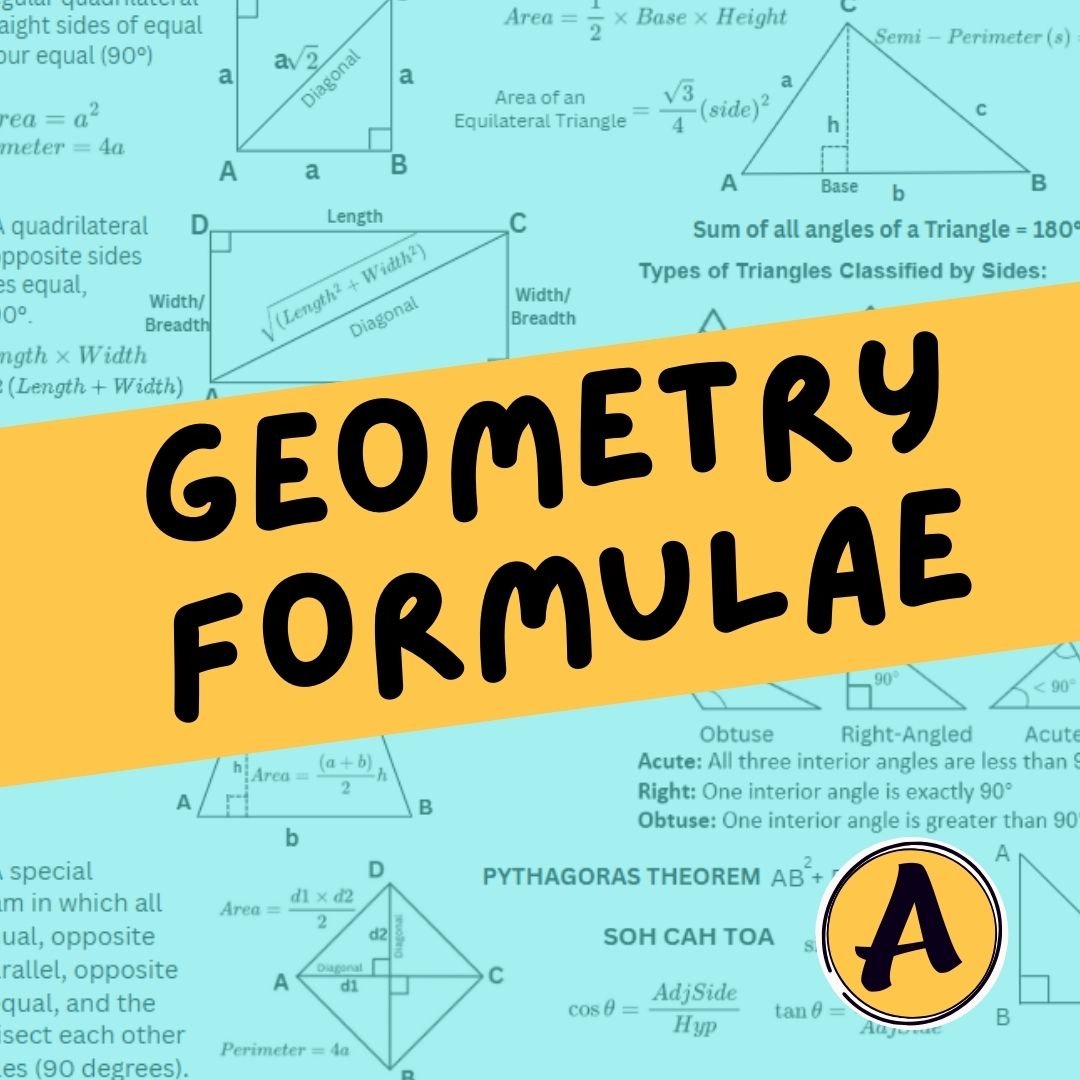
Geometry Formulae for 2D Shapes
Geometry becomes much easier when you stop treating every area formula as a completely separate rule. Most common 2D area formulae come from a few simple relationships involving base, perpendicular height and diagonals. This guide covers circles, triangles, rectangles, squares, parallelograms, rhombuses, kites and trapeziums.
Area Formulae for Common 2D Shapes
| Shape | Area Formula | Simple Idea |
|---|---|---|
| Parallelogram | A = b × h | Base × perpendicular height |
| Rectangle | A = l × w | Length and width act as base and height |
| Square | A = s² | Base and height are both equal to the side |
| Rhombus | A = b × h | A rhombus is a special parallelogram |
| Rhombus using diagonals | A = ½d₁d₂ | Can be divided into right triangles |
| Kite | A = ½d₁d₂ | Uses its perpendicular diagonals |
| Triangle | A = ½bh | Half of a parallelogram with the same base and height |
| Trapezium | A = ½(a + b)h | Average of the parallel sides × height |
| Circle | A = πr² | Can be understood by rearranging circle sectors |
Circle Formulae and Key Terms
A circle is a 2D shape where every point on its boundary is the same distance from the centre.
Chord: a line segment joining two points on the circumference. The diameter is the longest chord. Arc: part of the circumference. Sector: the region between two radii and their connecting arc.
Triangle Formulae and Rules
For Heron's formula: s = (a + b + c) ÷ 2. Pythagoras' theorem applies only to right-angled triangles, where c is the hypotenuse.
Types of Triangles
- Equilateral: three equal sides and three 60° angles.
- Isosceles: at least two equal sides.
- Scalene: all three side lengths are different.
- Right-angled: one angle is 90°.
- Acute: all angles are less than 90°.
- Obtuse: one angle is greater than 90°.
Quadrilateral Formulae
Parallelogram, Rectangle, Square and Rhombus
Squares, rectangles and rhombuses are special types of parallelograms. This is why their area can be connected to the same basic idea: base × perpendicular height.
Kite Formulae
Using the inclusive definition, a kite is a quadrilateral with two pairs of adjacent equal sides. Rhombuses and squares therefore satisfy the kite condition as special cases.
Trapezium Formula
A trapezium has a pair of parallel sides. Instead of using one base, take the average of the two parallel sides and multiply by the perpendicular height.
Parallel Line and Angle Rules
When a transversal crosses two parallel lines:Frequently Asked Questions about Geometry Formulae
Do students get a geometry formula sheet in NSW school exams for Years 7 to 10?
In NSW, it depends entirely on your school’s assessment policy for Years 7 to 10. Some schools allow students to bring a custom, handwritten reference sheet with formulas and examples. Others provide a generic, standardized formula sheet, while some do not allow any reference sheets at all. Always check with your maths teacher before your exam.
What geometry concepts are tested in the Year 7 and Year 9 NAPLAN numeracy tests?
NAPLAN Years 7 and 9 numeracy can include measurement and geometry questions involving shapes, length, area, spatial reasoning and related concepts. The exact mix of question types varies between tests.
What is the difference between Stage 4 and Stage 5 Geometry in the NSW Syllabus?
Stage 4 (Years 7 & 8) focuses heavily on the properties of 2D and 3D shapes, teaching students how to calculate basic area and perimeter, and identifying the vertices, edges, and faces of prisms and pyramids. Stage 5 (Years 9 & 10) is highly application-based, introducing challenging topics like trigonometry, true bearings, and applying Pythagoras’ theorem within 3D shapes.
Are these geometry formulas applicable to the Selective School and OC tests?
These geometry skills can support the mathematical reasoning required in OC and Selective tests. However, the placement tests assess reasoning rather than requiring students to memorise a fixed list of geometry formulae. Students should use the official NSW Department of Education practice tests to understand the question style.
How can I easily remember math geometry formulas for my school exams?
The easiest way is to understand the relationship between shapes instead of blindly memorising each formula separately.
For example:
- For a parallelogram: Area = base × height
- Because squares, rectangles, and rhombuses are technically parallelograms, the area of all these shapes is base × height
- A triangle is half of a parallelogram, so its area is: ½ ×
- base × height
- A trapezium is like two parallel sides averaged together, so its area is: Area = ½ × (a + b) × height
- A prism is a 3D shape with the same cross-section all the way through, so its volume is: Volume of a prism = cross-sectional area × length
- For circles, remember that the
- Diameter = 2 × radius
- Circumference = 2πr
- Area = πr²
A good exam tip is to group formulae by shape, draw a quick diagram, label the known values, and always check the units. Area uses square units such as cm², while volume uses cubic units such as cm³.
What is the easiest way to solve circle geometry questions in Year 9 and 10?
The secret to solving Year 9 and 10 circle geometry is mastering the core formulas first. Once you confidently know the Area (πr²) and Circumference (2πr) of a full circle, finding the area of a sector or the length of an arc is easy—you simply multiply your full circle formula by the fraction of the angle given (Angle ÷ 360°).
When do students learn Pythagoras' theorem in the NSW math curriculum?
NSW curriculum is stage-based, and Stage 4 encompasses Years 7–8. The official syllabus structure includes Pythagoras and trigonometry in the Stage 4/5 Core, but schools have flexibility in sequencing learning within stages.
How do I know whether to use the area or perimeter formula for a word problem?
It comes down to reading the context clues carefully. If the word problem mentions “fencing,” “border,” “outside,” or “walking around,” you need to calculate the perimeter. If the question mentions “covering,” “painting,” “flooring,” or finding the “inside space,” you need to calculate the area.