
Catch-Up Maths Tutoring in Sydney for Students Falling Behind
When a student is struggling with current school maths, the real problem may have started months—or even years—earlier. Our personalised Years 1–10 tutoring helps identify those learning gaps, rebuild the missing foundations and keep the student moving towards current school assessments.
We do not assume that a Year 7 student automatically needs more Year 7 questions. We first work out what they understand, what they are missing and which earlier skills are making the current topic difficult.
This is not a separate tutoring program. Catch-up support is one way our Years 1–10 maths tutoring can be personalised for students who need to rebuild foundations.


Sometimes the Current Topic Isn’t the Real Problem
In a classroom, teachers need to move a whole group through the curriculum. Some students understand a new idea quickly, while others need more explanation, more practice or a return to an earlier skill before the new topic makes sense.
If those gaps are not addressed, they can compound. A student may look as though they are struggling with Year 7 algebra when the deeper issue is insecure multiplication, fractions, negative numbers or basic operations.
Marks suddenly drop. Parents often seek tutoring after a disappointing report, assessment or exam result.
The student feels lost. They may know what to copy but not why the method works.
Confidence begins to fall. Repeated difficulty can make students avoid maths before the foundations have been repaired.
We Look Beyond the Wrong Answer and Ask: Why Is This Difficult?
Catch-up tutoring becomes much more useful when the lesson addresses the prerequisite skill causing the difficulty—not just the question the student happened to get wrong today.
The student cannot find the LCM
Giving another page of LCM questions may not fix the difficulty if multiplication facts are insecure.
Is multiplication recall the missing foundation?
If so, the starting point changes. We strengthen the prerequisite skill and then return to LCM with a better foundation.
Fix the foundation while still helping with what school expects now.
A student who is one or two years behind may need earlier content, but completely ignoring an upcoming school exam can damage confidence too.
That is why catch-up lessons can combine foundational rebuilding with current classwork, revision and assessment preparation.
A Practical Way to Find Where the Gap Begins
Questions are selected according to the student’s year level, current concerns and how they respond. The goal is to find the most useful starting point.
Start Around the Current Year Level
A Year 7 student may begin with Year 7 questions so we can see what is secure and what is not.
Step Back When Needed
If the student is struggling, we may move to Year 6 or earlier prerequisite skills instead of persisting with work that is too hard.
Look for Patterns
We investigate whether mistakes come from a topic gap, weak recall, missing foundations or difficulty applying the method.
Recommend a Starting Plan
Parents receive practical verbal feedback about the key gaps and an appropriate lesson focus.
NSW guidance recognises that students learn at different rates and may need to work across stages. Assessment guidance emphasises establishing where students are in their learning so teaching can be differentiated.
Rebuild the Basics Without Ignoring the Next Exam
A student can need foundational help and immediate school support at the same time. Catch-up tutoring can work on both.
Rebuild Missing Foundations
Earlier skills are revisited when they are necessary for current work to make sense.
- Number facts and multiplication tables
- Core operations and place value
- Fractions, decimals and percentages
- Negative numbers and number sense
- Earlier algebra or geometry prerequisites
Support Current Schoolwork and Assessments
Students still need to function in their current classroom, so lessons may also prepare for what is immediately ahead.
- Current school topics
- Homework and classwork clarification
- Revision before assessments
- Practice exam questions
- Exam confidence and question approach
Clear Notes First. Targeted Practice Next.
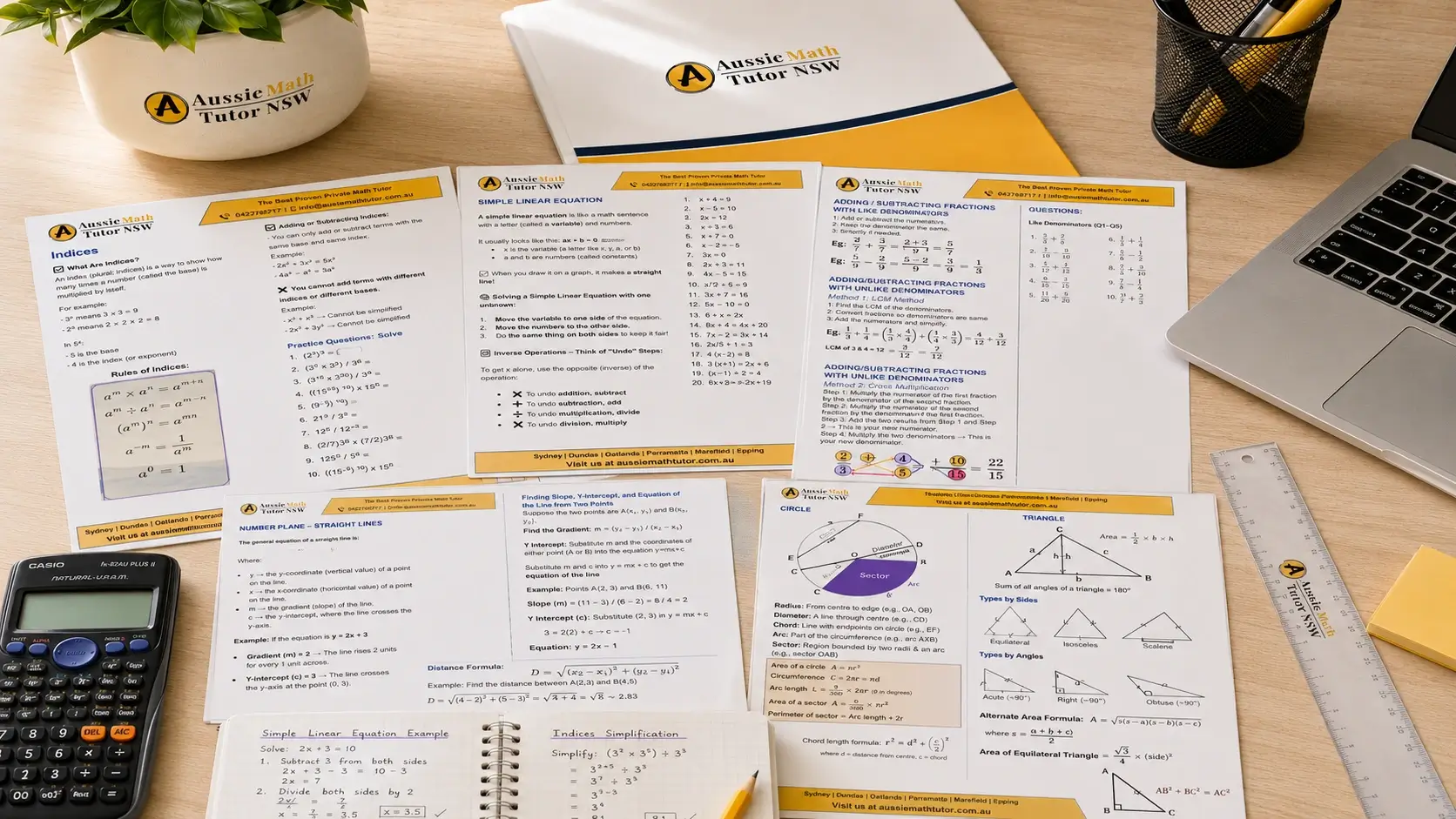
One of the strengths of our tutoring is the material used around each lesson. Students are not expected to search through pages of notes every time they need to remember a method.
One-Page Concept Sheets
Concise A4 sheets bring theory, key formulae, examples, short practice and answers together in one place for easier revision.
Session-Specific Worksheets
Worksheets are selected or created for the topic being taught that day rather than forcing every student through one fixed workbook.
Questions and Answers Together
Students generally receive the questions and answers together so they can check work without hunting through another book or platform.
Practice Exam Papers
Tutor-created assessment practice helps students become more comfortable with exam-style questions without claiming to reproduce the exact school paper.
Online Theory and Practice
Students can revisit maths explanations and free practice resources on the Aussie Math Tutor NSW website when printed notes are not available.

What Catch-Up Can Look Like in Real Tutoring
These examples are deliberately anonymous. They illustrate different starting points and are not promises of a particular result.
Very Low Confidence and Weak Foundations
A Year 7 student began tutoring with very low maths confidence and significant difficulty with foundational skills. Early lessons used easier material, clear explanations and repeated guided practice so the student could begin experiencing success again.
Most maths practice happened during tutoring rather than through extensive homework.
From C-Level Results to Stronger Grades
Two Year 8 students began tutoring while regularly receiving results around the C range. Lessons focused on understanding the method first and then practising the skill through carefully selected questions.
As the underlying skills became more secure, the question difficulty could increase and exam preparation became more productive.
Student outcomes vary. Progress depends on the student’s starting point, attendance, engagement, lesson frequency, school requirements and practice.
Progress Is Personal—So the Plan Has to Be Too
One Lesson or More Frequent Support?
One session each week can provide useful ongoing support, but rebuilding larger gaps may take longer. Two or more regular sessions can create greater continuity when a student needs more intensive catch-up work.
We do not promise a fixed number of weeks because the appropriate pace depends on what the assessment shows and how the student responds.
Clear Parent Check-Ins
Parent feedback is generally practical and conversational. We can explain what the student has been working on, where the main gaps appear to be and what should come next.
The purpose is to keep families informed in plain language rather than create paperwork for the sake of paperwork.
Revisit the Theory and Practise Online
Our website contains free explanations and practice resources students can use alongside tutoring.
Free Maths Practice Tests
Topic-based questions with instant checking and explanations across a growing range of maths skills.
Explore free practice tests →NSW Maths Syllabus Hub
Browse maths topics and year-level guides for students across Years 1–10.
Browse the NSW maths hub →Years 1–10 Maths Tutoring
See the main tutoring service that catch-up support forms part of.
View Years 1–10 tutoring →Catch-Up Support Face-to-Face or Online
The teaching approach can be adapted to either lesson format. The important part is identifying the right starting point and giving the student enough guided practice.
Need Help With a Specific NSW Assessment?
Catch-up support is part of general Years 1–10 tutoring. If the main goal is a particular assessment or placement test, use the dedicated service page.
See What Families Say About Aussie Math Tutor NSW
Read independent Google feedback about explanations, communication, learning support and the tutoring experience.
Catch-Up Maths Tutoring FAQs
If you are unsure whether the issue is the current topic or an earlier learning gap, the free assessment is the simplest place to begin.
Book a Free Assessment →Is catch-up maths tutoring a separate service?
No. Catch-up support is part of our Years 1–10 maths tutoring. It describes a learning need: rebuilding earlier foundations while continuing with current school mathematics.
Can you teach work below my child’s current year level?
Yes. If the assessment shows that an earlier skill is preventing the student from understanding current work, lessons may revisit material from a previous year or stage before moving forward.
Will you still help with an upcoming school exam?
Yes. Catch-up tutoring can balance foundational work with current school topics, revision and assessment preparation.
How do you know where the student is actually behind?
We begin with targeted questions around the student’s current level and adjust the difficulty. If a student struggles, we step back and investigate prerequisite skills until the useful starting point becomes clearer.
How long does it take for a student to catch up?
There is no responsible fixed answer. It depends on the size of the gap, engagement, lesson frequency, school demands and practice. We assess first rather than promise a result within a set number of weeks.
What learning material does the student receive?
Depending on the topic, students may use one-page concept sheets, targeted worksheets, answers, worked examples, exam-style practice papers and free online resources.
Do parents receive progress updates?
Yes. Feedback is generally provided through practical verbal conversations about work covered, learning gaps and the next priorities.
Can catch-up tutoring be done online?
Yes. Online tutoring can work on prerequisite skills, current school topics and guided practice using live explanations and an interactive whiteboard.
Your Child Does Not Need More Random Questions. They Need to Know What to Work on Next.
Start with a free maths assessment. We will look at the student’s current level, identify important learning gaps and recommend a practical starting focus for Years 1–10 tutoring.