Expanding and Factorising Algebraic Expressions

Expanding and factorising algebraic expressions are important algebra skills for NSW high school students. These skills support the NSW NESA Mathematics syllabus and help students prepare for equations, quadratic expressions, graphing and problem-solving questions.
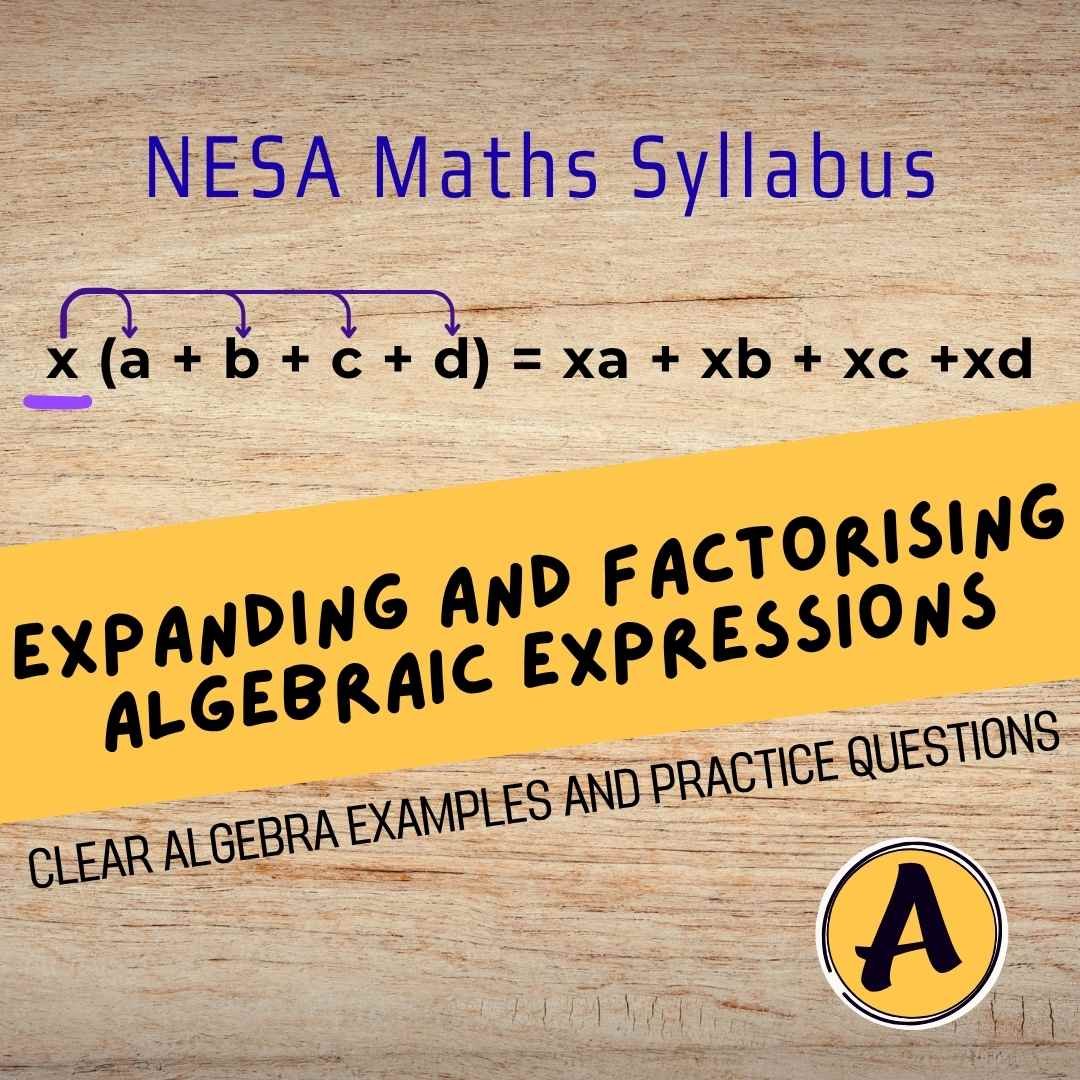
Expanding and factorising algebraic expressions guide for NSW NESA Maths Syllabus with algebra example and practice questions.

Table of Contents

Interactive maths practice

Expanding and Factorising Algebra Practice Questions

Build confidence with the main expanding and factorising techniques used in secondary algebra. Each section contains 10 questions with instant checking, helpful hints and complete working.

  • Expanding: single brackets, double brackets and collecting like terms
  • Common factors: factorise numerical and algebraic expressions using the highest common factor
  • Quadratics: factorise monic and non-monic quadratic expressions
  • Special products: recognise and factorise a difference of two squares
  • Mixed practice: decide whether to expand, simplify or factorise
  • 8 focused levels
  • 80 practice questions
  • Instant answer checks
  • Hints and full working
0Attempted
0Correct
80Total questions
Overall progress0 of 80 correct
0 of 80 correct

Spaces do not affect marking. Common equivalent factor orders and x² or x^2 notation are accepted. Your answers and checked results are saved automatically in this browser.

Level 1 Expanding Single Brackets 10 questions · Distributive law 0/10

Tip: Multiply every term inside the bracket by the term outside. Pay close attention to negative multipliers.
  1. Expand 3(x + 4).

    View hint and full working

    Hint: Multiply 3 by both terms inside the bracket.

    Working
    3(x + 4)
    = 3×x + 3×4
    = 3x + 12
    Answer: 3x+12
  2. Expand 5(2x - 3).

    View hint and full working

    Hint: Multiply 5 by 2x and by -3.

    Working
    5(2x - 3)
    = 5×2x + 5×(-3)
    = 10x - 15
    Answer: 10x-15
  3. Expand -2(x + 7).

    View hint and full working

    Hint: Be careful: a negative outside the bracket changes the signs.

    Working
    -2(x + 7)
    = -2×x + -2×7
    = -2x - 14
    Answer: -2x-14
  4. Expand 4(3a + 2).

    View hint and full working

    Hint: Multiply 4 by each term.

    Working
    4(3a + 2)
    = 4×3a + 4×2
    = 12a + 8
    Answer: 12a+8
  5. Expand 7(2m - 5).

    View hint and full working

    Hint: Distribute 7 to both terms.

    Working
    7(2m - 5)
    = 14m - 35
    Answer: 14m-35
  6. Expand -3(4x - 6).

    View hint and full working

    Hint: Negative times negative gives positive.

    Working
    -3(4x - 6)
    = -12x + 18
    Answer: -12x+18
  7. Expand 6(5p + 1).

    View hint and full working

    Hint: Multiply 6 by 5p and 1.

    Working
    6(5p + 1)
    = 30p + 6
    Answer: 30p+6
  8. Expand -5(2y + 9).

    View hint and full working

    Hint: Multiply -5 by each term.

    Working
    -5(2y + 9)
    = -10y - 45
    Answer: -10y-45
  9. Expand 8(3n - 4).

    View hint and full working

    Hint: Use the distributive law.

    Working
    8(3n - 4)
    = 24n - 32
    Answer: 24n-32
  10. Expand -4(5x - 2).

    View hint and full working

    Hint: Watch the second sign carefully.

    Working
    -4(5x - 2)
    = -20x + 8
    Answer: -20x+8

Level 2 Expanding and Collecting Like Terms 10 questions · Simplifying 0/10

Tip: Expand each bracket first. Then combine only terms with the same pronumeral and power.
  1. Expand and simplify 2(x + 5) + 3x.

    View hint and full working

    Hint: Expand 2(x + 5), then collect x terms.

    Working
    2(x + 5) + 3x
    = 2x + 10 + 3x
    = 5x + 10
    Answer: 5x+10
  2. Expand and simplify 4(x - 2) + 5(x + 1).

    View hint and full working

    Hint: Expand both brackets first.

    Working
    4(x - 2) + 5(x + 1)
    = 4x - 8 + 5x + 5
    = 9x - 3
    Answer: 9x-3
  3. Expand and simplify 3(2x + 1) - 2(x - 4).

    View hint and full working

    Hint: The minus before the second bracket affects both terms.

    Working
    3(2x + 1) - 2(x - 4)
    = 6x + 3 - 2x + 8
    = 4x + 11
    Answer: 4x+11
  4. Expand and simplify 5(a + 3) - 2(a - 1).

    View hint and full working

    Hint: Expand first, then simplify.

    Working
    5(a + 3) - 2(a - 1)
    = 5a + 15 - 2a + 2
    = 3a + 17
    Answer: 3a+17
  5. Expand and simplify 6(2m - 3) + 4m.

    View hint and full working

    Hint: Collect the m terms after expanding.

    Working
    6(2m - 3) + 4m
    = 12m - 18 + 4m
    = 16m - 18
    Answer: 16m-18
  6. Expand and simplify -3(x + 2) + 7x.

    View hint and full working

    Hint: Multiply -3 across the bracket.

    Working
    -3(x + 2) + 7x
    = -3x - 6 + 7x
    = 4x - 6
    Answer: 4x-6
  7. Expand and simplify 2(3x - 5) + 4(x + 6).

    View hint and full working

    Hint: Expand both brackets.

    Working
    2(3x - 5) + 4(x + 6)
    = 6x - 10 + 4x + 24
    = 10x + 14
    Answer: 10x+14
  8. Expand and simplify 9(y - 1) - 3(2y + 4).

    View hint and full working

    Hint: Subtract every term in the second bracket after multiplying by 3.

    Working
    9(y - 1) - 3(2y + 4)
    = 9y - 9 - 6y - 12
    = 3y - 21
    Answer: 3y-21
  9. Expand and simplify 4(2p + 3) - 5(p - 2).

    View hint and full working

    Hint: Be careful with -5(p - 2).

    Working
    4(2p + 3) - 5(p - 2)
    = 8p + 12 - 5p + 10
    = 3p + 22
    Answer: 3p+22
  10. Expand and simplify -2(3x - 7) + 5(x - 1).

    View hint and full working

    Hint: Expand both brackets, then collect terms.

    Working
    -2(3x - 7) + 5(x - 1)
    = -6x + 14 + 5x - 5
    = -x + 9
    Answer: -x+9

Level 3 Expanding Double Brackets 10 questions · Quadratic expressions 0/10

Tip: Multiply every term in the first bracket by every term in the second bracket, then collect like terms.
  1. Expand (x + 3)(x + 4).

    View hint and full working

    Hint: Multiply every term in the first bracket by every term in the second bracket.

    Working
    (x + 3)(x + 4)
    = x2 + 4x + 3x + 12
    = x2 + 7x + 12
    Answer: x2+7x+12
  2. Expand (x + 5)(x - 2).

    View hint and full working

    Hint: The last term is positive 5 times negative 2.

    Working
    (x + 5)(x - 2)
    = x2 - 2x + 5x - 10
    = x2 + 3x - 10
    Answer: x2+3x-10
  3. Expand (x - 6)(x + 1).

    View hint and full working

    Hint: Collect -6x and +x.

    Working
    (x - 6)(x + 1)
    = x2 + x - 6x - 6
    = x2 - 5x - 6
    Answer: x2-5x-6
  4. Expand (x - 4)(x - 7).

    View hint and full working

    Hint: Negative times negative gives a positive last term.

    Working
    (x - 4)(x - 7)
    = x2 - 7x - 4x + 28
    = x2 - 11x + 28
    Answer: x2-11x+28
  5. Expand (2x + 3)(x + 5).

    View hint and full working

    Hint: Use FOIL carefully.

    Working
    (2x + 3)(x + 5)
    = 2x2 + 10x + 3x + 15
    = 2x2 + 13x + 15
    Answer: 2x2+13x+15
  6. Expand (3x - 2)(x + 4).

    View hint and full working

    Hint: Collect 12x and -2x.

    Working
    (3x - 2)(x + 4)
    = 3x2 + 12x - 2x - 8
    = 3x2 + 10x - 8
    Answer: 3x2+10x-8
  7. Expand (2x - 5)(x - 3).

    View hint and full working

    Hint: Both last terms are negative, so the constant is positive.

    Working
    (2x - 5)(x - 3)
    = 2x2 - 6x - 5x + 15
    = 2x2 - 11x + 15
    Answer: 2x2-11x+15
  8. Expand (4x + 1)(x - 6).

    View hint and full working

    Hint: Collect -24x and +x.

    Working
    (4x + 1)(x - 6)
    = 4x2 - 24x + x - 6
    = 4x2 - 23x - 6
    Answer: 4x2-23x-6
  9. Expand (3x + 2)(2x - 5).

    View hint and full working

    Hint: Multiply all four pairs.

    Working
    (3x + 2)(2x - 5)
    = 6x2 - 15x + 4x - 10
    = 6x2 - 11x - 10
    Answer: 6x2-11x-10
  10. Expand (5x - 3)(2x + 1).

    View hint and full working

    Hint: Collect 5x and -6x.

    Working
    (5x - 3)(2x + 1)
    = 10x2 + 5x - 6x - 3
    = 10x2 - x - 3
    Answer: 10x2-x-3

Level 4 Factorising by a Common Factor 10 questions · Highest common factor 0/10

Tip: Find the highest common numerical and algebraic factor, place it outside the bracket, and divide each term by it.
  1. Factorise 6x + 12.

    View hint and full working

    Hint: The highest common factor is 6.

    Working
    6x + 12
    = 6(x + 2)
    Answer: 6(x+2)
  2. Factorise 10x - 15.

    View hint and full working

    Hint: The highest common factor is 5.

    Working
    10x - 15
    = 5(2x - 3)
    Answer: 5(2x-3)
  3. Factorise 12a + 8.

    View hint and full working

    Hint: Take out 4.

    Working
    12a + 8
    = 4(3a + 2)
    Answer: 4(3a+2)
  4. Factorise 14m - 35.

    View hint and full working

    Hint: Take out 7.

    Working
    14m - 35
    = 7(2m - 5)
    Answer: 7(2m-5)
  5. Factorise 9x + 18.

    View hint and full working

    Hint: Take out the largest common number.

    Working
    9x + 18
    = 9(x + 2)
    Answer: 9(x+2)
  6. Factorise 15p - 20.

    View hint and full working

    Hint: The highest common factor is 5.

    Working
    15p - 20
    = 5(3p - 4)
    Answer: 5(3p-4)
  7. Factorise 8x2 + 12x.

    View hint and full working

    Hint: Both terms share 4x.

    Working
    8x2 + 12x
    = 4x(2x + 3)
    Answer: 4x(2x+3)
  8. Factorise 18y2 - 6y.

    View hint and full working

    Hint: Both terms share 6y.

    Working
    18y2 - 6y
    = 6y(3y - 1)
    Answer: 6y(3y-1)
  9. Factorise 20x2 + 30x.

    View hint and full working

    Hint: Both terms share 10x.

    Working
    20x2 + 30x
    = 10x(2x + 3)
    Answer: 10x(2x+3)
  10. Factorise -12x + 18.

    View hint and full working

    Hint: Taking out a negative can make the first term inside the bracket positive.

    Working
    -12x + 18
    = -6(2x - 3)
    Answer: -6(2x-3)

Level 5 Factorising Monic Quadratics 10 questions · x² + bx + c 0/10

Tip: Find two numbers that multiply to the constant term and add to the coefficient of x.
  1. Factorise x2 + 7x + 12.

    View hint and full working

    Hint: 3 and 4 multiply to 12 and add to 7.

    Working
    x2 + 7x + 12
    = (x + 3)(x + 4)
    Answer: (x+3)(x+4)
  2. Factorise x2 + 3x - 10.

    View hint and full working

    Hint: 5 and -2 multiply to -10 and add to 3.

    Working
    x2 + 3x - 10
    = (x + 5)(x - 2)
    Answer: (x+5)(x-2)
  3. Factorise x2 - 5x - 6.

    View hint and full working

    Hint: -6 and 1 multiply to -6 and add to -5.

    Working
    x2 - 5x - 6
    = (x - 6)(x + 1)
    Answer: (x-6)(x+1)
  4. Factorise x2 - 11x + 28.

    View hint and full working

    Hint: -4 and -7 multiply to 28 and add to -11.

    Working
    x2 - 11x + 28
    = (x - 4)(x - 7)
    Answer: (x-4)(x-7)
  5. Factorise x2 + 8x + 15.

    View hint and full working

    Hint: 3 and 5 multiply to 15 and add to 8.

    Working
    x2 + 8x + 15
    = (x + 3)(x + 5)
    Answer: (x+3)(x+5)
  6. Factorise x2 - x - 20.

    View hint and full working

    Hint: -5 and 4 multiply to -20 and add to -1.

    Working
    x2 - x - 20
    = (x - 5)(x + 4)
    Answer: (x-5)(x+4)
  7. Factorise x2 - 2x - 24.

    View hint and full working

    Hint: -6 and 4 multiply to -24 and add to -2.

    Working
    x2 - 2x - 24
    = (x - 6)(x + 4)
    Answer: (x-6)(x+4)
  8. Factorise x2 + 10x + 21.

    View hint and full working

    Hint: 3 and 7 multiply to 21 and add to 10.

    Working
    x2 + 10x + 21
    = (x + 3)(x + 7)
    Answer: (x+3)(x+7)
  9. Factorise x2 - 9x + 20.

    View hint and full working

    Hint: -4 and -5 multiply to 20 and add to -9.

    Working
    x2 - 9x + 20
    = (x - 4)(x - 5)
    Answer: (x-4)(x-5)
  10. Factorise x2 + x - 30.

    View hint and full working

    Hint: 6 and -5 multiply to -30 and add to 1.

    Working
    x2 + x - 30
    = (x + 6)(x - 5)
    Answer: (x+6)(x-5)

Level 6 Factorising Harder Quadratics 10 questions · ax² + bx + c 0/10

Tip: Use suitable bracket pairs or split the middle term. Check the result by expanding your factors.
  1. Factorise 2x2 + 13x + 15.

    View hint and full working

    Hint: The expanded middle terms are 10x and 3x.

    Working
    2x2 + 13x + 15
    = (2x + 3)(x + 5)
    Answer: (2x+3)(x+5)
  2. Factorise 3x2 + 10x - 8.

    View hint and full working

    Hint: The expanded middle terms are 12x and -2x.

    Working
    3x2 + 10x - 8
    = (3x - 2)(x + 4)
    Answer: (3x-2)(x+4)
  3. Factorise 2x2 - 11x + 15.

    View hint and full working

    Hint: The expanded middle terms are -6x and -5x.

    Working
    2x2 - 11x + 15
    = (2x - 5)(x - 3)
    Answer: (2x-5)(x-3)
  4. Factorise 4x2 - 23x - 6.

    View hint and full working

    Hint: The expanded middle terms are -24x and +x.

    Working
    4x2 - 23x - 6
    = (4x + 1)(x - 6)
    Answer: (4x+1)(x-6)
  5. Factorise 6x2 - 11x - 10.

    View hint and full working

    Hint: The expanded middle terms are -15x and 4x.

    Working
    6x2 - 11x - 10
    = (3x + 2)(2x - 5)
    Answer: (3x+2)(2x-5)
  6. Factorise 10x2 - x - 3.

    View hint and full working

    Hint: The expanded middle terms are 5x and -6x.

    Working
    10x2 - x - 3
    = (5x - 3)(2x + 1)
    Answer: (5x-3)(2x+1)
  7. Factorise 3x2 + 14x + 8.

    View hint and full working

    Hint: The expanded middle terms are 12x and 2x.

    Working
    3x2 + 14x + 8
    = (3x + 2)(x + 4)
    Answer: (3x+2)(x+4)
  8. Factorise 5x2 + 17x + 6.

    View hint and full working

    Hint: The expanded middle terms are 15x and 2x.

    Working
    5x2 + 17x + 6
    = (5x + 2)(x + 3)
    Answer: (5x+2)(x+3)
  9. Factorise 4x2 + 4x - 3.

    View hint and full working

    Hint: The expanded middle terms are -2x and 6x.

    Working
    4x2 + 4x - 3
    = (2x + 3)(2x - 1)
    Answer: (2x+3)(2x-1)
  10. Factorise 6x2 + 7x - 3.

    View hint and full working

    Hint: The expanded middle terms are 9x and -2x.

    Working
    6x2 + 7x - 3
    = (3x - 1)(2x + 3)
    Answer: (3x-1)(2x+3)

Level 7 Difference of Two Squares 10 questions · Special factorisation 0/10

Tip: Use a² − b² = (a − b)(a + b). This rule applies only when two square terms are being subtracted.
  1. Factorise x2 - 9.

    View hint and full working

    Hint: 9 is 3².

    Working
    x2 - 9
    = x2 - 32
    = (x - 3)(x + 3)
    Answer: (x-3)(x+3)
  2. Factorise x2 - 25.

    View hint and full working

    Hint: 25 is 5².

    Working
    x2 - 25
    = (x - 5)(x + 5)
    Answer: (x-5)(x+5)
  3. Factorise 4x2 - 9.

    View hint and full working

    Hint: 4x² is (2x)² and 9 is 3².

    Working
    4x2 - 9
    = (2x)2 - 32
    = (2x - 3)(2x + 3)
    Answer: (2x-3)(2x+3)
  4. Factorise 9x2 - 16.

    View hint and full working

    Hint: 9x² is (3x)² and 16 is 4².

    Working
    9x2 - 16
    = (3x)2 - 42
    = (3x - 4)(3x + 4)
    Answer: (3x-4)(3x+4)
  5. Factorise 25x2 - 1.

    View hint and full working

    Hint: 1 is 1².

    Working
    25x2 - 1
    = (5x)2 - 12
    = (5x - 1)(5x + 1)
    Answer: (5x-1)(5x+1)
  6. Factorise 16a2 - 49.

    View hint and full working

    Hint: 16a² is (4a)² and 49 is 7².

    Working
    16a2 - 49
    = (4a)2 - 72
    = (4a - 7)(4a + 7)
    Answer: (4a-7)(4a+7)
  7. Factorise 36m2 - 81.

    View hint and full working

    Hint: You can first take out 9, then use difference of squares.

    Working
    36m2 - 81
    = 9(4m2 - 9)
    = 9(2m - 3)(2m + 3)
    Answer: 9(2m-3)(2m+3)
  8. Factorise x2 - 64.

    View hint and full working

    Hint: 64 is 8².

    Working
    x2 - 64
    = (x - 8)(x + 8)
    Answer: (x-8)(x+8)
  9. Factorise 49x2 - 4.

    View hint and full working

    Hint: 49x² is (7x)² and 4 is 2².

    Working
    49x2 - 4
    = (7x - 2)(7x + 2)
    Answer: (7x-2)(7x+2)
  10. Factorise 100p2 - 121.

    View hint and full working

    Hint: 100p² is (10p)² and 121 is 11².

    Working
    100p2 - 121
    = (10p - 11)(10p + 11)
    Answer: (10p-11)(10p+11)

Level 8 Mixed Expanding and Factorising Challenge 10 questions · Mixed review 0/10

Tip: Decide which process is required. Brackets usually indicate expansion; an expression without brackets may need factorising.
  1. Expand (x + 2)(x + 8).

    View hint and full working

    Hint: Use FOIL.

    Working
    (x + 2)(x + 8)
    = x2 + 8x + 2x + 16
    = x2 + 10x + 16
    Answer: x2+10x+16
  2. Factorise x2 + 10x + 16.

    View hint and full working

    Hint: 2 and 8 multiply to 16 and add to 10.

    Working
    x2 + 10x + 16
    = (x + 2)(x + 8)
    Answer: (x+2)(x+8)
  3. Expand 3(x - 4) - 2(x + 5).

    View hint and full working

    Hint: Expand both brackets, then collect terms.

    Working
    3(x - 4) - 2(x + 5)
    = 3x - 12 - 2x - 10
    = x - 22
    Answer: x-22
  4. Factorise 12x2 - 18x.

    View hint and full working

    Hint: Take out the highest common factor 6x.

    Working
    12x2 - 18x
    = 6x(2x - 3)
    Answer: 6x(2x-3)
  5. Expand (2x - 7)(x + 3).

    View hint and full working

    Hint: Collect 6x and -7x.

    Working
    (2x - 7)(x + 3)
    = 2x2 + 6x - 7x - 21
    = 2x2 - x - 21
    Answer: 2x2-x-21
  6. Factorise 2x2 - x - 21.

    View hint and full working

    Hint: The expanded middle terms are 6x and -7x.

    Working
    2x2 - x - 21
    = (2x - 7)(x + 3)
    Answer: (2x-7)(x+3)
  7. Expand -4(2x - 3) + 5(x + 1).

    View hint and full working

    Hint: Use the negative multiplier carefully.

    Working
    -4(2x - 3) + 5(x + 1)
    = -8x + 12 + 5x + 5
    = -3x + 17
    Answer: -3x+17
  8. Factorise 81x2 - 100.

    View hint and full working

    Hint: This is a difference of two squares.

    Working
    81x2 - 100
    = (9x)2 - 102
    = (9x - 10)(9x + 10)
    Answer: (9x-10)(9x+10)
  9. Expand (3x + 5)(x - 2).

    View hint and full working

    Hint: Collect -6x and 5x.

    Working
    (3x + 5)(x - 2)
    = 3x2 - 6x + 5x - 10
    = 3x2 - x - 10
    Answer: 3x2-x-10
  10. Factorise 3x2 - x - 10.

    View hint and full working

    Hint: The expanded middle terms are -6x and 5x.

    Working
    3x2 - x - 10
    = (3x + 5)(x - 2)
    Answer: (3x+5)(x-2)
NSW Years 7–10 algebra guide

Expanding and Factorising Algebraic Expressions

Expanding removes brackets by multiplying, while factorising rewrites an expression as a product of factors. These opposite processes help students simplify algebra, solve quadratic equations and understand the equations of parabolas.

  • expand single and double brackets;
  • collect like terms correctly;
  • factorise using a highest common factor;
  • factorise monic and non-monic quadratics;
  • recognise difference-of-squares patterns;
  • check factorised answers by expanding.

Quick Summary

Skill What it means Example
Expanding Remove brackets using multiplication. 3(x + 4) = 3x + 12
Factorising Rewrite an expression as a product. 3x + 12 = 3(x + 4)
Double brackets Multiply every term in one binomial by every term in the other. (x + 2)(x + 3) = x² + 5x + 6
Difference of squares Use the pattern a² − b² = (a − b)(a + b). x² − 25 = (x − 5)(x + 5)

How Expansion and Factorisation Fit the NSW Syllabus

Expansion and factorisation sit within the NSW Mathematics K–10 focus areas of Algebra and equations and Linear and non-linear relationships. Students generally develop foundational algebraic techniques during Stage 4 and extend them into quadratic expressions, equations and parabolas during Stage 5.

Stage 4: Years 7–8

Students commonly strengthen the distributive law, simplifying expressions, collecting like terms and taking out common factors. Review the Year 7 NSW Maths guide and Year 8 NSW Maths guide.

Stage 5: Years 9–10

Students may progress to binomial products, quadratic expressions, special factorisation patterns and applications involving equations and graphs. See the Year 9 guide and Year 10 guide.

Timing varies by school. NSW schools organise content through their own scope and sequence, so a method may be introduced earlier or later. Students should follow their teacher’s program while using this guide for revision and extra practice.

1. Expanding Single Brackets

To expand a single bracket, multiply the term outside the bracket by every term inside. This is the distributive law:

a(b + c) = ab + ac
Worked example: Expand 8(x + 5)
8(x + 5) = 8x + 40

The 8 multiplies both x and 5.

Expanding with a negative multiplier

A negative multiplier changes the signs of the terms it multiplies:

−3(2x − 5) = −6x + 15
Common mistake: Expanding 8(x + 5) as 8x + 5. The outside factor must multiply every term, so the correct answer is 8x + 40.

2. Expanding and Collecting Like Terms

After expanding, combine terms that have exactly the same pronumeral part and power. For example, 4x and 6x are like terms, but x and x² are not.

Worked example: Simplify 4(x + 3) + 6x
4(x + 3) + 6x
= 4x + 12 + 6x
= 10x + 12

Only the coefficients of like terms are added or subtracted. Constants combine with constants, x-terms with x-terms, and x²-terms with x²-terms.

3. Expanding Double Brackets

Multiply every term in the first bracket by every term in the second bracket. FOIL—First, Outer, Inner, Last—is a useful memory aid for two binomials, but the distributive law is the underlying method.

Worked example: Expand (x + 2)(x + 3)
(x + 2)(x + 3)
= x² + 3x + 2x + 6
= x² + 5x + 6
FOIL has limits: It is designed for two binomials. For longer expressions, use systematic distribution or a multiplication grid so that every pair of terms is included.

4. Factorising by a Common Factor

Factorising is the reverse of expanding. Find the highest common factor shared by every term, place it outside the bracket and divide each term by it.

Examples
5x + 15 = 5(x + 3)
8x² + 4x = 4x(2x + 1)

Always look for a common factor before trying another method. An expression is not fully factorised while its terms still share a common factor.

5. Factorising Monic Quadratics

A monic quadratic has a coefficient of 1 in front of x². Its general form is:

x² + bx + c

Find two numbers that:

  1. multiply to give c; and
  2. add to give b.
Worked example: Factorise x² + 5x + 6

The numbers 2 and 3 multiply to 6 and add to 5.

x² + 5x + 6 = (x + 2)(x + 3)

6. Factorising Non-Monic Quadratics

A non-monic quadratic has a leading coefficient other than 1:

ax² + bx + c, where a ≠ 1

One reliable method is to multiply a and c, find two numbers that multiply to ac and add to b, split the middle term, then factorise by grouping.

Worked example: Factorise 2x² + 7x + 3
2x² + 7x + 3

Here, a × c = 2 × 3 = 6. The numbers 6 and 1 multiply to 6 and add to 7.

= 2x² + 6x + x + 3
= 2x(x + 3) + 1(x + 3)
= (2x + 1)(x + 3)

Check the result by expanding:

(2x + 1)(x + 3) = 2x² + 7x + 3

7. Difference of Two Squares

A difference of two squares contains two perfect-square terms separated by subtraction:

a² − b² = (a − b)(a + b)
Examples
x² − 25 = x² − 5² = (x − 5)(x + 5)
4x² − 9 = (2x)² − 3² = (2x − 3)(2x + 3)
Important: This pattern requires subtraction. The sum a² + b² does not factorise into real linear factors using the difference-of-squares rule.

8. Perfect-Square Trinomials

A useful related pattern occurs when the first and last terms are squares and the middle term is twice their product:

a² + 2ab + b² = (a + b)²
a² − 2ab + b² = (a − b)²
Example
x² + 10x + 25 = (x + 5)²

The first term is x², the last term is 5², and the middle term is 2 × x × 5 = 10x.

How to Choose the Correct Method

Look for brackets

If the instruction says expand, multiply to remove the brackets and collect like terms.

Look for a common factor first

Before factorising a quadratic or using a special pattern, check whether every term shares a numerical or algebraic factor.

Identify the expression type

Decide whether it is a monic quadratic, non-monic quadratic, difference of squares or perfect-square trinomial.

Verify the answer

Expand the factorised expression. It should reproduce the original expression exactly.

Why Factorising Matters for Equations and Parabolas

Factorising is not only a simplification skill. It is used to solve quadratic equations through the zero-product property:

AB = 0 implies A = 0 or B = 0
Solving a quadratic by factorising
x² + 5x + 6 = 0
(x + 2)(x + 3) = 0
x = −2 or x = −3

In a parabola equation such as

y = (x + 2)(x + 3)
, the factors show that the graph crosses the x-axis at x = −2 and x = −3. Continue with the quadratic equations guide and the parabolas guide and practice questions.

Common Mistakes to Avoid

  • Multiplying only the first term inside a bracket.
  • Losing a negative sign when distributing a negative multiplier.
  • Combining unlike terms such as x and x².
  • Forgetting one of the four products when expanding double brackets.
  • Not taking out the highest common factor first.
  • Using numbers that multiply correctly but do not add to the middle coefficient.
  • Stopping before an expression is fully factorised.
  • Using difference of squares when the terms are being added.
  • Failing to verify a factorised answer by expanding it.

Revision Checklist

  • I can apply the distributive law to every term inside a bracket.
  • I can collect like terms after expanding.
  • I can expand two binomials systematically.
  • I look for a highest common factor before other methods.
  • I can factorise monic and non-monic quadratics.
  • I recognise difference-of-squares and perfect-square patterns.
  • I can check factorisation by expanding.

Frequently Asked Questions

What is the difference between expanding and factorising?

Expanding removes brackets by multiplication. Factorising reverses the process by rewriting an expression as a product of factors.

Should I always take out the common factor first?

Yes. Checking for a highest common factor first usually makes the remaining expression simpler and helps ensure the final answer is fully factorised.

Does the order of factors matter?

No. Multiplication is commutative, so (x + 2)(x + 3) and (x + 3)(x + 2) are equivalent.

Can every quadratic expression be factorised using integers?

No. Some quadratics do not have integer factors. Depending on the question, students may need the quadratic formula, completing the square or another method.

Why is factorising useful for parabolas?

Factorised form can reveal the x-intercepts of a parabola. It also helps solve quadratic equations associated with the graph.

Related Aussie Math Tutor NSW Resources

Trusted external references

Check the official NSW Mathematics K–10 syllabus overview, the official NSW Mathematics glossary, and the NSW Department of Education’s Years 7–10 units and assessments.

For additional worked explanations, students can review factoring polynomials at OpenStax, quadratic factorisation at Khan Academy, and expanding algebra at Maths Is Fun.

Still Finding Expansion or Factorisation Difficult?

Students often know one method but become unsure when signs change, brackets are doubled or the quadratic is non-monic. A free assessment can identify the exact algebra skills that need strengthening.

View Free Assessment Times

Frequently Asked Questions about Expanding and Factorising algebraic expressions

Year 9 students usually need to understand how to expand brackets and factorise simple algebraic expressions.

For expansion, students learn how to multiply a term outside the bracket with every term inside the bracket. For example:

3(x + 4) = 3x + 12

For factorisation, students learn how to find the common factor and place it outside the bracket. For example:

6x + 12 = 6(x + 2)

Some schools may also introduce more advanced algebra, such as expanding double brackets and factorising simple quadratic expressions. However, many students are expected to become more confident with quadratic expansion and factorisation in Year 10.

Factorising quadratics is important because quadratic equations are a major topic in Stage 5 Mathematics. Students often need factorisation to solve quadratic equations, simplify expressions, and understand the connection between algebra and graphs.

Quadratics are also closely connected to parabolas. When students study parabolas, they need to understand how different forms of a quadratic expression show different information about the graph.

For example:

y = x² + 5x + 6

can be factorised as:

y = (x + 2)(x + 3)

This helps students find the x-intercepts of the parabola. That is why expanding and factorising are not just isolated algebra skills. They are foundation skills for Year 10 algebra, quadratic equations and parabola graphing.


A private maths tutor can help by first checking whether the student understands the basics of algebra, brackets, multiplication and common factors.

A good tutor will not just give random questions. They will explain the full structure of the topic first, so the student understands what expansion and factorisation actually mean. Then they will teach each method step by step, including expanding single brackets, collecting like terms, factorising common terms and moving towards quadratic expressions when the student is ready.

After that, the student needs regular practice. Expansion and factorisation become easier when students see many examples and learn how to recognise the method needed for each question.

At Aussie Math Tutor NSW, we focus on clear explanations, step-by-step working and repeated practice so students can become more confident with algebra.

Our practice questions are created to support the NSW Mathematics syllabus and are based on common school-style questions, past exam patterns and the skills students are expected to develop in Years 9 and 10.

The practice tests are designed to help students revise important skills such as expanding brackets, factorising common terms, expanding double brackets and factorising quadratic expressions.

However, schools may teach topics in a slightly different order, and the syllabus or assessment style may change over time. That is why students should also follow their school teacher’s guidance and use our practice tests as extra support for revision and confidence-building.

Expanding means removing brackets by multiplying the term outside the bracket with each term inside the bracket.

Example:

4(x + 3) = 4x + 12

Factorising is the reverse process. It means taking out the common factor and putting the expression back into brackets.

Example:

4x + 12 = 4(x + 3)

A simple way to remember it is:

Expanding opens brackets. Factorising creates brackets.

Many students struggle with expanding and factorising because they try to memorise steps without understanding what is happening.

Common mistakes include:

  • multiplying only the first term inside the bracket
  • forgetting negative signs
  • not collecting like terms properly
  • not recognising the highest common factor
  • confusing expansion with factorisation

Once students understand that expanding and factorising are opposite processes, the topic becomes much easier. Regular practice also helps students recognise patterns faster.

Yes. Factorising is very important for both quadratic equations and parabolas.

In quadratic equations, factorising helps students solve equations such as:

x² + 5x + 6 = 0

which becomes:

(x + 2)(x + 3) = 0

In parabolas, factorised form helps students find where the graph crosses the x-axis. This makes factorising a key skill for algebra and graphing in Stage 5 Mathematics.


Addition Practice Tests in Sydney

Mastering Addition: Easy Step-by-Step Explanations for All Levels

Addition problems with step-by-step explanations for each calculation. It covers various types of addition, including two-digit, three-digit, and four-digit numbers, and further categorizes the four-digit problems into basic, advanced, and those involving carrying over. Each question is explained in a concise manner, breaking down the addition into tens, hundreds, and thousands, and highlighting any carrying-over that occurs. This approach ensures a clear understanding of how the sums are calculated

Read More »
Math Geometry Pie
Math Symbols
Maths tutor helping a student with schoolwork during a one-on-one tutoring session

Not sure whether maths tutoring is right for your child?

Book a free initial maths assessment to discuss your child’s current level, learning gaps and suitable next steps.

Years 1–10 • NSW syllabus-aligned • Face-to-face and online tutoring