➖ Subtraction — 2-digit
➖ Subtraction — 3-digit
➖ Subtraction — 4-digit (Basic)
➖ Subtraction — 4-digit (Advanced)
What is Subtraction?
Subtraction, along with addition, multiplication, and division, is the most basic operation in math. In simple terms,
Subtraction means taking away one number from another.
The sign for subtraction is minus (-).
We use subtraction every day – e.g. money, shopping, measurements, or counting down.
It helps us know the difference between numbers.
✨ Why Learn Subtraction? Why Subtraction Matters in Everyday Life
Subtraction isn’t just for school—it’s something we use every single day. Knowing how to subtract well makes life easier and helps us make smarter decisions.
💰 Money & Budgeting
Subtraction helps you work out savings.
Example: If you earn $4,000 and spend $3,200 → $4,000 – $3,200 = $800 saved.
Without subtraction, it’s hard to manage money or plan expenses.
📏 Measurements
Builders, carpenters, or even people DIY-ing at home use subtraction to adjust lengths and sizes.
Example: A wall planned at 5m but measured at 4.6m → 5 – 4.6 = 0.4m adjustment needed.
🛒 Business & Stock Control
Shops use subtraction to track inventory.
Example: 200 apples in stock – 75 sold = 125 left.
This helps businesses restock on time and avoid losses.
⚖️ Health & Fitness
Subtraction shows progress in fitness goals.
Example: Starting weight 75kg – current weight 70kg = 5kg lost.
It makes tracking goals simple and motivating.
How to perform Subtraction?
Subtraction is done using the following steps:
- Start with the units place – Subtract the bottom digit from the top digit in the rightmost column (units place).
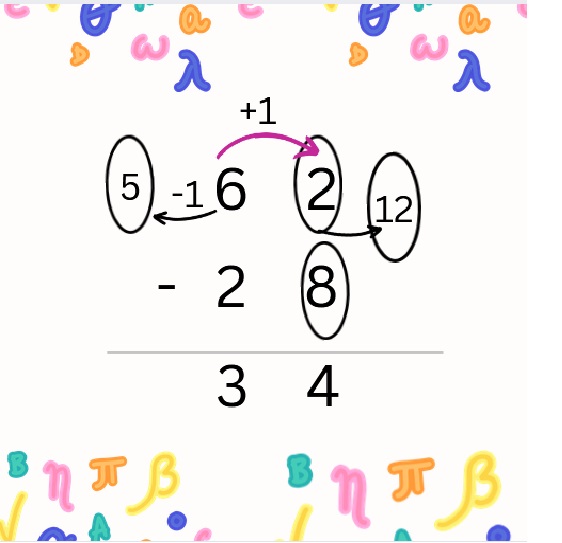
- Borrow if needed – If the top digit is smaller than the bottom digit, borrow 1 from the next column (tens place). Reduce the digit in the tens place by 1 and add 10 to the current column.
- Move to the tens place – Subtract the digits in the tens place, including any adjustments from borrowing. If needed, borrow from the next column again.
- Repeat the process – Continue subtracting in the hundreds, thousands, and higher place values until all digits have been processed.
- Write the final result – Once all subtractions and borrowings are complete, the remaining number is the final difference.
This method ensures accurate subtraction, even when dealing with larger numbers.
🟢 Two-Digit Subtraction
Break numbers into tens and ones (units).
Example: 87 – 34
80 – 30 = 50
7 – 4 = 3
Final Answer = 53
If the bottom number is bigger (like 5 – 6), borrow from the tens.
Example: 75 – 26 = 49
🟡 Three-Digit Subtraction
Line up numbers in hundreds, tens, ones.
Example: 732 – 245
2 can’t subtract 5 → borrow → 12 – 5 = 7
2 can’t subtract 4 → borrow → 12 – 4 = 8
6 – 2 = 4
Final Answer = 487
🔵 Four-Digit Subtraction
Same method, but with thousands, hundreds, tens, ones.
Without borrowing:
5234 – 1234 = 4000
With borrowing:
7180 – 3425 = 3755
Always start from the right side and move left.
✅ Tips to Get Better at Subtraction
Practice daily with small and big numbers.
Use online games and worksheets for fun.
Try word problems (real-life style).
Join study groups or practice with friends.
Why Mastering Subtraction is Important?
Mastering subtraction is super important, and here’s why in a way that’s easy to understand:
1. You Build Math Skills: Subtraction is like the ABCs of math. Just like you need to know your letters to read, you need to know how to subtract, just like you need to add, multiply, and divide.
2. You Use It Every Day: You use subtraction all the time, even if you don’t realize it. Whether you’re counting your money, figuring out how many slices of pizza everyone gets, or keeping track of your score in a game, you’re using addition!
3. You Solve Problems: Imagine you’re a detective solving puzzles. You use subtraction as one of your tools to figure things out and solve problems, whether you’re in school or just trying to decide how many more toys you need to reach ten.
4. You Get Smarter: When you practice subtraction, you exercise your brain. Just like playing sports makes you stronger, doing math makes your brain sharper and quicker at figuring things out.
5. You Feel Confident: As you get better at subtraction, you start feeling more confident. It’s like exploring the world. The more you explore, the better you can try even bigger challenges. Plus, you feel proud of yourself every time you solve a problem!
6. You Do Well in School: You’ll use subtraction in lots of school subjects, not just math. When you get really good at it, you do better in school overall because math is everywhere!
So, when you master subtraction, you give yourself a superpower that helps you with school, games, and life in general!
Conclusion and Further Practice
Subtraction is a skill we use daily—whether in school, budgeting, measuring, or problem-solving. The best way to master it is through steady practice. Younger learners can use fun apps and games, while older students benefit from workbooks and word problems that build deeper thinking. Study groups or math clubs also make learning more engaging. With consistent practice and a positive mindset, anyone can strengthen their subtraction skills and gain confidence in mathematics.