Number Plane Practice Questions: Coordinates, Gradient and Distance
Build confidence with the main number-plane and straight-line skills. Work through rise and run, gradient, distance, coordinates, intercepts, equations, midpoint and line relationships.
- Rise, run and gradient: calculate coordinate changes and the slope of a line
- Distance: find horizontal, vertical and diagonal distances between points
- Coordinates: identify quadrants, axes and reflected points
- Straight lines: substitute into y = mx + c and find intercepts or equations
- Mixed skills: use midpoint, parallel and perpendicular gradients and missing coordinates
- 8 focused levels
- 64 practice questions
- Instant answer checks
- Hints and full working
Common equivalent forms are accepted, including coordinates with or without brackets and fractions or matching decimals. Your answers and checked results are saved automatically in this browser.
Level 1
Finding Rise and Run
8 questions · Coordinate changes
0/8
Level 2
Finding Slope or Gradient
8 questions · Rise over run
0/8
Level 3
Horizontal and Vertical Distance
8 questions · Same x or y value
0/8
Level 4
Distance Between Two Points
8 questions · Distance formula
0/8
Level 5
Coordinates, Axes and Quadrants
8 questions · Number-plane position
0/8
Level 6
Substitution Into y = mx + c
8 questions · Missing values
0/8
Level 7
Intercepts and Equations of Straight Lines
8 questions · y = mx + c
0/8
Level 8
Mixed Number-Plane Skills
8 questions · Midpoint and line relationships
0/8
Number Plane Straight Lines: Gradient and Y-Intercept
This topic explains how points and straight lines are represented on a number plane. Students learn to read coordinates, calculate rise and run, find a line’s gradient, identify its intercepts, write the equation of a line and calculate distances between points.
- plot and read coordinates written as (x, y);
- understand the x-axis, y-axis, origin and quadrants;
- calculate rise, run and gradient;
- use and interpret y = mx + c;
- find equations from points, gradients or intercepts;
- calculate midpoint and distance as extension skills.
What Is a Number Plane?
A number plane, also called a Cartesian plane or coordinate plane, uses two perpendicular number lines to show the position of points and graphs.
The x-axis
The horizontal axis. Values increase as you move right and decrease as you move left.
The y-axis
The vertical axis. Values increase as you move up and decrease as you move down.
The origin
The point where the axes meet: (0, 0).
Coordinates
A point is written as (x, y). Read the x-coordinate first, followed by the y-coordinate.
Start at the origin. Move 3 units to the right because the x-coordinate is positive. Then move 2 units down because the y-coordinate is negative.
The axes divide the plane into four quadrants:
A point lying on an axis is not in a quadrant. For example, (0, 5) lies on the y-axis and (−4, 0) lies on the x-axis.
The Equation of a Straight Line
The most common form of a straight-line equation is:
- y
- The vertical coordinate of a point on the line.
- x
- The horizontal coordinate of a point on the line.
- m
- The gradient or slope, which describes the line’s direction and steepness.
- c
- The y-intercept: the y-value where the line crosses the y-axis.
The gradient is m = 2. The line rises 2 units for every 1 unit it moves to the right.
The y-intercept is c = 3, so the line crosses the y-axis at (0, 3).
Gradient, Rise and Run
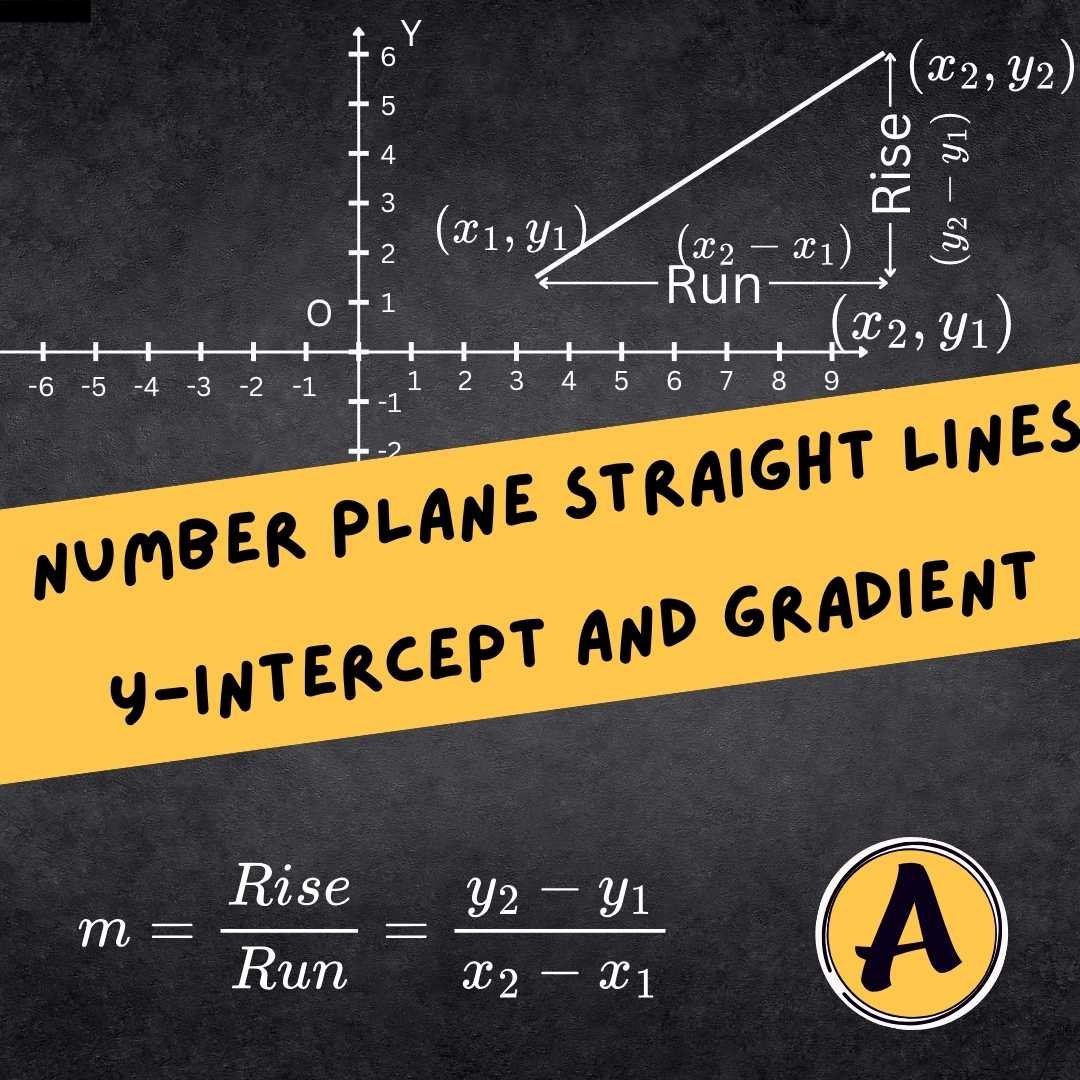
Gradient measures how much the y-value changes compared with the change in x. It is often described as rise over run.
When two coordinates are known, use:
| Type of line | Gradient | What happens as x increases? |
|---|---|---|
| Rises from left to right | Positive | The y-values increase. |
| Falls from left to right | Negative | The y-values decrease. |
| Horizontal line | 0 | The y-value stays constant, such as y = −2. |
| Vertical line | Undefined | The x-value stays constant, such as x = 4. |
Finding the Equation of a Line From Two Points
Suppose a straight line passes through:
Find the gradient
Use m = (y₂ − y₁)/(x₂ − x₁). Simplify the fraction where possible.
Find the y-intercept
Substitute the gradient and either known point into y = mx + c and solve for c.
Write the equation
Substitute the values of m and c into y = mx + c.
Check the equation
Substitute the other point. Its x-coordinate should produce its correct y-coordinate.
Step 1: Find the gradient.
Step 2: Substitute (2, 3) into y = mx + c.
Step 3: Write the equation.
Check: When x = 6, y = 2(6) − 1 = 11, so point B lies on the line.
Finding the Gradient and Y-Intercept From an Equation
When an equation is already written as y = mx + c, the gradient and y-intercept can be read directly.
The gradient is m = 3. The y-intercept is c = −4, which gives the point (0, −4).
When the equation is not written with y by itself, rearrange it first.
Subtract 2x from both sides:
Divide every term by 3:
Therefore, the gradient is −2/3 and the y-intercept is 4.
Finding the x-Intercept and Y-Intercept
Y-intercept
Set x = 0. In y = mx + c, this gives y = c, so the point is (0, c).
x-intercept
Set y = 0 and solve for x. The intercept has the form (x, 0).
The x-intercept is (3, 0).
How to Graph a Straight Line From Its Equation
You do not need a long table of values when the equation is in y = mx + c form.
- Plot the y-intercept (0, −1).
- Read the gradient as rise/run = 2/3.
- From (0, −1), move 3 units right and 2 units up to reach (3, 1).
- Draw a straight line through the points and extend it in both directions.
For a negative gradient, moving to the right means moving down. For example, a gradient of −3/2 can be shown by moving 2 units right and 3 units down.
Point–Slope Form: A Useful Extension
When a gradient and one point are known, another useful form is:
Substitute the known gradient and point, then expand and rearrange into y = mx + c when required. This can be quicker because it avoids finding c as a separate first step.
Parallel and Perpendicular Lines
Parallel lines
Parallel non-vertical lines have the same gradient.
They have different y-intercepts unless they are the same line.
Perpendicular lines
For non-horizontal and non-vertical lines, perpendicular gradients are negative reciprocals.
For example, a line with gradient 3 is perpendicular to a line with gradient −1/3.
Midpoint and Distance Between Two Points
These coordinate-geometry skills are often studied alongside gradient and straight lines.
Midpoint formula
The midpoint is found by averaging the two x-values and averaging the two y-values.
Distance formula
The distance formula comes from Pythagoras’ theorem. It measures the straight-line distance between two coordinates.
Common Mistakes to Avoid
- Writing a coordinate in the wrong order. Always use (x, y).
- Using different subtraction orders in the gradient numerator and denominator.
- Confusing the y-intercept value c with the point (0, c).
- Reading a negative gradient incorrectly. A negative line falls as x increases.
- Forgetting that a horizontal line has gradient 0.
- Trying to divide by zero for a vertical line. Its gradient is undefined.
- Reading m and c before rearranging the equation so that y is by itself.
- Using the new value instead of the change in values when calculating rise and run.
Quick Summary
- A coordinate is written as (x, y).
- A straight line is commonly written as y = mx + c.
- m is the gradient and c is the y-intercept.
- Gradient equals rise divided by run.
- The y-intercept is found by setting x = 0.
- The x-intercept is found by setting y = 0.
- Two points can be used to calculate the gradient and equation of a line.
- Parallel lines have equal gradients; perpendicular gradients are negative reciprocals.
Related Aussie Math Tutor NSW Resources
Trusted external learning resources
The official NSW Mathematics K–10 syllabus overview shows how linear and non-linear relationships fit within secondary mathematics. Students can also review gradient and slope at Maths Is Fun and practise linear equations and graphs at Khan Academy.
Still Unsure About Gradient or Straight-Line Equations?
Students often understand the formula but become unsure when coordinates are negative, the equation must be rearranged or the y-intercept is not given. A free assessment can identify which number-plane or algebra skills need strengthening.
View Free Assessment Times