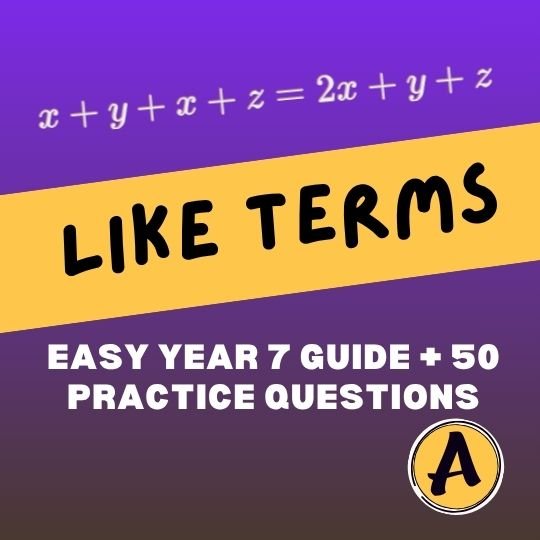
Like Terms Practice Test
Learn to recognise and combine like terms step by step. Start by identifying matching variable parts, then progress through mixed expressions, powers, reordered variables and challenging multi-term simplification.
- 5 progressive levels
- 50 practice questions
- Instant answer checks
- Hints and full working
Your answers and checked results are saved automatically in this browser.
Level 1
Identify Like and Unlike Terms
10 questions · Foundation
0/10
Level 2
Combine Basic Like Terms
10 questions · Easy
0/10
Level 3
Mixed Like-Term Expressions
10 questions · Developing
0/10
Level 4
Powers and Multiple Variables
10 questions · Intermediate
0/10
Level 5
Challenge: Simplify Complex Expressions
10 questions · Challenge
0/10
What Are Like Terms in Algebra?
Like terms are algebraic terms that have exactly the same variable or pronumeral part, including the same powers. The numbers in front of the variables — called coefficients — can be different.
Like terms are one of the most important foundations of basic algebra . Year 7 students need to recognise like terms before they can confidently simplify expressions, expand brackets and solve equations.
The interactive test above contains 50 free Like Terms practice questions, with progressive levels, instant answer checks, hints and worked solutions.
Same letters + same powers = like terms.
The Apple and Orange Method for Understanding Like Terms
When I teach like terms, I often begin with a simple real-world example before introducing algebra.
Yes. They are the same kind of item, so they can be combined.
We cannot say:
We simply have 1 apple and 1 orange. They are different types of objects, so they stay separate.
Algebra works in the same way.
Both terms are x terms, so they can be combined.
x and y are different, so they must stay separate.
Why Is x + y + x Equal to 2x + y?
One of the first expressions that confuses students beginning algebra is:
Look for the terms that match.
- The first x and the last x are like terms.
- Think of the expression as x + x + y.
- Since x means 1x, we have 1x + 1x = 2x.
- The y is a different variable, so it remains separate.
What Is a Coefficient?
A coefficient is the number multiplying a variable.
| Term | Coefficient | Variable Part |
|---|---|---|
| 5x | 5 | x |
| −3y | −3 | y |
| 7x² | 7 | x² |
| x | 1 | x |
| −x | −1 | x |
When no number is written in front of a variable, its coefficient is 1.
Like Terms, Unlike Terms and Constants
| Terms | Like Terms? | Reason |
|---|---|---|
| 3x and 5x | Yes | Both contain x |
| 4y and −7y | Yes | Both contain y |
| x and x² | No | The powers are different |
| 2xy and 6xy | Yes | Both contain xy |
| 3x and 3y | No | The variables are different |
| 5a² and 9a² | Yes | Both contain a² |
| 2ab and 7ba | Yes | ab and ba are equivalent |
| 4x²y and 3xy² | No | The powers of x and y are different |
Constants can also be like terms. Constants are numbers without variables.
The x terms are like terms, and the constants 5 and −7 are also like terms.
Why Are x and x² Not Like Terms?
Students often see the letter x in both terms and assume they must be like terms. However, the powers also need to match.
Remember:
So x and x² represent different algebraic quantities. If powers such as x² and x³ are still confusing, review the guide to indices and powers .
Think of x and x² as differently labelled groups. You might imagine one group as green apples and the other as red apples.
If you have two green apples and two red apples, you cannot say that you have four green apples.
In the same way:
cannot be simplified by combining the two terms.
How to Combine Like Terms
Once you have identified which terms are alike, simplifying the expression is usually straightforward:
Add or subtract the coefficients and keep the variable part unchanged.
Basic Example
Add the coefficients:
Therefore:
Subtracting Like Terms
The variable y stays unchanged. Only the coefficients are subtracted.
Negative Coefficients
Combining More Than One Group
Group the x terms and y terms:
Now simplify:
Does the Order of Variables Matter?
When variables are multiplied, their order can be rearranged because multiplication is commutative.
Therefore:
Adding Is Not the Same as Multiplying
This is one of the most common mistakes students make when first learning algebra.
There are two copies of x.
x is multiplied by itself.
Addition gives 2x. Multiplication gives x².
Worked Like Terms Examples
Example 1: Simple Like Terms
Example 2: Different Variables
x and y are unlike terms, so the expression cannot be simplified further.
Example 3: Same Powers
Example 4: Different Powers
x² and x are unlike terms, so they remain separate.
Example 5: Longer Expression
Combine the coefficients:
Therefore:
Common Mistakes with Like Terms
Combining Different Variables
x and y are unlike terms. Leave the expression as 3x + 4y.
Ignoring the Powers
These terms cannot be combined because x and x² are different.
Adding the Powers
Do not change the answer to 8x². When adding like terms, the variable part stays unchanged.
Forgetting That x Means 1x
Losing a Negative Sign
Treat the subtraction sign as part of the coefficient that follows it.
A Simple Method for Like Terms Questions
- Look at the variable part. Ignore the coefficients at first.
- Check the powers. x and x² are different.
- Group matching terms. Put x terms with x terms, y terms with y terms, x² terms with x² terms, and constants with constants.
- Add or subtract the coefficients.
- Keep the variable part unchanged.
Same letters + same powers = combine them.
Different letters or different powers = keep them separate.
Why Like Terms Matter in Year 7 Algebra
Like terms may appear to be a small part of algebra, but they are a foundation for many of the topics students study next.
Students need to recognise and combine like terms when they learn to:
- simplify algebraic expressions
- expand brackets
- solve linear equations
- substitute values into expressions
- factorise expressions
- work with powers and indices
- simplify more advanced algebraic expressions
For example, students who later study simple linear equations often need to simplify like terms before solving the equation.
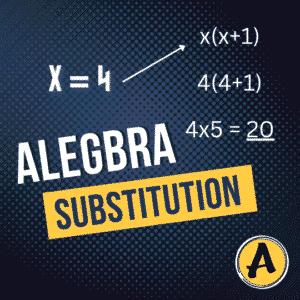
Students also use these ideas when learning algebra substitution .
If a student is still unsure why x and x² are different, or cannot simplify an expression such as x + y + x, later algebra can become unnecessarily difficult.
Like Terms in the NSW Mathematics Curriculum
Algebra and equations are an important part of secondary mathematics in NSW. In Stage 4, students begin developing stronger skills with algebraic expressions, variables, equations and mathematical relationships.
The exact order in which individual algebra skills are taught can vary between schools, but recognising and simplifying algebraic expressions is an important foundation for Year 7 mathematics and later algebra.
Students can see how Like Terms connect with other Year 7 topics in the Year 7 Maths NSW Syllabus Guide .
For official curriculum information, visit the NSW Mathematics K–10 Syllabus .
What Should Students Learn After Like Terms?
Once a student can confidently identify and combine like terms, the next step is to connect this skill with other important algebra topics.
Need Help with Like Terms or Year 7 Algebra?
Like terms can seem simple once algebra becomes familiar, but students seeing pronumerals for the first time can genuinely struggle with expressions such as x + y + x or x + x².
I often go back to simple examples such as apples and oranges before replacing the objects with x, y and x². The aim is for students to understand why terms can or cannot be combined rather than simply memorising a rule.
Aussie Math Tutor NSW provides step-by-step maths support for students who need more time to build these algebra foundations. Face-to-face tutoring is available around Telopea, Oatlands, Dundas, Dundas Valley, Rydalmere, Ermington and Carlingford, with online tutoring available for students across NSW.
Students can also work through the 50-question Like Terms interactive practice test above before moving on to more advanced Year 7 algebra.
Explore Years 1–10 Maths Tutoring | Maths Tutoring in Telopea