Geometry Formulae for Triangles, Quadrilaterals and Circles

Struggling to remember your math rules? This comprehensive guide breaks down the essential geometry formulae for triangles, quadrilaterals, and circles. Complete with a downloadable cheat sheet, an interactive practice quiz, and NESA-aligned FAQs to help NSW students confidently ace their exams.
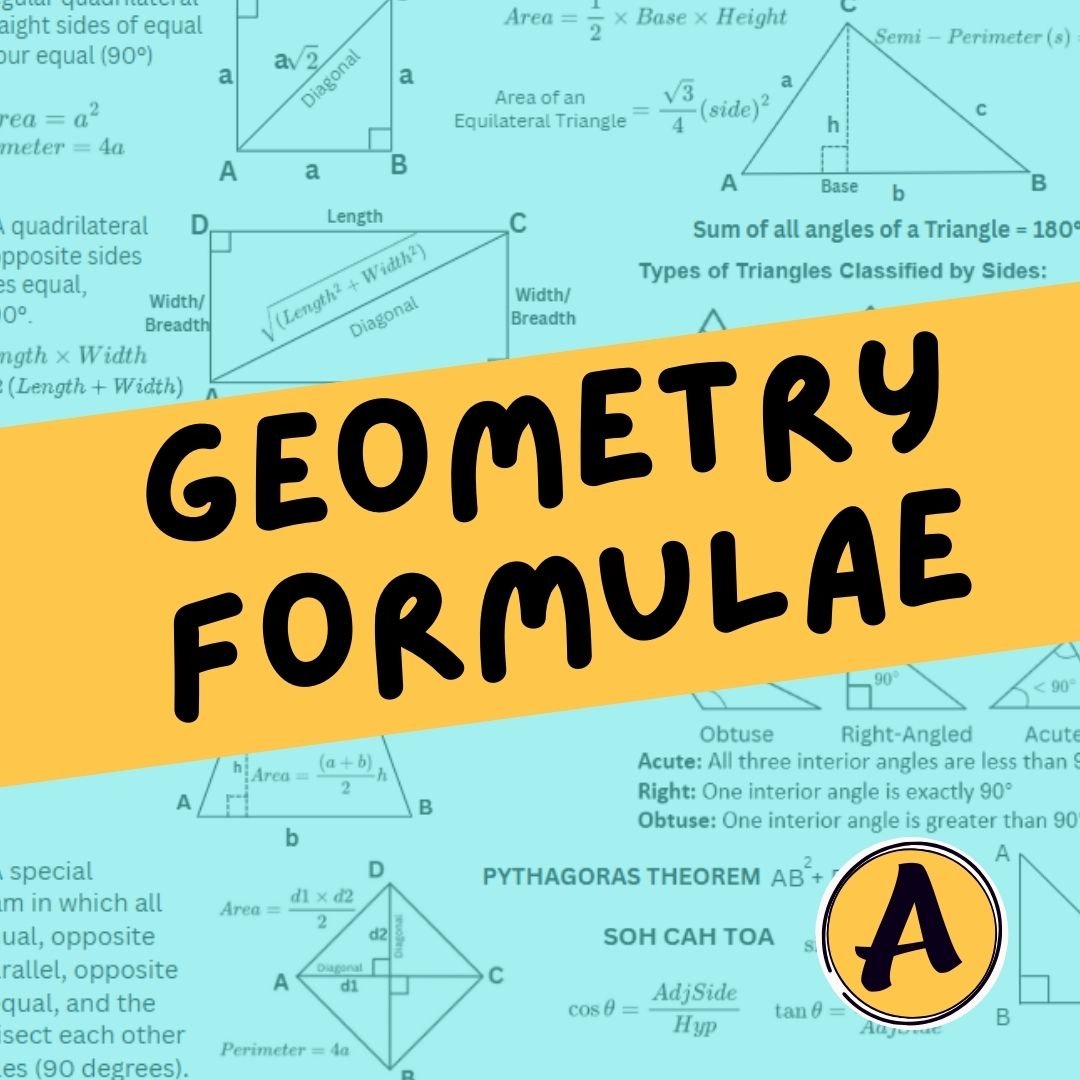
Geometry formulae poster showing and circles, triangles and quadrilaterals formulae

Table of Contents

Interactive maths practice

NESA-Aligned Geometry Formulae Practice Questions

Revise important geometry skills through three focused sections. Each section contains 10 questions with instant checking, helpful hints and complete working.

  • Triangles: angle sums, classifications, perimeter, area, Pythagoras and triangle inequality
  • Quadrilaterals: angle sums, rectangles, squares, parallelograms, trapeziums and kites
  • Circles: radius, diameter, circumference and area using π = 3.14
  • 3 focused levels
  • 30 practice questions
  • Instant answer checks
  • Hints and full working
0Attempted
0Correct
30Total questions
Overall progress0 of 30 correct
0 of 30 correct

Your answers and checked results are saved automatically in this browser.

Level 1 Triangles — Angles, Perimeter and Properties 10 questions · Foundation 0/10

Tip: Enter the answer only. Degree symbols and units are optional. For word answers, use terms such as isosceles, yes or no.
  1. Angles in a triangle add up to ____.

    View hint and full working

    Hint: The interior angles of every triangle have a total of 180°.

    Working
    Triangle angle sum = 180°
    Answer: 180°
  2. A triangle has angles of 45° and 55°. Find the third angle.

    View hint and full working

    Hint: Subtract the two known angles from 180°.

    Working
    45° + 55° = 100°
    Third angle = 180° − 100°
    = 80°
    Answer: 80°
  3. An isosceles triangle has two equal angles of 50°. Find the third angle.

    View hint and full working

    Hint: Add the two equal angles, then subtract their total from 180°.

    Working
    50° + 50° = 100°
    Third angle = 180° − 100°
    = 80°
    Answer: 80°
  4. A right-angled triangle has one angle of 90° and another angle of 35°. Find the third angle.

    View hint and full working

    Hint: The three angles must add to 180°.

    Working
    90° + 35° = 125°
    Third angle = 180° − 125°
    = 55°
    Answer: 55°
  5. Find the perimeter of a triangle with side lengths 6, 8 and 10.

    View hint and full working

    Hint: Perimeter is the sum of all side lengths.

    Working
    Perimeter = 6 + 8 + 10
    = 24
    Answer: 24
  6. A triangle has side lengths 7, 7 and 10. What type of triangle is it?

    View hint and full working

    Hint: A triangle with two equal sides is isosceles.

    Working
    Two sides are equal: 7 and 7.
    Therefore, the triangle is isosceles.
    Answer: isosceles
  7. Find the area of a triangle with a base of 10 and a perpendicular height of 6.

    View hint and full working

    Hint: Use area = ½ × base × perpendicular height.

    Working
    Area = ½ × 10 × 6
    = 30
    Answer: 30
  8. A triangle has side lengths 3, 4 and 5. Is it a right-angled triangle? Enter yes or no.

    View hint and full working

    Hint: Check whether the two shorter sides satisfy Pythagoras.

    Working
    3² + 4² = 9 + 16
    = 25
    5² = 25
    The values match, so it is a right-angled triangle.
    Answer: yes
  9. In an equilateral triangle, each angle is ____.

    View hint and full working

    Hint: The three equal angles share the total of 180°.

    Working
    180° ÷ 3 = 60°
    Answer: 60°
  10. Can side lengths 2, 3 and 6 form a triangle? Enter yes or no.

    View hint and full working

    Hint: The sum of any two sides must be greater than the third side.

    Working
    2 + 3 = 5
    5 is not greater than 6.
    Therefore, these lengths cannot form a triangle.
    Answer: no

Level 2 Quadrilaterals — Angles, Perimeter and Area 10 questions · Core skills 0/10

Tip: Identify the quadrilateral and choose the correct angle, perimeter or area rule. Enter numbers only.
  1. Angles in any quadrilateral add up to ____.

    View hint and full working

    Hint: The interior angle sum of every quadrilateral is 360°.

    Working
    Quadrilateral angle sum = 360°
    Answer: 360°
  2. A quadrilateral has angles of 90°, 110° and 80°. Find the fourth angle.

    View hint and full working

    Hint: Subtract the three known angles from 360°.

    Working
    90° + 110° + 80° = 280°
    Fourth angle = 360° − 280°
    = 80°
    Answer: 80°
  3. A rectangle has a length of 12 and a width of 5. Find its perimeter.

    View hint and full working

    Hint: Use perimeter = 2(length + width).

    Working
    Perimeter = 2(12 + 5)
    = 2 × 17
    = 34
    Answer: 34
  4. A rectangle has a length of 12 and a width of 5. Find its area.

    View hint and full working

    Hint: Use area = length × width.

    Working
    Area = 12 × 5
    = 60
    Answer: 60
  5. A square has a side length of 9. Find its perimeter.

    View hint and full working

    Hint: A square has four equal sides.

    Working
    Perimeter = 4 × 9
    = 36
    Answer: 36
  6. A square has a side length of 9. Find its area.

    View hint and full working

    Hint: Use area = side².

    Working
    Area = 9²
    = 81
    Answer: 81
  7. A parallelogram has a base of 11 and a perpendicular height of 7. Find its area.

    View hint and full working

    Hint: Use area = base × perpendicular height.

    Working
    Area = 11 × 7
    = 77
    Answer: 77
  8. A trapezium has parallel sides of 8 and 14 and a perpendicular height of 6. Find its area.

    View hint and full working

    Hint: Use area = ½ × (sum of parallel sides) × height.

    Working
    Area = ½ × (8 + 14) × 6
    = ½ × 22 × 6
    = 66
    Answer: 66
  9. A kite has diagonals of 10 and 6. Find its area.

    View hint and full working

    Hint: Use area = ½ × diagonal 1 × diagonal 2.

    Working
    Area = ½ × 10 × 6
    = 30
    Answer: 30
  10. A rectangle has one angle of 90°. How many right angles does it have?

    View hint and full working

    Hint: Every interior angle of a rectangle is a right angle.

    Working
    A rectangle has four right angles.
    Answer = 4
    Answer: 4

Level 3 Circles — Radius, Diameter, Circumference and Area 10 questions · Core skills 0/10

Tip: Use π = 3.14 when stated. Enter the number only; units are optional.
  1. A circle has a radius of 7. What is its diameter?

    View hint and full working

    Hint: The diameter is twice the radius.

    Working
    Diameter = 2 × radius
    = 2 × 7
    = 14
    Answer: 14
  2. A circle has a diameter of 10. What is its radius?

    View hint and full working

    Hint: The radius is half the diameter.

    Working
    Radius = diameter ÷ 2
    = 10 ÷ 2
    = 5
    Answer: 5
  3. Use π = 3.14. A circle has a radius of 5. Find its circumference.

    View hint and full working

    Hint: Use circumference = 2πr.

    Working
    Circumference = 2 × 3.14 × 5
    = 31.4
    Answer: 31.4
  4. Use π = 3.14. A circle has a diameter of 12. Find its circumference.

    View hint and full working

    Hint: Use circumference = πd.

    Working
    Circumference = 3.14 × 12
    = 37.68
    Answer: 37.68
  5. Use π = 3.14. A circle has a radius of 6. Find its area.

    View hint and full working

    Hint: Use area = πr².

    Working
    Area = 3.14 × 6²
    = 3.14 × 36
    = 113.04
    Answer: 113.04
  6. Use π = 3.14. A circle has a diameter of 8. Find its area.

    View hint and full working

    Hint: First find the radius, then use area = πr².

    Working
    Radius = 8 ÷ 2 = 4
    Area = 3.14 × 4²
    = 3.14 × 16
    = 50.24
    Answer: 50.24
  7. A semicircle has a radius of 10. What is the diameter of the full circle?

    View hint and full working

    Hint: The diameter is twice the radius.

    Working
    Diameter = 2 × 10
    = 20
    Answer: 20
  8. Use π = 3.14. A circle has a radius of 3. Find its circumference.

    View hint and full working

    Hint: Use circumference = 2πr.

    Working
    Circumference = 2 × 3.14 × 3
    = 18.84
    Answer: 18.84
  9. True or false: The diameter of a circle is always twice its radius.

    View hint and full working

    Hint: The relationship between diameter and radius is d = 2r.

    Working
    d = 2r
    Therefore, the statement is true.
    Answer: true
  10. Use π = 3.14. A circle has a circumference of 62.8. Find its radius.

    View hint and full working

    Hint: Rearrange C = 2πr to find r.

    Working
    r = C ÷ (2π)
    = 62.8 ÷ (2 × 3.14)
    = 62.8 ÷ 6.28
    = 10
    Answer: 10

Geometry Formulae for Circles, Triangles and Quadrilaterals

These geometry formulae help NSW students revise important rules for circles, triangles, rectangles, squares, trapeziums, rhombuses, kites and parallelograms. Use this as a quick formula guide before attempting geometry practice questions.

1 Circle Formulae and Key Terms

Important circle terms

Circle: A round shape where every point on the boundary is the same distance from the centre.
Radius: The distance from the centre of the circle to the edge.
Diameter: A straight line through the centre of the circle. It is twice the radius.
Chord: A line segment with both endpoints on the circumference. The diameter is the longest chord.
Arc: Part of the circumference of a circle.
Sector: A part of a circle made by two radii and the arc between them.

Circle formulae

Diameter
d = 2r
Circumference
C = 2πr
C = πd
Area of a Circle
A = πr²
Arc Length
Arc = (θ ÷ 360°) × 2πr
Sector Area
A = (θ ÷ 360°) × πr²
Student tip: If the question gives the diameter, divide it by 2 first to get the radius.

2 Triangle Formulae and Rules

Basic triangle rules

Angle Sum of a Triangle
A + B + C = 180°
Area of a Triangle
A = ½ × base × height
Pythagoras’ Theorem
a² + b² = c²
Use this only for right-angled triangles. c is the hypotenuse.
Triangle Inequality
a + b > c
a + c > b
b + c > a

Types of triangles

  • Equilateral: all three sides are equal and each angle is 60°.
  • Isosceles: two sides are equal and the opposite angles are equal.
  • Scalene: all sides have different lengths.
  • Right-angled: one angle is exactly 90°.
  • Obtuse: one angle is greater than 90°.
  • Acute: all angles are less than 90°.
Area of an Equilateral Triangle
A = (√3 ÷ 4) × side²
Heron’s Formula
A = √s(s − a)(s − b)(s − c)
where s = (a + b + c) ÷ 2

3 Quadrilateral Formulae

Key rule: The interior angles of any quadrilateral add up to 360°.

Rectangle and Square

Rectangle Area
A = length × width
Rectangle Perimeter
P = 2(length + width)
Rectangle Diagonal
d = √(length² + width²)
Square Area
A = side²
Square Perimeter
P = 4 × side
Square Diagonal
d = side√2

Parallelogram and Trapezium

Parallelogram: A quadrilateral with two pairs of parallel sides. Opposite angles are equal.
Parallelogram Area
A = base × height
Parallelogram Perimeter
P = 2(a + b)
Trapezium: A quadrilateral with one pair of parallel opposite sides.
Trapezium Area
A = ½(a + b)h
a and b are the parallel sides. h is the perpendicular height.

4 Rhombus and Kite Formulae

Rhombus Formulae

Rhombus: A special parallelogram where all sides are equal. Opposite sides are parallel, opposite angles are equal, and the diagonals bisect each other at right angles.
Rhombus Area Using Diagonals
A = (d₁ × d₂) ÷ 2
Rhombus Perimeter
P = 4a
Rhombus Area Using Base and Height
A = base × height

Kite Formulae

Kite: A quadrilateral with two pairs of adjacent equal sides.
Kite Area Using Diagonals
A = (d₁ × d₂) ÷ 2
Kite Perimeter
P = 2(a + b)
a and b are the two different side lengths.
Student tip: Rhombus and kite area can both use diagonal formulae, so check the diagram carefully before choosing the formula.

5 Parallel Line Angle Rules

Corresponding and alternate angles

Corresponding angles: Angles in the same position when a transversal crosses two parallel lines. They are equal.
Alternate interior angles: Angles inside the parallel lines and on opposite sides of the transversal. They are equal.
Alternate exterior angles: Angles outside the parallel lines and on opposite sides of the transversal. They are equal.

Vertical opposite angles

Vertical opposite angles: Angles opposite each other when two straight lines intersect. They are equal.
Student tip: In geometry questions, mark equal angles on the diagram first. This makes the solution easier to see.

Frequently Asked Questions about Geometry Formulae

In NSW, it depends entirely on your school’s assessment policy for Years 7 to 10. Some schools allow students to bring a custom, handwritten reference sheet with formulas and examples. Others provide a generic, standardized formula sheet, while some do not allow any reference sheets at all. Always check with your maths teacher before your exam.

Year 7 NAPLAN numeracy focuses on foundational 2D spatial reasoning, including the area and perimeter of squares, rectangles, triangles, circles, and simple composite shapes. The Year 9 NAPLAN test steps up to more complex spatial reasoning, testing Pythagoras’ theorem, advanced composite shape problems, and the properties of 3D objects.

Stage 4 (Years 7 & 8) focuses heavily on the properties of 2D and 3D shapes, teaching students how to calculate basic area and perimeter, and identifying the vertices, edges, and faces of prisms and pyramids. Stage 5 (Years 9 & 10) is highly application-based, introducing challenging topics like trigonometry, true bearings, and applying Pythagoras’ theorem within 3D shapes.

Yes. For the Opportunity Class (OC) test, students must know basic area and perimeter formulas for squares, rectangles, and triangles. The Selective High School Placement Test is much harder; students must master 3D shapes (prisms and pyramids) and all quadrilateral formulas (trapezium, rhombus, parallelogram) to quickly solve advanced spatial reasoning applications.

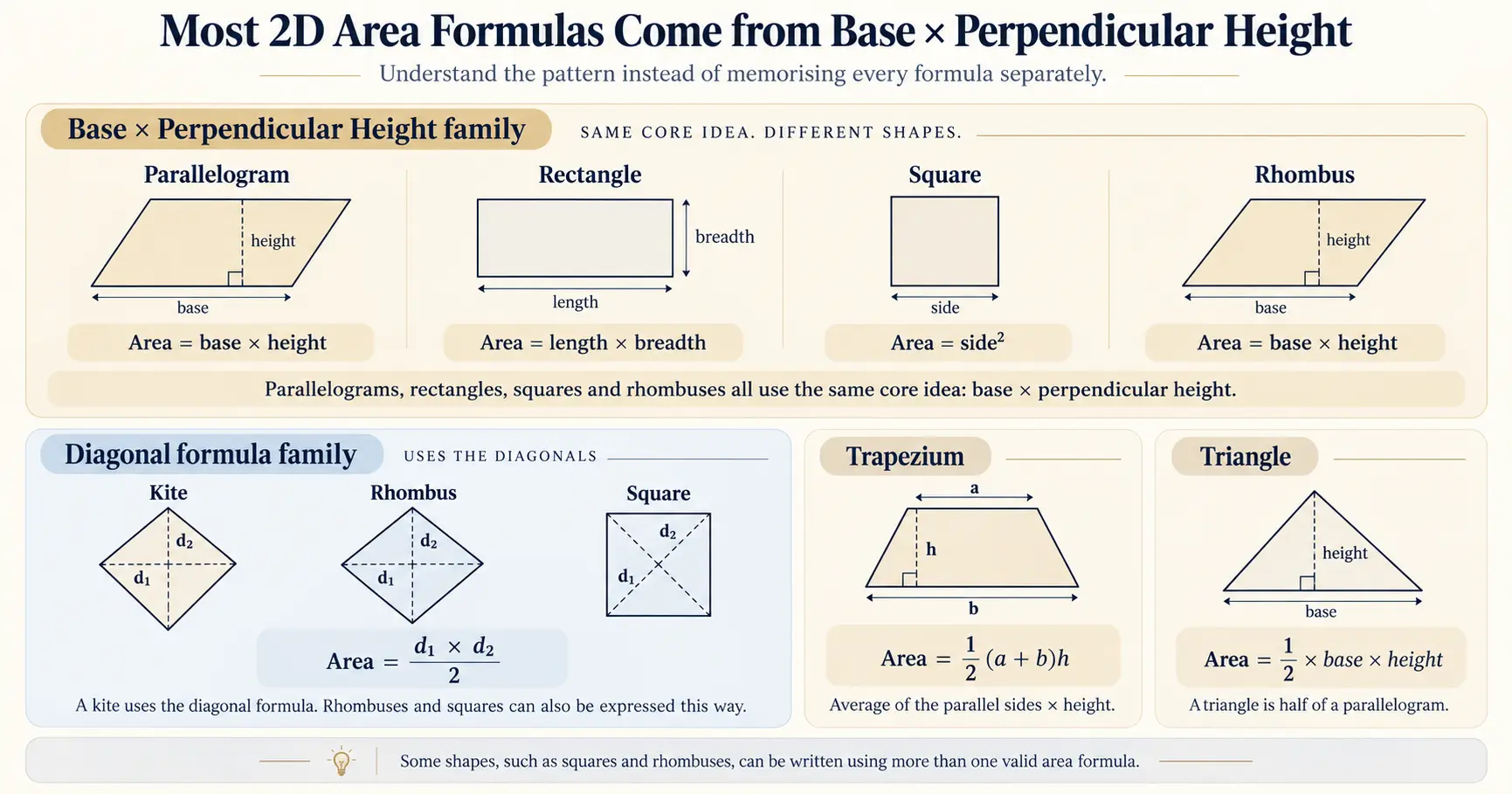
The easiest way is to understand the relationship between shapes instead of blindly memorising each formula separately.

For example:

  • For a parallelogram: Area = base × height
  • Because squares, rectangles, and rhombuses are technically parallelograms, the area of all these shapes is base × height
  • A triangle is half of a parallelogram, so its area is: ½ ×
  • base × height
  • A trapezium is like two parallel sides averaged together, so its area is: Area = ½ × (a + b) × height
  • A prism is a 3D shape with the same cross-section all the way through, so its volume is: Volume = area of base × height/length
  • For circles, remember that the
    1. Diameter = 2 × radius
    2. Circumference = 2πr
    3. Area = πr²

A good exam tip is to group formulae by shape, draw a quick diagram, label the known values, and always check the units. Area uses square units such as cm², while volume uses cubic units such as cm³.

The secret to solving Year 9 and 10 circle geometry is mastering the core formulas first. Once you confidently know the Area (πr²) and Circumference (2πr) of a full circle, finding the area of a sector or the length of an arc is easy—you simply multiply your full circle formula by the fraction of the angle given (Angle ÷ 360°).

According to the NESA NSW mathematics syllabus, Pythagoras’ theorem is first introduced in Year 8 (Stage 4). By Year 9 and Year 10 (Stage 5), students are expected to apply this theorem to solve much more complex, multi-step problems, such as calculating the lengths of diagonals within 3D shapes.

It comes down to reading the context clues carefully. If the word problem mentions “fencing,” “border,” “outside,” or “walking around,” you need to calculate the perimeter. If the question mentions “covering,” “painting,” “flooring,” or finding the “inside space,” you need to calculate the area.

Trigonometry study graphic showing the Law of Sines, Cosine Rule, area of a triangle formula and CAST rule for NSW Year 9 and Year 10 maths students.

Trigonometry Guide for the NESA Maths Syllabus

Trigonometry is an important topic in the NESA Mathematics syllabus for NSW high school students. This guide explains SOH CAH TOA for right-angled triangles, the sine, cosine and tangent ratios, the cosine rule, the area rule, and the CAST rule for the four quadrants. It is designed to help students understand formulas, choose the correct method, and practise exam-style trigonometry questions.

Read More »
Number plane Advance showing gradient, rise and run, and y-intercept on a graph

Number Plane: The Complete Guide with Easy Made Theory & Egs

The Cartesian Plane and Number Plane theory covers plotting points, quadrants, line equations, slope, distance, and midpoint formulas with step-by-step explanations and exercises. It also explains the relationships between parallel and perpendicular lines and how to draw a line from a given equation. For personalized tutoring, students can contact Aussie Math Tutor NSW via phone, WhatsApp, or email to book a session.

Read More »
Math Geometry Pie
Math Symbols
Maths tutor helping a student with schoolwork during a one-on-one tutoring session

Not sure whether maths tutoring is right for your child?

Book a free initial maths assessment to discuss your child’s current level, learning gaps and suitable next steps.

Years 1–10 • NSW syllabus-aligned • Face-to-face and online tutoring