OC Maths Test Analysis: What Exactly Should My Child Practise?
For many NSW families, preparing for the Opportunity Class test can feel overwhelming. The most common question parents ask is: What exactly should our child be practising?
The answer isn’t simply doing more equations. The OC Mathematical Reasoning test is quite different from everyday school maths. It doesn’t just check if a student can add, subtract, multiply, or divide. Instead, it tests whether they can think clearly, spot patterns, read diagrams, tackle tricky word problems, and apply their maths knowledge to completely new situations.
The Secret to a Strong Score
After reviewing available OC practice papers, one trend stands out:
The strongest students aren’t just fast at maths—they are highly skilled at reasoning.
They know how to slow down, break down the question, draw a quick diagram, test the different options, and avoid common traps.
What Is OC Mathematical Reasoning?
OC Mathematical Reasoning is one part of the Opportunity Class Placement Test for NSW students. It is usually attempted by students in Year 4 who are applying for Year 5 opportunity class placement.
The Mathematical Reasoning section contains 35 multiple-choice questions in 40 minutes. This means students have a little over one minute per question. That is not much time, especially because many questions involve diagrams, graphs, word problems or multi-step thinking. (NSW Education)
The test is not just about memorising formulas. It may include questions from different maths areas such as:
number reasoning
fractions
ratios
measurement
geometry
graphs
probability
patterns
logic
word problems
The NSW Department of Education also explains that questions can be drawn from a range of mathematical content areas and are designed to test how students apply their understanding to new problems. (NSW Education)
That is why normal textbook practice is not enough on its own. Students need to practise OC-style thinking.
Why OC Maths Feels Hard for Many Students
A lot of students know the maths, but still lose marks in OC practice papers.
Why?
Because the questions are often written in a way that requires careful thinking.
For example, a student might be able to calculate the perimeter of a rectangle. But in the OC test, the question may give them a shape made from small squares and ask them to count the outside edge only.
A student might understand fractions. But the test may ask them to work out how much is left after several steps.
A student might know how to read a graph. But the test may ask which of three statements is correct, and one statement may be very close but not exactly true.
This is where many students lose marks.
The problem is usually not intelligence. The problem is:
rushing
not reading the full question
ignoring diagrams
misreading units
choosing an answer too quickly
doing everything mentally
not checking whether the answer makes sense
The best OC preparation teaches students how to think through the problem, not just calculate quickly.
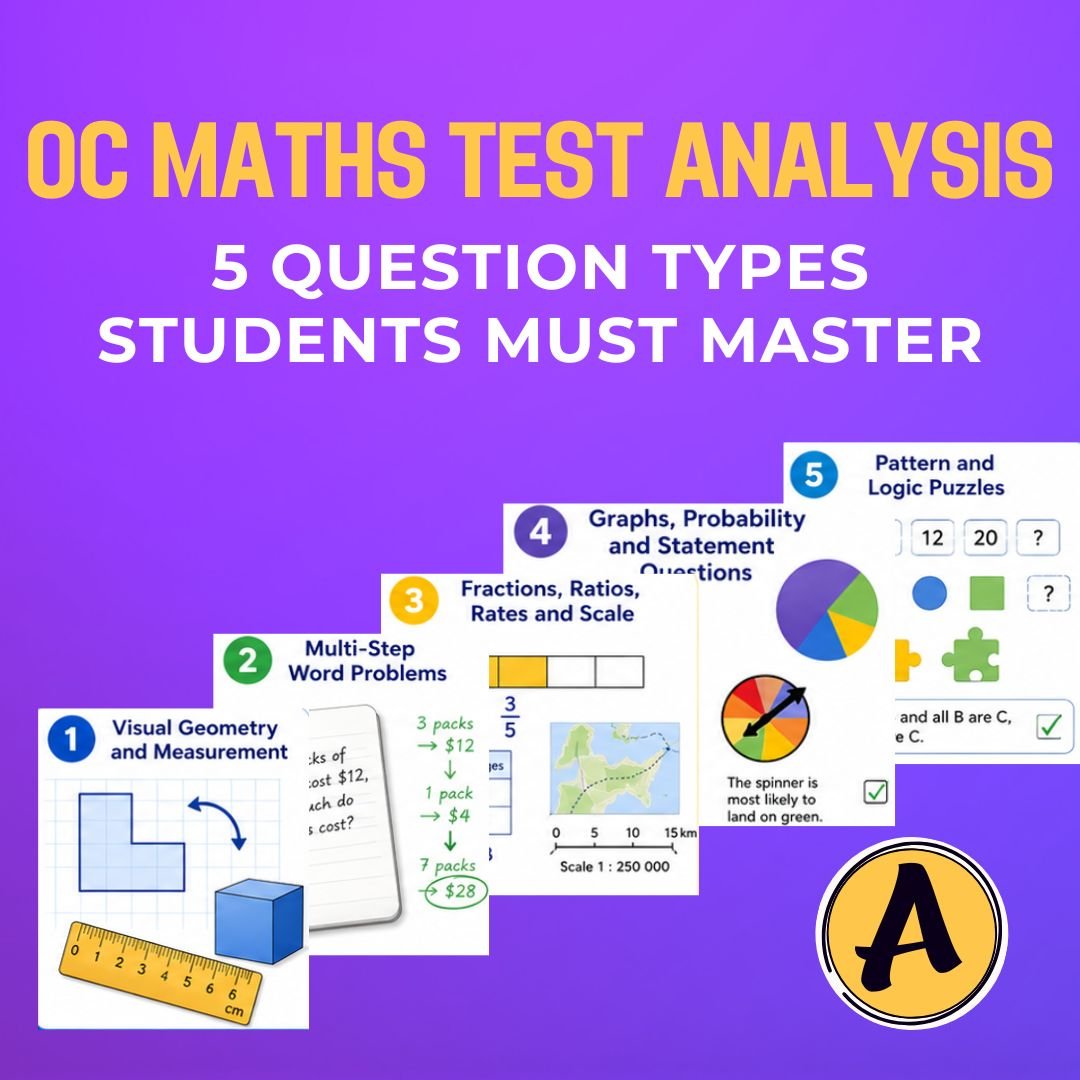
The 5 Main OC Maths Question Types
Based on the practice papers analysed, OC Mathematical Reasoning questions can be grouped into five major areas:
Visual geometry and measurement
Multi-step arithmetic word problems
Fractions, ratios, rates and scale
Graphs, probability and statement questions
Pattern and logic puzzles
Let’s go through each one in detail.
1. Visual Geometry and Measurement
This should be one of the biggest focus areas for OC maths preparation.
Many students spend too much time practising number questions, but not enough time practising diagrams. In the OC Mathematical Reasoning test, visual questions appear frequently and can be tricky.
These questions may include:
rotations
reflections
line symmetry
grid references
directions
maps
scale
area
perimeter
cube faces
3D views
folding and cutting shapes
volume using cubes
unusual measuring scales
These questions separate strong students from average students because they require careful visual thinking.
Example skills students need
A student may be asked to rotate a shape 90 degrees clockwise. This sounds simple, but many students accidentally reflect the shape instead of rotating it.
They may be asked to find a line of symmetry. Some shapes have one line of symmetry, some have more than one, and some have none.
They may be shown a stack of cubes and asked how many cubes are hidden. This requires the student to imagine the back or bottom layer, not just count what they can see.
They may be asked to read an unusual measuring scale where the numbers are not marked in simple intervals.
These are not just geometry questions. They are reasoning questions.
Why students lose marks here
Students often lose marks in visual geometry because they try to “see” the answer too quickly. They look at the diagram and guess.
This is risky.
A better method is:
Mark the important points.
Count squares carefully.
Draw the movement or reflection.
Label hidden sides or hidden cubes.
Check the answer against the diagram.
For example, in perimeter questions, students must remember:
Only count the outside edge.
If two squares or rectangles are joined together, the shared edge inside the shape is not part of the perimeter.
For cube questions, students should remember:
Each cube has 6 faces, but joined faces are hidden.
Every time two cubes touch, two faces are hidden.
What students should practise?
To improve in this area, students should practise:
rotating shapes on grids
reflecting shapes across mirror lines
finding missing shaded squares for symmetry
reading coordinates on grids
following north, south, east and west directions
using map scales
counting area using square units
finding perimeter of composite shapes
counting visible and hidden cube faces
matching front, side and top views of 3D solids
solving folding and cutting paper questions
converting units such as cm to m, mL to L and g to kg
This is a high-value area. A student who becomes strong in visual geometry and measurement can gain marks that many students miss.
2. Multi-Step Arithmetic Word Problems
Multi-step word problems are another major part of OC maths.
These questions are not difficult because the numbers are huge. They are difficult because the student must follow a story.
A common structure is:
Start amount → change → final amount
For example:
A bus has 42 people. Some people get off. Some people get on. At the next stop, the same thing happens again. How many people are on the bus now?
The maths may only involve addition and subtraction. But if the student rushes, they may mix up who got on and who got off.
Common OC-style word problem patterns
Students should practise word problems involving:
people getting on and off a bus
money spent and change received
points spent and earned in a game
books borrowed and returned
objects added and removed
sharing totals between people
time between two events
number of items from total cost
items packed into groups
leftovers after selling or using items
These questions test whether the student can organise information.
The Best method for word problems
Students should be trained to write a small working line.
For example:
Start: 38
Change: −6 + 9 −4 + 7
Final: 44
This is much safer than trying to solve the whole question mentally.
For money questions, students should write:
Start money − cost + money received = final money
For time questions, students should break the time into parts.
For example:
1:35 pm to 2:35 pm = 1 hour
2:35 pm to 3:20 pm = 45 minutes
Total = 1 hour 45 minutes
This method helps students avoid common time mistakes.
Why students lose marks in word problems
Students lose marks when they:
read too quickly
miss the word “left”
add when they should subtract
forget one step
do the first calculation correctly but answer the wrong final question
confuse total cost with change
confuse number of groups with number in each group
The final check is very important.
Students should always ask:
“Does my answer make sense in the story?”
If the question asks for money left, the answer should be less than the starting money unless more money was added.
If the question asks how many items were sold, the answer should be a number of items, not a dollar amount.
3. Fractions, Ratios, Rates and Scale
This is the area that often separates strong students from average students.
Many students can do simple fraction questions. But OC-style fraction and ratio questions usually require more reasoning.
They may involve:
fractions of shapes
equivalent fractions
fractions left after several steps
ratio sharing
rates per person
two people working together
map scale
unit conversion
These questions are very important because they connect number skills with reasoning skills.
Fraction of a shape
A common OC-style question may show a shape divided into equal parts and ask what fraction is shaded.
Students must check two things:
Are the parts equal?
How many total parts are there?
If a shape has 8 equal parts and 3 are shaded, the fraction shaded is:
3 out of 8
So the answer is 3/8.
This sounds easy, but students often rush and count the wrong number of parts.
Fractions left after several steps
These questions are more difficult.
For example:
A jug is full. Liam drinks 1/4 of the jug. His sister drinks 1/3 of the whole jug. What fraction is left?
The student must understand that both fractions are from the whole jug.
So the amount used is:
1/4 + 1/3
The common denominator is 12:
3/12 + 4/12 = 7/12
So the fraction left is:
12/12 − 7/12 = 5/12
The key is to use the same whole.
Students should draw a fraction bar when solving these questions.
Ratio sharing
Ratio questions are very common in selective-style and OC-style maths preparation.
A simple example:
Red and blue counters are in the ratio 2:3.
If there are 10 red counters, how many blue counters are there?
The ratio tells us:
Red = 2 parts
Blue = 3 parts
If 2 parts = 10 red counters, then 1 part = 5 counters.
So blue = 3 parts = 15 counters.
The best method is a ratio table:
| Colour | Parts | Amount |
|---|---|---|
| Red | 2 | 10 |
| Blue | 3 | 15 |
This makes the problem much easier to understand.
Rates
Rate questions test how much happens in a certain amount of time.
For example:
A baker packs 18 cupcakes in 6 minutes. How many cupcakes can the baker pack in 12 minutes?
First find the rate for 1 minute:
18 ÷ 6 = 3 cupcakes per minute
Then multiply by 12:
3 × 12 = 36 cupcakes
Students should learn to ask:
“What happens in 1 unit?”
This is the key to rate problems.
Two people working together
These questions can be tricky.
For example:
Mia can finish a job in 12 minutes. Leo can finish the same job in 12 minutes. If they work together, how long will it take?
If both work at the same speed, they complete the job twice as fast.
So the time is:
12 ÷ 2 = 6 minutes
Students should understand that two people working together does not mean you add the times. You combine their work rates.
Scale conversion
Scale questions often appear with maps or floor plans.
Example:
On a map, 1 cm represents 5 km. Two towns are 7 cm apart. What is the real distance?
If 1 cm = 5 km, then:
7 cm = 7 × 5 km = 35 km
Students should write the scale clearly before calculating.
Unit conversion
Students should know common conversions:
1000 mL = 1 L
1000 g = 1 kg
100 cm = 1 m
60 minutes = 1 hour
Unit conversion questions can be easy marks if students are careful. But they become tricky when mixed into a word problem.
For example:
A bag can hold 1.5 kg. Each box weighs 400 g. How many boxes fit?
Students must convert 1.5 kg to 1500 g before solving.
This is why units matter.
4. Graphs, Probability and Statement Questions
Graphs and probability questions can look easy, but they often contain traps.
Students need to slow down and check the details.
These questions may involve:
bar graphs
column graphs
picture graphs
missing graph scales
probability language
likely and unlikely events
statement checking
“which claims are correct?” questions
Graph questions
Students may be shown a bar graph and asked:
Which category has the most?
How many more?
What is the total?
Which statement is correct?
What is missing from the graph?
What does each symbol represent?
The first step is always:
Read the scale.
Some students look at the tallest bar and answer too quickly. But if the scale is unusual, they may misread the value.
For graph questions, students should use this method:
Read the title.
Read the axis labels.
Check the scale.
Write the values above the bars.
Answer the question carefully.
This small process can prevent many mistakes.
Picture graphs
Picture graphs can be tricky because one picture may not equal one item.
For example, one symbol might represent 4 votes. Half a symbol might represent 2 votes.
Students must always check the key.
A common mistake is counting symbols instead of converting them using the key.
Probability questions
Probability questions often use words such as:
certain
impossible
possible
more likely
less likely
equally likely
least likely
most likely
Students must understand these words clearly.
For example:
A bag has 4 red counters, 3 blue counters and 1 yellow counter.
The most likely colour is red because there are more red counters than any other colour.
The least likely colour is yellow because there is only 1 yellow counter.
If there are 4 red and 4 blue counters, then red and blue are equally likely.
Statement questions
These are very common in reasoning tests.
A question may give three statements and ask which are correct.
For example:
A class survey showed:
12 students walk
9 students come by car
6 students ride bikes
Which statement is correct?
A. More students ride bikes than come by car.
B. Walking is the most common travel method.
C. Car and bike are equally common.
Students must check each statement separately.
A is false because 6 is not more than 9.
B is true because 12 is the largest number.
C is false because 9 and 6 are not equal.
So the answer is B.
The best method is to write:
True or false?
True or false?
True or false?
Then choose the option.
Students should not guess from the answer choices first.
5. Pattern and Logic Puzzles
Pattern and logic questions are another important part of OC maths preparation.
These questions may include:
number sequences
shape patterns
repeated cycles
missing numbers
code puzzles
logic riddles
arrangement problems
“what comes next?” questions
These questions test flexible thinking.
Number patterns
A simple number pattern may be:
4, 7, 10, 13, __
The rule is +3 each time.
So the next number is 16.
But some patterns are more difficult.
For example:
3, 6, 12, 24, __
The rule is ×2 each time.
So the next number is 48.
Students should test the rule across the whole sequence, not just between the first two numbers.
Shape patterns
A repeated pattern may be:
triangle, square, circle, triangle, square, circle…
What is the 10th shape?
The pattern has 3 shapes.
Positions:
1 triangle
2 square
3 circle
4 triangle
5 square
6 circle
7 triangle
8 square
9 circle
10 triangle
So the 10th shape is triangle.
A faster method is to divide by the cycle length.
10 ÷ 3 = 3 remainder 1
Remainder 1 means the first shape in the pattern.
So the answer is triangle.
Logic puzzles
Logic puzzles require students to think carefully about words.
For example:
I am an odd number. Take away one letter and I become even. What number am I?
The answer is seven.
Seven is odd. If you remove the letter “s”, it becomes “even”.
These questions are not about calculation. They are about flexible thinking and reading carefully.
How Students Can Prepare for Full Marks
Getting full marks in OC Mathematical Reasoning is difficult, but students can improve a lot with the right preparation.
The goal is not to do hundreds of random questions. The goal is to practise the right question types and build strong habits.
Here are the habits strong students need.
1. Read the final question carefully
Before calculating, students should ask:
“What is the question actually asking me to find?”
Many students calculate something correctly but answer the wrong thing.
For example, a question may give total money spent but ask for change. Or it may give a graph and ask how many more, not how many altogether.
The final question matters.
2. Underline key words and numbers
Students should underline words such as:
total
left
altogether
difference
more than
less than
each
equally
per
after
before
smallest
greatest
not
These words tell the student what operation or reasoning is needed.
3. Draw quick diagrams
Strong students draw.
They do not try to hold everything in their head.
Useful diagrams include:
fraction bars
ratio tables
number lines
quick grids
small clocks
unit tables
cube sketches
tally marks
A quick diagram often saves time because it prevents confusion.
4. Use answer choices wisely
Because the OC maths questions are multiple choice, students can use the options to help.
They can:
eliminate impossible answers
estimate before calculating
test the answer in the question
check whether the units match
look for answers that are too small or too large
However, students should not rely only on guessing. The best approach is:
Solve first, then use the options to check.
5. Do not spend too long on one question
The test has 35 questions in 40 minutes, so students cannot afford to spend five minutes on one problem. (NSW Education)
A good strategy is:
answer easy questions first
circle hard questions
make a temporary guess if needed
return if time allows
never leave a question blank
The official practice paper instructions also say students will not lose marks for incorrect answers, so they should attempt all questions. (NSW Education)
This is very important. A blank answer has no chance. A sensible guess at least gives a chance.
Suggested OC Maths Study Plan
Here is a simple 4-week plan for students preparing for OC Mathematical Reasoning.
Week 1: Visual Geometry and Measurement
Practise:
rotations
reflections
symmetry
grid references
direction
map scales
area
perimeter
cubes
volume
measuring scales
Goal:
Build confidence with diagrams and visual reasoning.
Week 2: Word Problems and Number Reasoning
Practise:
start-change-final problems
money questions
time questions
bus and people problems
objects added and removed
sharing problems
total cost and change
number of items from total price
Goal:
Improve accuracy in multi-step questions.
Week 3: Fractions, Ratios, Rates and Scale
Practise:
fraction of a shape
equivalent fractions
fraction left
ratio sharing
rates
working together
map scale
unit conversion
Goal:
Build higher-level reasoning skills.
Week 4: Graphs, Probability, Patterns and Timed Practice
Practise:
bar graphs
picture graphs
probability language
statement questions
number patterns
shape patterns
logic puzzles
full timed practice papers
Goal:
Improve speed, accuracy and test confidence.
Common Mistakes Students Should Avoid
Here are the most common mistakes students make in OC Mathematical Reasoning.
Mistake 1: Rushing diagrams
Students often glance at a diagram and choose an answer too quickly.
Fix:
Mark the diagram. Count carefully. Use the grid.
Mistake 2: Forgetting one step in a word problem
A student may subtract the first amount but forget to add the second amount.
Fix:
Write every change in order.
Mistake 3: Mixing up ratio parts and actual numbers
If the ratio is 2:3, that does not always mean the numbers are 2 and 3. It means the quantities are in those parts.
Fix:
Use a ratio table.
Mistake 4: Misreading the graph scale
Students may assume each line means 1, when it may mean 2, 5 or 10.
Fix:
Check the axis before reading the bars.
Mistake 5: Not checking the units
A question may mix grams and kilograms, or millilitres and litres.
Fix:
Convert units before calculating.
Mistake 6: Leaving questions blank
There is no penalty for a wrong answer in the official practice paper instructions, so students should attempt every question. (NSW Education)
Fix:
Make a sensible guess if stuck and move on.
What Parents Can Do at Home
Parents do not need to teach advanced maths to help their child improve.
The most useful thing parents can do is help their child build calm problem-solving habits.
Try this:
Give your child 10 mixed OC-style questions.
Ask them to show working.
Ask them to explain why they chose the answer.
Review mistakes together.
Write each mistake into a “mistake log”.
Practise similar questions again later.
The mistake log is very powerful.
It may show patterns such as:
rushing graph questions
weak time calculations
confusion with fractions
poor understanding of ratio
difficulty with rotations
not reading the final question
Once the pattern is clear, preparation becomes much more targeted.
Final Thoughts: What Should Students Focus on First?
If your child is preparing for OC Mathematical Reasoning, the best approach is not to practise random maths every day.
The best approach is to focus on the question types that appear again and again.
The five key areas are:
Visual geometry and measurement
Multi-step arithmetic word problems
Fractions, ratios, rates and scale
Graphs, probability and statement questions
Pattern and logic puzzles
Out of these, visual geometry and measurement should receive special attention because many students do not practise it enough.
Strong OC students are not just fast calculators. They are careful thinkers.
They read the question properly.
They draw diagrams.
They check units.
They test answer choices.
They do not panic when the question looks unfamiliar.
That is the real goal of OC maths preparation.
At Aussie Math Tutor NSW, we help students build the maths skills, reasoning habits and confidence needed for NSW-style OC Mathematical Reasoning questions. With the right practice, students can move from guessing to thinking clearly and solving questions step by step.
Frequently Asked Questions about OC Maths Test
What is the OC Mathematical Reasoning test?
The OC Mathematical Reasoning test is part of the NSW Opportunity Class Placement Test. It assesses how well students can apply maths knowledge to unfamiliar problems. The test includes 35 multiple-choice questions in 40 minutes.
What topics are in OC Mathematical Reasoning?
Questions can come from different maths areas, including number, fractions, measurement, geometry, graphs, probability, patterns and logic. The focus is on reasoning, not just memorising formulas.
What is the hardest part of OC maths?
Many students find visual geometry, multi-step word problems, fractions, ratios and graph-based statement questions challenging because they require careful reading and reasoning.
How should my child prepare for OC maths?
Your child should practise OC-style questions, learn to draw quick diagrams, review mistakes, complete timed practice and focus on the main question types: visual geometry, word problems, fractions/ratios/rates, graphs/probability and patterns.
Is normal school maths enough for OC preparation?
School maths is important, but OC Mathematical Reasoning often requires deeper problem-solving. Students need to practise unfamiliar question styles and learn how to apply their knowledge quickly and accurately.
Should students guess if they are stuck?
Yes. The official practice paper instructions state that students do not lose marks for incorrect answers, so they should attempt every question