Trigonometry Practice Questions: NSW Year 9–10
This quiz covers the five main trigonometry skills students need for Year 9 and Year 10 maths practice. Each section has 10 questions with answers and working.
- Year 9: Right-Angled Triangles and SOH CAH TOA
- Year 9: The Law of Sines, also called the Sine Rule
- Year 10: The Cosine Rule
- Year 10: Area of a Triangle Using Trigonometry
- Year 10: The Four Quadrants and the CAST Rule
1. Right-Angled Triangles and SOH CAH TOA (Year 9)
2. The Law of Sines / Sine Rule (Year 9)
3. The Cosine Rule (Year 10)
4. Area of a Triangle Using Trigonometry (Year 10)
5. The Four Quadrants and CAST Rule (Year 10)
Trigonometry helps students connect angles and side lengths in triangles. In NSW high school maths, students usually begin with right-angled triangles and SOH CAH TOA, then move into the Sine Rule, Cosine Rule, area rule and the four quadrants using the CAST rule.
Trigonometry Topics Covered in This Article
This article explains the main trigonometry topics students commonly study across Year 9 and Year 10 in NSW.
- Year 9: Right-Angled Triangles and SOH CAH TOA
- Year 9: The Law of Sines, also called the Sine Rule
- Year 10: The Cosine Rule
- Year 10: Area of a Triangle Using Trigonometry
- Year 10: The Four Quadrants and the CAST Rule
1. Right-Angled Triangles and SOH CAH TOA (Year 9)
In Year 9 trigonometry, students usually begin with right-angled triangles. The main goal is to find a missing side or missing angle by choosing the correct trigonometric ratio.
A right-angled triangle has one angle of \(90^\circ\). The longest side is called the hypotenuse. The other two sides are labelled opposite and adjacent, depending on the angle being used.
SOH: \( \sin\theta = \frac{\text{Opposite}}{\text{Hypotenuse}} \)
CAH: \( \cos\theta = \frac{\text{Adjacent}}{\text{Hypotenuse}} \)
TOA: \( \tan\theta = \frac{\text{Opposite}}{\text{Adjacent}} \)
| Known sides | Ratio to use | Memory clue |
|---|---|---|
| Opposite and Hypotenuse | Sine | SOH |
| Adjacent and Hypotenuse | Cosine | CAH |
| Opposite and Adjacent | Tangent | TOA |
Find the missing side
A right-angled triangle has an angle of \(30^\circ\) and a hypotenuse of 10 cm. Find the side opposite the angle.
- Opposite and hypotenuse are involved, so use sine.
- \( \sin 30^\circ = \frac{\text{Opposite}}{10} \)
- \( 0.5 = \frac{\text{Opposite}}{10} \)
- \( \text{Opposite} = 5 \)
Find the missing angle
In a right-angled triangle, the opposite side is 6 m and the adjacent side is 8 m. Find the angle \( \theta \).
- Opposite and adjacent are involved, so use tangent.
- \( \tan\theta = \frac{6}{8} \)
- \( \theta = \tan^{-1}(0.75) \)
- \( \theta \approx 36.9^\circ \)
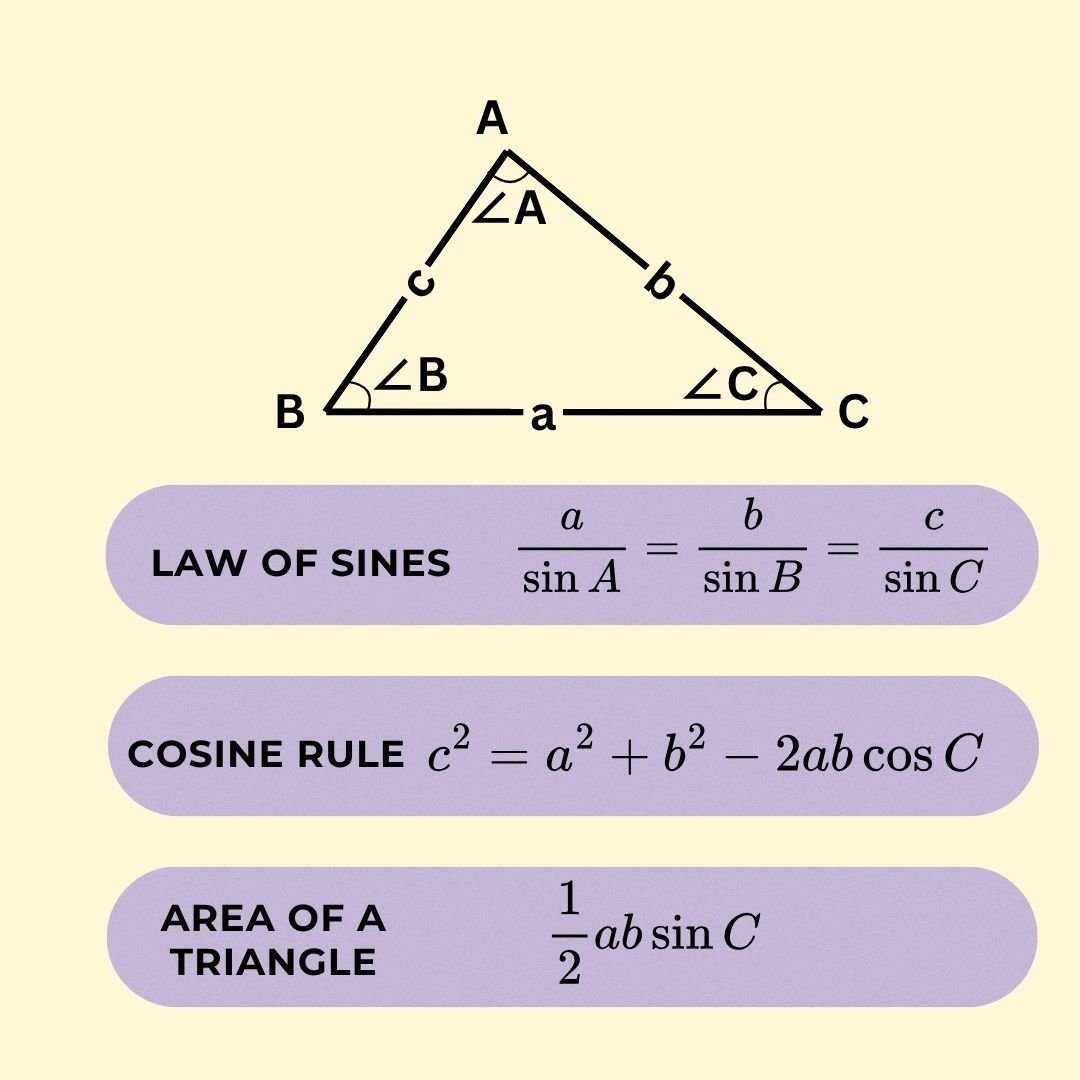
2. The Law of Sines (Sine Rule) (Year 9)
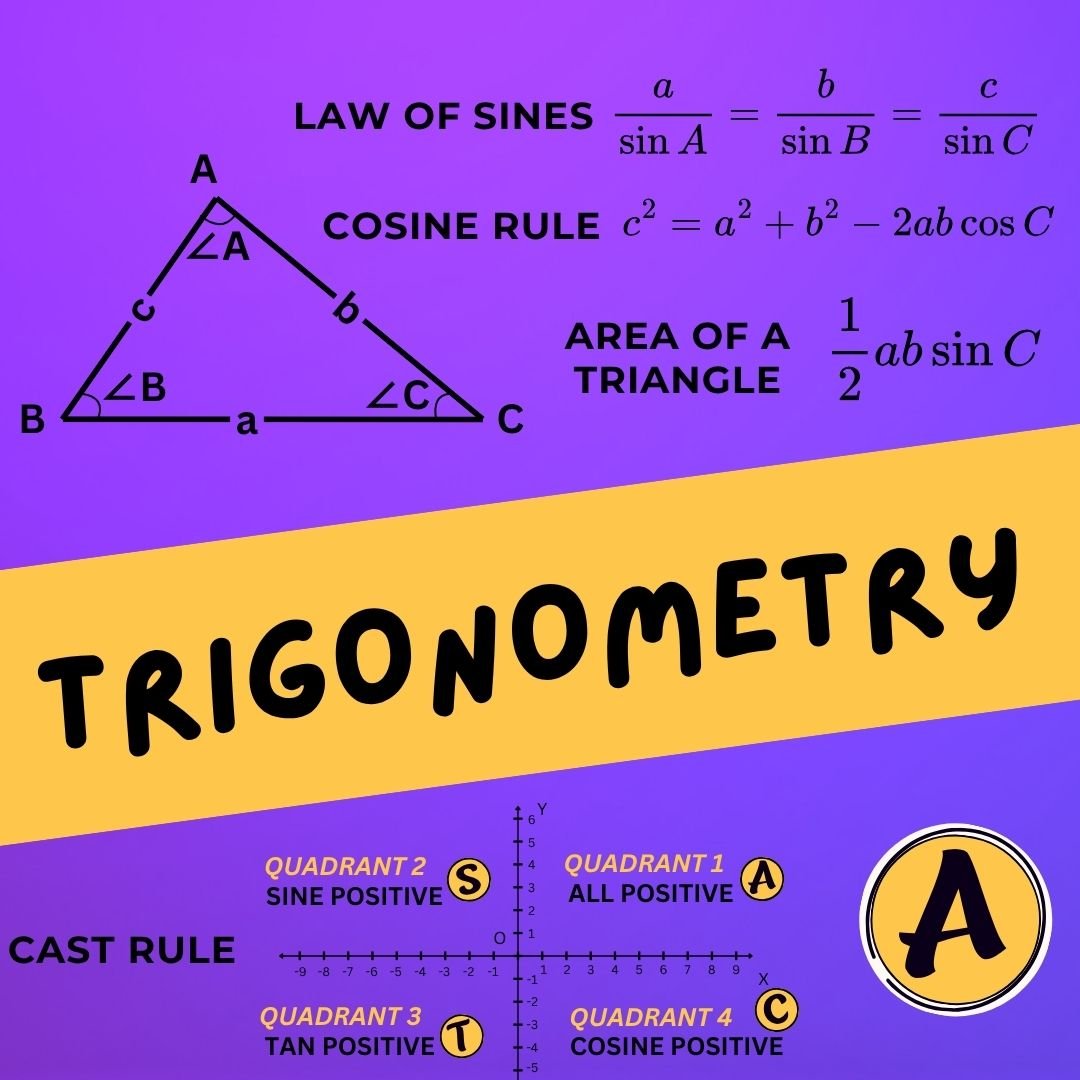
The Law of Sines, commonly called the Sine Rule, is used when a triangle does not have a right angle. SOH CAH TOA works directly for right-angled triangles, but the Sine Rule helps students solve some non-right-angled triangles.
Sine Rule: \( \frac{a}{\sin A} = \frac{b}{\sin B} = \frac{c}{\sin C} \)
Capital letters \(A\), \(B\), and \(C\) represent angles. Lowercase letters \(a\), \(b\), and \(c\) represent the sides opposite those angles.
- When two angles and one side are known.
- When two sides and a non-included angle are known.
- When a side can be matched with its opposite angle.
The most important step is matching each side with its opposite angle. Side \(a\) is opposite angle \(A\), side \(b\) is opposite angle \(B\), and side \(c\) is opposite angle \(C\).
Find a missing side using the Sine Rule
In triangle \(ABC\), \(A = 40^\circ\), \(B = 60^\circ\), and side \(a = 10\) cm. Find side \(b\).
- Match the side with its opposite angle: \(a \leftrightarrow A\), \(b \leftrightarrow B\).
- \( \frac{a}{\sin A} = \frac{b}{\sin B} \)
- \( \frac{10}{\sin 40^\circ} = \frac{b}{\sin 60^\circ} \)
- \( b = \frac{10\sin 60^\circ}{\sin 40^\circ} \)
- \( b \approx 13.47 \) cm
3. The Cosine Rule (Year 10)
The Cosine Rule is used for non-right-angled triangles when the Sine Rule is not suitable. It is especially useful when students know two sides and the included angle, or when all three sides are known.
Cosine Rule: \( c^2 = a^2 + b^2 - 2ab\cos C \)
If two sides and the angle between them are known, the Cosine Rule can be used to find the missing side.
If all three sides are known, the Cosine Rule can be rearranged to find a missing angle.
Find a missing side using the Cosine Rule
A triangle has sides \(a = 7\) cm and \(b = 9\) cm with an included angle \(C = 60^\circ\). Find side \(c\).
- \( c^2 = a^2 + b^2 - 2ab\cos C \)
- \( c^2 = 7^2 + 9^2 - 2(7)(9)\cos 60^\circ \)
- \( c^2 = 49 + 81 - 126(0.5) \)
- \( c^2 = 67 \)
- \( c = \sqrt{67} \approx 8.19 \)
4. Area of a Triangle Using Trigonometry (Year 10)
Students can also use trigonometry to find the area of a triangle when the perpendicular height is not given. This is useful when two sides and the included angle are known.
Area Rule: \( \text{Area} = \frac{1}{2}ab\sin C \)
In this formula, \(a\) and \(b\) are two known sides, and \(C\) is the angle between them. If the included angle is not given directly, students may need to find it first using another trigonometry rule.
Find the area using two sides and an included angle
A triangle has sides \(a = 8\) cm and \(b = 12\) cm with an included angle \(C = 45^\circ\). Find the area.
- \( \text{Area} = \frac{1}{2}ab\sin C \)
- \( \text{Area} = \frac{1}{2}(8)(12)\sin 45^\circ \)
- \( \text{Area} = 48 \times 0.7071 \)
- \( \text{Area} \approx 33.94 \)
5. The Four Quadrants (CAST) (Year 10)
In Year 10 trigonometry, students may extend their understanding beyond acute angles and begin working with angles across the full \(360^\circ\) plane. The CAST Rule helps students remember which trigonometric ratios are positive in each quadrant.
| Quadrant | Angle range | Positive ratio | CAST letter |
|---|---|---|---|
| Quadrant 1 | \(0^\circ\) to \(90^\circ\) | All ratios are positive | A |
| Quadrant 2 | \(90^\circ\) to \(180^\circ\) | Sine is positive | S |
| Quadrant 3 | \(180^\circ\) to \(270^\circ\) | Tangent is positive | T |
| Quadrant 4 | \(270^\circ\) to \(360^\circ\) | Cosine is positive | C |
This topic is important for questions involving quadrants, bearings, direction and angles greater than \(90^\circ\). For bearings, students should remember that directions are usually measured clockwise from north.
How to Study Trigonometry Effectively
The best way to improve in trigonometry is to practise one skill at a time. Students should first master SOH CAH TOA, then move to the Sine Rule, Cosine Rule, area rule and finally quadrant-based questions.
- Revise opposite, adjacent and hypotenuse.
- Practise choosing between sine, cosine and tangent.
- Use inverse trigonometry when finding angles.
- Learn when to use the Sine Rule and Cosine Rule.
- Practise area rule questions using two sides and an included angle.
- Use the CAST rule for quadrant questions.
For extra practice, visit our free maths worksheets, practice tests, and Year 10 Maths NSW syllabus guide.
Need Help with Trigonometry?
If your child is struggling with SOH CAH TOA, the Sine Rule, Cosine Rule, area rule, bearings or the CAST Rule, Aussie Math Tutor NSW can help build confidence with clear explanations and targeted practice.
Book a Maths Tutoring SessionReferences and Useful Links
Navigating Trigonometry in the NSW NESA Syllabus
Understanding the exact expectations of the NESA mathematics syllabus can sometimes be overwhelming. In NSW, trigonometry is introduced and expanded upon during Stage 5, which spans Year 9 and Year 10. However, the exact topics a student will face depend heavily on their year level and their specific mathematical pathway.
Year 9 vs. Year 10: What is the Difference?
Generally, Year 9 students focus on building a rock-solid foundation. The curriculum introduces basic trigonometric ratios strictly within right-angled triangles. Students spend their time mastering SOH CAH TOA, finding missing sides and angles, and applying these skills to simple word problems. While some schools may introduce the Sine Rule early, Year 9 students typically do not need to know advanced formulas like the Cosine Rule unless they are in an accelerated class.
In Year 10, the training wheels come off. The syllabus extends into complex, non-right-angled triangles and advanced problem-solving. Students must master the Sine Rule, the Cosine Rule, the area of a triangle using trigonometry, navigational bearings, and the CAST Rule for analyzing angles across the full 360-degree plane.
Stage 5.2 vs. Stage 5.3 Mathematics Pathways
In NSW schools, Stage 5 math is split into different pathways that dictate the difficulty of the trigonometry taught:
Stage 5.2 Trigonometry: This pathway is highly practical. It focuses on using trigonometric ratios to solve standard, real-world problems, primarily sticking to right-angled triangles.
Stage 5.3 Trigonometry: This is the advanced pathway, crucial for students planning to take higher-level mathematics in Years 11 and 12. Stage 5.3 students tackle non-right-angled geometry, exact values, 3D trigonometry, and quadrant-based calculations.
Mastering the Core Trigonometric Rules
To succeed in high school exams, students must know exactly when and how to apply specific trigonometric rules.
SOH CAH TOA
SOH CAH TOA is the ultimate memory trick for solving right-angled triangles. It tells students exactly which ratio to use based on the information provided in the question
The golden rule of SOH CAH TOA is that it only works directly in right-angled triangles. If the question gives you the hypotenuse and asks for the opposite side, you use Sine. If it gives you the opposite and adjacent sides and asks for an angle, you use the inverse Tangent.
Moving Beyond 90 Degrees: The CAST Rule
In Year 10, trigonometry no longer stops at 90°. Students must calculate angles across a full 360° Cartesian plane. This is where the CAST Rule becomes essential. It dictates which trigonometric ratios are positive in each of the four quadrants:
Understanding CAST prevents major exam mistakes. For example, many students panic when their calculator gives them a negative cosine value and assume their working out is wrong. However, a negative cosine is perfectly normal! While cos60° is positive (Quadrant 1), cos120° is negative because 120° falls into Quadrant 2, where only Sine is positive.
The Biggest Hurdle: Navigational Bearings
Ask any high school student in NSW what the hardest part of trigonometry is, and they will likely say bearings.
Many students struggle with bearings because they confuse them with standard trigonometric angles. A standard angle is measured anti-clockwise from the horizontal x-axis. A bearing, however, is always measured clockwise from True North. This single difference causes massive confusion when students attempt to draw their diagrams.
Furthermore, bearing questions are essentially “boss fights” that test multiple skills at once. To solve a single bearings question, a student might need to combine:
Navigational direction (North, South, East, West)
Alternate and co-interior angles (parallel line rules)
Right-angled triangle analysis (SOH CAH TOA)
The Sine Rule or Cosine Rule
Our top tutoring tip: Never try to solve a bearings question in your head. Always draw a large, clear diagram first. Mark True North, sketch the bearing angle, and isolate the specific triangle you need to solve the problem.
Frequently Asked Questions about BODMAS
What trigonometry topics are covered in Year 9 and Year 10 as per the NSW NESA syllabus?
In NSW, trigonometry is usually taught across Stage 5, which commonly covers Year 9 and Year 10. The exact order can vary depending on the school, class level and whether the student is studying a Core, Standard, 5.2 or 5.3 pathway.
Generally, Year 9 students begin with the basic trigonometric ratios in right-angled triangles. This includes SOH CAH TOA, finding missing sides, finding missing angles, and applying trigonometry to simple word problems. Many students are also introduced to the Sine Rule for non-right-angled triangles.
In Year 10, students usually extend their knowledge to more advanced trigonometry topics such as the Cosine Rule, area of a triangle using trigonometry, bearings, and the CAST Rule for angles in the four quadrants.
The safest way to understand the NSW approach is that trigonometry develops from basic right-angled triangles into non-right-angled triangles, bearings and quadrant-based problems.
Do Year 9 students in NSW need to know the Cosine Rule?
It depends on the school and the class pathway. In many NSW schools, the Cosine Rule is taught more commonly in Year 10, especially when students are working with non-right-angled triangles.
However, some advanced Year 9 classes may introduce the Cosine Rule earlier, especially if the students are studying at a higher level or preparing for accelerated maths pathways.
For most Year 9 students, the main focus should be on:
- SOH CAH TOA
- right-angled triangle problems
- finding missing sides and angles
- basic applications of trigonometry
- the Sine Rule, if taught by the school
So, generally, Year 9 students do not need to master the Cosine Rule unless their school has specifically included it in their program.
What is the difference between Stage 5.2 and Stage 5.3 trigonometry in NSW?
In NSW, Stage 5 maths is usually studied across Year 9 and Year 10. Stage 5.2 and Stage 5.3 refer to different levels of depth and difficulty.
Stage 5.2 trigonometry usually focuses on using trigonometric ratios to solve practical problems, especially with right-angled triangles and standard applications.
Stage 5.3 trigonometry is more advanced. Students may work with more complex non-right-angled triangles, the Sine Rule, Cosine Rule, area rule, bearings, exact values, and quadrant-based trigonometry. Stage 5.3 is often important for students who want to continue into higher-level mathematics in Years 11 and 12.
A simple way to understand it is this: Stage 5.2 builds strong trigonometry skills, while Stage 5.3 extends those skills into more advanced problem-solving and preparation for senior maths.
When should I use SOH CAH TOA?
SOH CAH TOA is a memory trick used for trigonometry in right-angled triangles.
Students should use SOH CAH TOA when the triangle has a right angle and they need to find a missing side or a missing angle.
For example, if the question gives an angle and the hypotenuse, and asks for the opposite side, students should use sine. If the question gives the opposite and adjacent sides and asks for an angle, students should use tangent and inverse tan.
The most important rule is: SOH CAH TOA only works directly in right-angled triangles.
Why is the CAST Rule important in trigonometry?
The CAST Rule is important because trigonometry does not stop at angles between 0° and 90° In Year 10 and higher-level maths, students often work with angles across the full 360° plane.
The CAST Rule helps students remember which trigonometric ratios are positive in each quadrant:
- Quadrant 1: All are positive
- Quadrant 2: Sine is positive
- Quadrant 3: Tangent is positive
- Quadrant 4: Cosine is positive
This matters because values such as sin, cos and tan are based on acute reference angles, but the final answer may be positive or negative depending on the quadrant.
For example, cos 60° is positive, but cos 120° is negative because 120° is in Quadrant 2, where cosine is negative.
Knowing the CAST Rule helps students understand signs, reference angles and exact trigonometric values without relying only on a calculator.
Why do high school students struggle with bearings in trigonometry, especially in NSW schools?
Many students struggle with bearings because they confuse bearings with normal trigonometric angles.
- A standard trigonometric angle is usually measured anticlockwise from the positive x-axis.
- A bearing, however, is measured clockwise from north.
This difference can confuse students when they are trying to draw diagrams or decide which angle belongs inside the triangle.
Students also struggle because bearing questions often combine several skills at once, including:
- direction
- angle facts
- parallel lines
- right-angled triangles
- SOH CAH TOA
- Sine Rule or Cosine Rule
- worded problem interpretation
The best way to solve bearings questions is to draw a clear diagram first, mark north carefully, write the bearing angle, and then identify the triangle needed to solve the problem.
Does a negative cosine value mean my answer is wrong?
No. A negative cosine value does not mean the answer is wrong.
Cosine is positive in Quadrant 1 and Quadrant 4, but it is negative in Quadrant 2 and Quadrant 3.
For example:
cos 60° is positive because 60° is in Quadrant 1.
cos 120° is negative because 120° is in Quadrant 2.
So if a cosine value is negative, students should not automatically assume they made a mistake. They should check which quadrant the angle is in and apply the CAST Rule.