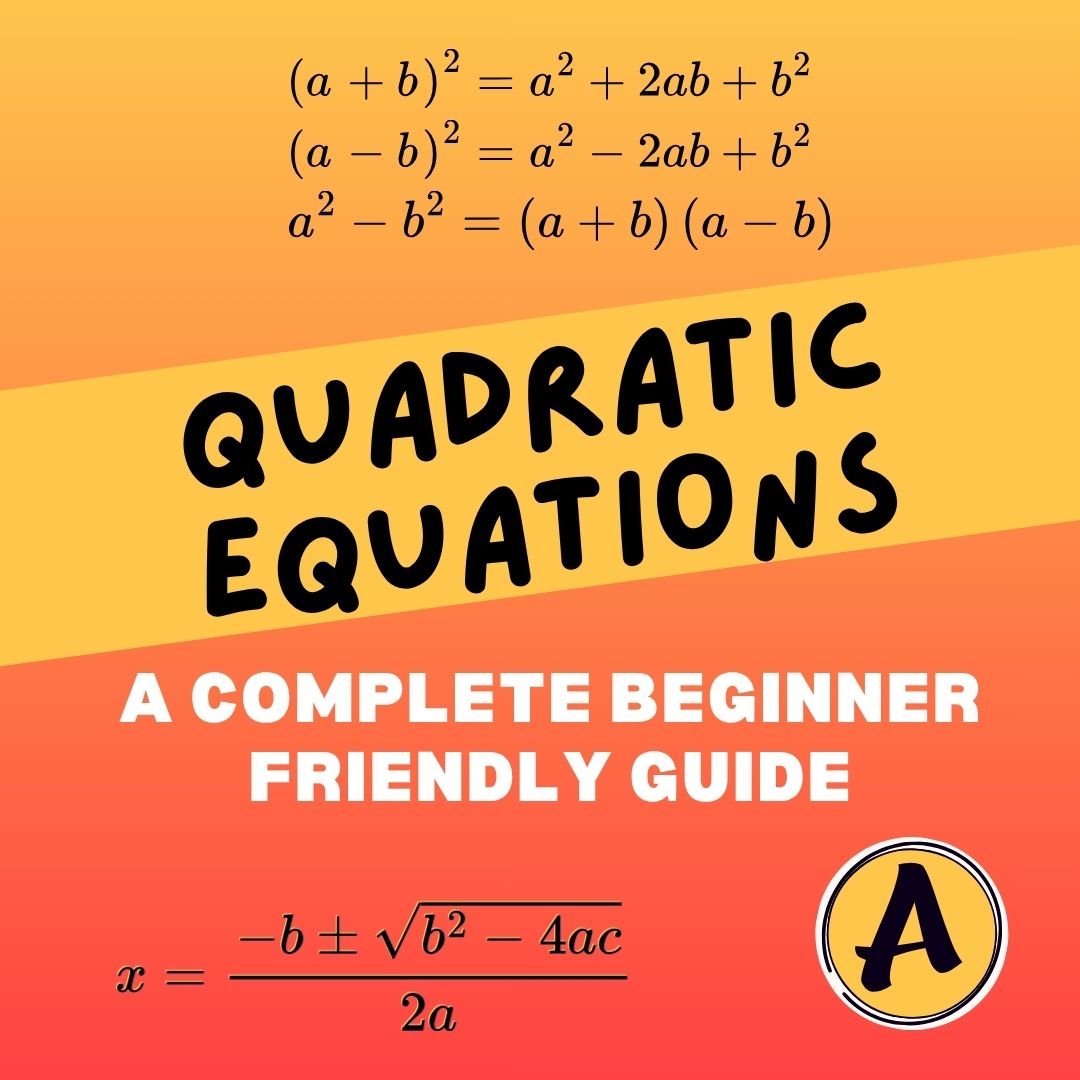
Quadratic Equations Practice Questions
Develop your quadratic-equation skills across five focused sections. Each section contains 10 questions with instant checking, helpful hints and complete step-by-step working.
- Number of solutions: identify whether an equation has zero, one or two distinct real roots
- Factorisation: solve quadratic equations using factors and the zero-product property
- Quadratic formula: substitute the values of a, b and c accurately
- Discriminant: calculate D = b² − 4ac and interpret the result
- Completing the square: rewrite a quadratic as a perfect square and solve
- 5 progressive levels
- 50 practice questions
- Instant answer checks
- Hints and full working
Equivalent root orders and common fraction or decimal forms are accepted. Your answers and checked results are saved automatically in this browser.
Level 1
Simple Quadratic Equations: Number of Solutions
10 questions · Foundation
0/10
Level 2
Solving Quadratic Equations by Factorisation
10 questions · Factorising
0/10
Level 3
Using the Quadratic Formula
10 questions · Formula method
0/10
Level 4
Understanding the Discriminant
10 questions · Number of roots
0/10
Level 5
Solving by Completing the Square
10 questions · Algebraic technique
0/10
How to Solve Quadratic Equations
A quadratic equation can be solved using factorisation, the quadratic formula, completing the square, or by analysing the graph. As per NESA syllabus, expansion and factorisation are usually introduced first, while the quadratic formula and discriminant become more important in later Stage 5 work.In this article, we will cover:
- What is a quadratic equation?
- The standard form of a quadratic equation
- Simple quadratic equations
- The number of solutions in a quadratic equation
- Solving quadratic equations by factorisation
- Using the quadratic formula
- Understanding the discriminant
- Solving quadratic equations by completing the square
However, The syllabus pathway can vary from school to school.
What is a Quadratic Equation?
A quadratic equation is an algebraic equation where the highest power of the pronumeral, usually x, is 2. When a quadratic relation is plotted on a graph, it forms a Parabola.
The Standard Form of a Quadratic Equation
The standard form of a quadratic equation is:
ax² + bx + c = 0, where a ≠ 0
The value of a cannot be 0 because the ax² term would disappear, and the equation would become linear, not quadratic.
Number of Solutions for a Quadratic Equation
The most simple quadratic equation is in the form of: x² = c.
To solve for x, we take the square root of both sides. Because squaring a negative number gives a positive result, we must account for both positive and negative possibilities: x = +√c or -√c
The number of solutions for x depends entirely on the value of c:
If c is positive (c > 0): x has 2 real solutions. (For example, if x² = 16, then x = 4 or x = -4).
If c is zero (c = 0): x has 1 real solution. x² = 0, then x = 0
If c is negative (c < 0): x has no real solutions. This is because no real number multiplied by itself will give a negative result (you cannot take the square root of a negative number).
| Equation | Number of Solutions | Example |
|---|---|---|
| x² = c, where c > 0 | 2 solutions | x² = 16, hence x = ±4 |
| x² = 0 | 1 solution | x = 0 |
| x² = c, where c < 0 | No real solution | x² = -9; √-9 is not real |
Expanding brackets in quadratic equations
If there is an equation where you have to expand the terms : (a+b)(c+d)
Multiply every term in the first bracket by every term in the second bracket.
For example:
(a+b)(c+d) becomes: ac + ad + bc + bd
Hence, in the case of quadratics:
(x+a)(x+b)=x² + ax+ bx + ab
Factorisation Method
The factorisation method is used when the quadratic expression can be factored easily.
Steps:
- Convert the equation into standard form.
- Split the middle term b into two numbers whose sum is b and product is a × c.
- Factor the quadratic.
- Set each factor equal to zero.
- Solve for x.
Example: Solve x² − 5x + 6 = 0
x² − 5x + 6 = 0
Here, a = 1, b = -5 and c = 6.
We need two numbers whose sum is -5 and whose product is 6.
The numbers are -3 and -2.
x² − 5x + 6 = 0
x² − 3x − 2x + 6 = 0
x(x − 3) − 2(x − 3) = 0
(x − 3)(x − 2) = 0
Therefore, either:
x − 3 = 0 or x − 2 = 0
Therefore:
x = 3 or x = 2
If a quadratic equation cannot be factorised easily using integers, then use Completing the Squares Method.
The Quadratic Formula(Universal Method)
The quadratic formula is a universal method because it can be used to solve any quadratic equation.
The formula is:
x = (-b ± √(b² − 4ac)) / 2a
This means:
x₁ = (-b + √(b² − 4ac)) / 2a
and
x₂ = (-b − √(b² − 4ac)) / 2a
Once you know the roots, the quadratic can be written as:
a(x − x₁)(x − x₂) = 0
The Discriminant in Quadratic Equations
The discriminant tells us how many real solutions a quadratic equation has.
D = b² − 4ac
- If D > 0, there are two real solutions.
- If D = 0, there is one real solution or equal roots.
- If D < 0, there are no real solutions.
Completing the Square
Completing the square is used when a quadratic equation cannot be factorised easily using integers.
Steps:
- Make the coefficient of x² equal to 1.
- Move the constant to the other side.
- Take half of the coefficient of x and square it: (b/2)².
- Add this number to both sides.
- Write the left side as a perfect square.
- Take the square root of both sides and solve for x.
Example: Solve x² + 6x + 5 = 0
Step 1: Move the constant to the other side
x² + 6x = -5
Step 2: Take half of 6 and square it
(6/2)² = 3² = 9
Step 3: Add 9 to both sides
x² + 6x + 9 = -5 + 9
Step 4: Write the left side as a square
(x + 3)² = 4
Step 5: Take the square root of both sides
x + 3 = ±2
Step 6: Solve for x
x = -3 ± 2
Therefore:
x = -1 or x = -5
Final Answer: x = -1 or x = -5
Best Books and Resources for Learning Quadratic Equations (NSW Syllabus)
Having the right study materials can make all the difference when mastering algebra. For NSW students in Years 7 to 10, here are the best textbooks and online resources we recommend for tackling quadratic equations:
- The Top Recommendation: Cambridge Mathematics Textbooks
For comprehensive coverage of the NESA syllabus, the Cambridge Mathematics series is widely considered the gold standard. Their explanations of factorisation and parabolas are clear, and they provide an excellent range of practice questions from foundational to advanced levels. - Alternative High-Quality Textbooks
If your school uses different materials, the ICE-EM Mathematics books and Jacaranda publications are also fantastic choices. Both series do a great job of breaking down complex algebraic steps into manageable chunks for high school students. - Online Practice Platforms
For digital learning, Class Mathematics is a highly relevant online resource tailored specifically to the Australian curriculum. It offers great interactive materials to help students visualise and practice quadratics. - Aussie Math Tutor NSW Material
Sometimes, textbooks can be overwhelming. If you want something that cuts straight to the point, students can use the official Aussie Math Tutor NSW study notes. Our notes are designed to be precise, concise, and focused exactly on what you need to know to ace your exams without the unnecessary fluff.
What Should Students Know Before Solving Quadratic Equations?
Before solving quadratic equations, students should be confident with square numbers and square roots, positive and negative numbers, expanding brackets, collecting like terms, simplifying algebraic expressions, and basic factorisation. These foundation skills help students understand why methods such as factorisation, the quadratic formula, completing the square, and parabola graphs work, instead of simply memorising steps.
Navigating Quadratic Equations in the NSW Mathematics Syllabus
Understanding how to solve quadratic equations is a core component of high school mathematics in Australia. However, students are not expected to learn everything at once. The NSW NESA syllabus introduces these concepts gradually, allowing students to build their confidence year by year.
Please note: The exact timing of when quadratic equations are introduced can vary between schools, classes and learning programs.
Early High School: Years 7 and Year 8 Basics
For students in NSW Year 7, the focus remains on foundational algebra; quadratic equations are not yet part of the curriculum. The introduction begins in Year 8, where students tackle simple quadratic basics. At this stage, they are presented with elementary equations such as x² = 16. The primary goal for Year 8 students is to analyze these basic equations and determine the number of possible outcomes: identifying whether the equation has one solution, two solutions, or no real solutions.
Year 9 Maths: Building the Foundations
As students move into Year 9, the difficulty naturally scales up. Year 9 students generally do not use the universal quadratic formula. Instead, they focus heavily on learning the basics of factorisation methods and the expansion of brackets. Mastering these two skills is critical, as they form the building blocks for senior mathematics.
Year 10 Stage 5 NESA Syllabus: Advanced Problem Solving
For Year 10 NSW students studying the Stage 5 Mathematics NESA syllabus, quadratics become a major focus. At this level, students must know how to solve complex quadratic equations using three primary methods: advanced factorisation, completing the square, and applying the universal quadratic formula. Furthermore, Year 10 exams frequently mix algebra with geometry by introducing parabolas, requiring students to understand that all parabolic graphs are directly derived from quadratic equations.
Choosing the Best Method to Solve a Quadratic Equation
The easiest and fastest way to solve a quadratic equation is usually by factorisation. However, not all quadratic equations can be factorised using simple whole numbers. When factorisation is not possible, students can use the completing the square method, which is particularly useful when preparing to graph the vertex of a parabola.
However, the most highly advised fallback is the universal quadratic formula, which works for every quadratic equation.
Understanding the Discriminant and “No Solutions”
Sometimes, a quadratic equation simply cannot be solved with real numbers. To identify this, students use the discriminant (b² – 4ac). If the discriminant yields a negative number, the equation has no real solutions. Visually, in terms of a graph, a quadratic with no solutions translates to a parabola that never intercepts the x-axis.
Where Do NSW Students Struggle the Most?
According to our tutoring experience across the NESA mathematics syllabus, high school students generally face two major hurdles when learning quadratics:
Grasping Factorisation: Many students find it incredibly frustrating to find the correct pair of numbers needed to split the middle term. Even when they successfully find the factors, completing the subsequent algebraic steps to fully factorise the expression often leads to simple arithmetic errors.
Expanding Binomial Brackets: While students are usually comfortable with simple, linear algebra, moving to quadratic expansion is a leap. Multiplying two pairs of brackets together—such as (a+b)(c+d) or (x+a)(x+b)—requires a strict adherence to the FOIL method (First, Outer, Inner, Last), which can be highly confusing to grasp at first.
Frequently Asked Questions about How to Solve Quadratic Equations
What is the easiest way to solve a quadratic equation?
The easiest way to solve a quadratic equation is by the way of factorisation. However, in all cases, the factorisation method is not possible. In that case, it is advised that a student uses the universal method using the quadratic formula. Another option is to use the completing the square method.
For Year 9 students in NSW, what do they have to study for the exams?
For a Year 9 student, generally, they will be focusing on the expansion of brackets in quadratic equations and factorisation methods. Year 9 NSW students generally don’t use the universal formula method yet, as they are just learning the basics.
What questions do Year 8 students face for quadratic equations?
Year 8 students deal with the simple basics of quadratic equations. They will be facing equations such as x² = 16, and then they have to give answers determining whether it has one solution, two solutions, or no solutions. That is the main thing Year 8 students do.
What do Year 10 NSW students studying the Stage 5 Mathematics NESA syllabus have to do for quadratic equations?
Year 10 NSW students studying the Stage 5 Mathematics NESA syllabus have to solve quadratic equations by using factorisation, and by using completing the square. In some questions, they will also have to deal with the universal formula method. These are the three main things. The questions will also be mixed fairly with parabolas because all parabolas are derived from quadratic equations.
What quadratic concepts are covered across Years 7 to 10 NSW NESA syllabus?
For NSW NESA syllabus, Year 7 students do not have any topics related to quadratic equations. Year 8 students have to deal with basic quadratics, which is identifying no solution, one solution, or two solutions. Year 9 students have to deal with factorisation and the expansion of brackets. Finally, Year 10 covers the advanced topics based on quadratic equations that we discussed above.
Can all quadratic equations be solved by factorisation?
No, there are a lot of equations where you won’t be able to use factorisation.
When are there no solutions for a quadratic equation?
In this case, we will be using the discriminant to see if it has any real solutions or no solutions. In terms of a graph, a quadratic with no solutions is basically a parabola which doesn’t intercept the x-axis at all.
What parts of quadratic equations do NSW students struggle with the most?
High school students studying the NESA mathematics syllabus generally face two major hurdles when learning quadratic equations:
Grasping Factorisation: Many students struggle to find the correct numbers needed to split the middle term. Even after finding the factors, they often find it difficult to complete the algebraic steps required to fully factorise the expression.
Expanding Binomial Brackets: While students are usually comfortable with simple, linear expansions in early algebra, they often trip up when moving to quadratic expansion. Multiplying two pairs of brackets together—such as (a+b)(c+d) or (x+a)(x+b)—requires a strong grasp of the FOIL method, which can be confusing at first.