Aussie Math Tutor NSW Free Tutor Assessment

Logarithms Made Super Easy (With Formulae & a Confidence-Boosting Test!)

Logarithms are essential for students due to their foundational role in higher mathematics, their ability to simplify complex calculations, and their widespread applications in science, technology, and problem-solving. Get easy-to-understand theory, Formulae, and Interactive Exam-Style Questions with Instant Scoring and Detailed Explanations.
Logarithms Made Super Easy (With Formulae & a Confidence-Boosting Test!)

Table of Contents

What are Logarithms?

Logarithms trying to find out the power you have to raise to get figure out another number.

Logarithm Formulae and Practice Questions

Logarithm Formulae and Practice Questions

The main Logarithm Formula is:

If \(b^x = n\), then \(\log_{b}(n) = x\)


Common Logarithm Formulas:

  • \(\log_{b}(1) = 0\)
  • \(\log_{b}(b) = 1\)
  • \(\log_{b}(xy) = \log_{b}(x) + \log_{b}(y)\)
  • \(\log_{b}(x/y) = \log_{b}(x) - \log_{b}(y)\)
  • \(\log_{b}(x^n) = n \log_{b}(x)\)
  • \(\log_{b}(a) = \frac{\log_{c}(a)}{\log_{c}(b)}\)


Logarithm Quiz

To write the answers, Use logb(x^n), sqrt for √, +- for ±.
1. Solve for \(x\) :

a) \(\log_{4}(x) = 2\)

\(\log_{4}(x) = 2 \implies x = 16\)

b) \(\log_{5}(x) = 3\)

\(\log_{5}(x) = 3 \implies x = 125\)

2. Evaluate:

a) \(\log_{2}(16)\)

4

b) \(\log_{3}(81)\)

4

3. Simplify:

a) \(\log_{5}(25)\)

2

b) \(\log_{2}\bigl(\tfrac{1}{8}\bigr)\)

-3

4. Change of base:

a) \(\log_{4}(16)\)

2

b) \(\log_{6}(36)\)

2

5. Solve:

a) \(\log_{3}(x) = 1 + \log_{3}(27)\)

81

b) \(\log_{2}(2x) = 3\)

4

6. Expand:

a) \(\log_{7}(x^2 y)\)

2*log7(x) + log7(y)

b) \(\log_{2}\bigl(\tfrac{x}{y^3}\bigr)\)

log2(x) - 3*log2(y)

7. Condense:

a) \(3\log_{2}(x) - \log_{2}(y)\)

log2(x^3/y)

b) \(\tfrac12\log_{3}(x) + \log_{3}(y)\)

log3(sqrt(x)) + log3(y)

8. Solve:

a) \(\log_{4}(x-1)+\log_{4}(x+1)=2\)

+-sqrt(17)

b) \(\log_{3}(x+2)-\log_{3}(x-2)=2\)

2.5

9. Evaluate:

a) \(\log_{5}(125)\)

3

b) \(\log_{3}(27)\)

3

10. Solve:

a) \(\log_{2}(x)+\log_{2}(x-2)=3\)

4

b) \(\log_{3}(x^2-4)=2\)

+-sqrt(13)
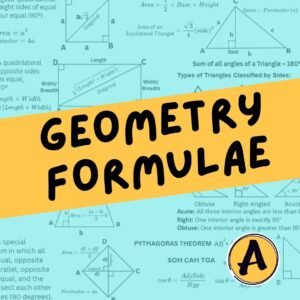
Geometry formulae poster showing and circles, triangles and quadrilaterals formulae

Geometry Formulae for 2D Shapes: Area Formulas & Practice

All Squares, Rectangles, Rhombuses are Parallelograms. Hence,
Area of a Parallelogram, Rhombus, Rectangle & Square = Base × Perpendicular height

Area of a Rhombus, Square and Kite = ½ × d₁ × d₂

A triangle can be thought of as half of a parallelogram. Therefore:
Area of a Triangle = ½ × Base × Perpendicular Height

For a trapezium, we take the average of the two parallel sides and multiply it by the perpendicular height:
Area of a Trapezium = ½ × (a + b) × h

Area of a Circle = πr²

Read More »

Let's help your child with maths

Tell us what your child needs help with. We'll be in touch.