
✅ Indices — Easy
⚡ Indices — Medium
🔥 Indices — Hard
Indices Laws Explained: Easy Theory with Clear Examples
What are Indices in Math?
In mathematics, an index (the plural is indices) indicates how many times a base number is multiplied by itself. It’s written as a superscript to the right of the base number.
For example, in the expression 24, ‘2’ is the base and ‘4’ is the index (or exponent or power). This means you multiply 2 by itself 4 times: 24=2×2×2×2=16.
Indices make maths faster, cleaner, and easier, especially when numbers and variables get large.
Why Do Students Learn Indices?
Indices are a key part of Year 8 algebra because they help students:
- Simplify algebraic expressions
- Work efficiently with large numbers
- Prepare for advanced maths and science
- Avoid long, messy calculations
Once indices are understood properly, many algebra topics become much easier.
The Laws of Indices (Rules You Must Remember)
1. Multiplying Powers with the Same Base
Add the indices
When multiplying powers with the same base:
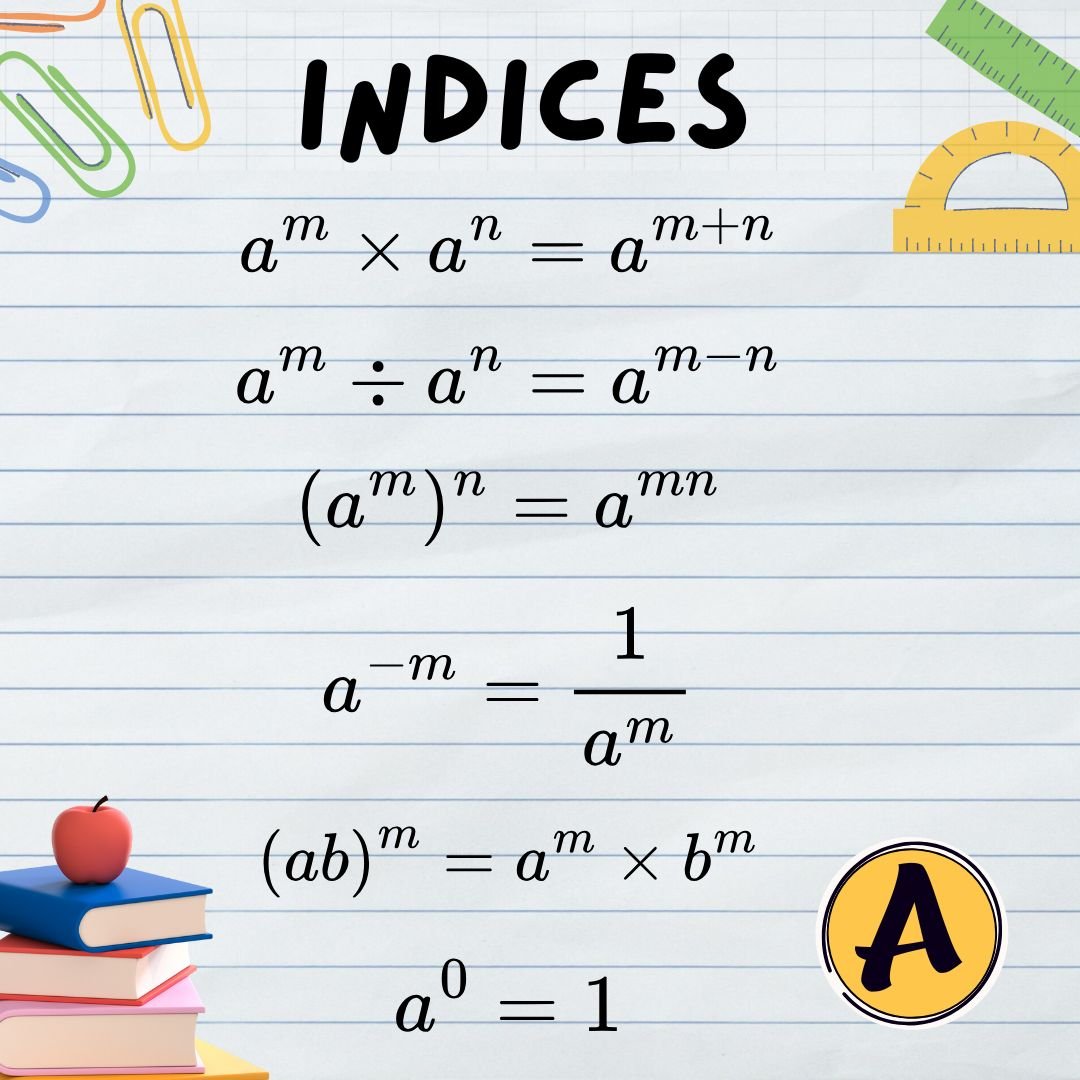
am × an = am+n
Example:
23 × 24 = 27
📌 Same base → ADD the powers
2. Dividing Powers with the Same Base
Subtract the indices
When dividing powers with the same base:
am ÷ an = am−n
Example:
57 ÷ 53 = 54
📌 Same base → SUBTRACT the powers
3. Power of a Power
Multiply the indices
When a power is raised to another power:
(am)n = am×n
Example:
(32)4 = 38
📌 Brackets with powers → MULTIPLY the indices
4. Power of a Product
Apply the power to every factor
When a product is raised to a power:
(ab)n = anbn
Example:
(2x)3 = 23x3
📌 The power applies to everything inside the bracket
5. Power of a Quotient
Apply the power to the numerator and denominator
(a/b)n = an / bn (b ≠ 0)
Example:
(3/5)2 = 9/25
6. Zero Index Rule
Any non-zero base raised to zero equals 1
a0 = 1 (a ≠ 0)
Examples:
70 = 1
1000 = 1
📌 Zero power → Answer is always 1
7. Negative Indices
Flip the base
A negative index means reciprocal:
a−n = 1 / an
Example:
2−3 = 1 / 23 = 1/8
📌 Final answers should always use positive indices
Indices Laws Explained: Writing Final Answers Correctly
In exams and textbooks:
- Always use positive indices
- Simplify fully
- Avoid unnecessary brackets
- Example:
❌ a−2b3
✅ b3 / a2
Common Mistakes Students Make with Indices
- Adding indices when bases are different
- Forgetting to apply powers to every term
- Leaving answers with negative indices
- Mixing up multiplication and division rules
Understanding the rules clearly helps avoid these errors.
Summary: Indices Rules at a Glance
Situation What to Do
- Same base × Add indices
- Same base ÷ Subtract indices
- Power of a power Multiply indices
- Product in brackets Power applies to all terms
- Quotient in brackets Power applies top and bottom
- Zero index Answer is 1
- Negative index Write as a fraction
Why Mastering Indices Is Important
Indices appear in:
- Algebra
- Science formulas
- Computer programming
- Senior high school mathematics
- Astronomy
Once students master indices, future maths topics become much easier and less stressful.
✅ Next Step for Students
After learning the theory, students should practise:
- easy questions (basic powers)
- medium questions (multiple laws)
- hard questions (negative and fractional indices)
Practice builds confidence and accuracy.
What are the 7 rules of indices?
The rules of indices (also known as laws of indices) help simplify expressions involving powers. Here are the common ones:
Multiplication Rule: When multiplying terms with the same base, add the indices.
- Rule: am × an = am+n
- Example: 23 × 22 = 25 = 32
Division Rule: When dividing terms with the same base, subtract the indices.
- Rule: am ÷ an = am−n
- Example: 35 ÷ 32 = 33 = 27
Power of a Power Rule: When raising a power to another power, multiply the indices.
- Rule: (am)n = am×n
- Example: (42)3 = 46 = 4096
Power of a Product Rule: When a product is raised to a power, apply the power to each factor.
- Rule: (ab)n = anbn
- Example: (2×3)2 = 22×32 = 4×9 = 36
Power of a Quotient Rule: When a quotient is raised to a power, apply the power to both numerator and denominator.
- Rule: (a/b)n = an/bn (where b ≠ 0)
- Example: (3/2)3 = 33/23 = 27/8
Zero Index Rule: Any non-zero base raised to the power of zero is equal to 1.
- Rule: a0 = 1 (where a ≠ 0)
- Example: 50 = 1
Negative Index Rule: A base raised to a negative power is equal to the reciprocal of the base raised to the positive power.
- Rule: a−n = 1/an (where a ≠ 0)
- Example: 2−3 = 1/23 = 1/8
Fractional Index Rule (Root Rule): am/n = (ⁿ√a)m = ⁿ√(am)
Example: 82/3 = (³√8)2 = 22 = 4
While often listed, some consider the core rules to be fewer, with others derived. The 7 above are commonly taught.
Recommended Books & Resources to Learn Indices
For deeper understanding and extra practice on indices, these textbooks and learning resources are highly recommended. They explain the theory, include worked examples, and align with the Australian curriculum:
- CambridgeMATHS NSW Years 7–10 Second Edition – A comprehensive core mathematics series that covers indices and other algebraic techniques aligned to the NSW syllabus.
- Class Mathematics NSW Course Books – Includes NSW curriculum topics like algebra and indices, plus optional downloadable eBooks.
- Indices & Standard Form (Cambridge IGCSE) – A focused mini-book with many practice questions and explanations on indices (good for extra practice and extension work).
- Cambridge HOTmaths Interactive Textbooks – Digital learning system with interactive explanations and exercises.