
Parabola: The Complete Guide with Easy Made Theory & Egs

Learn Parabola theory, equations, maximum/minimum points, dilation, and how to sketch or derive its equation from a graph. Step-by-step guides and examples help students understand and apply key concepts effectively. For personalized math support, students can contact Aussie Math Tutor NSW via phone, WhatsApp, or email to book a session.
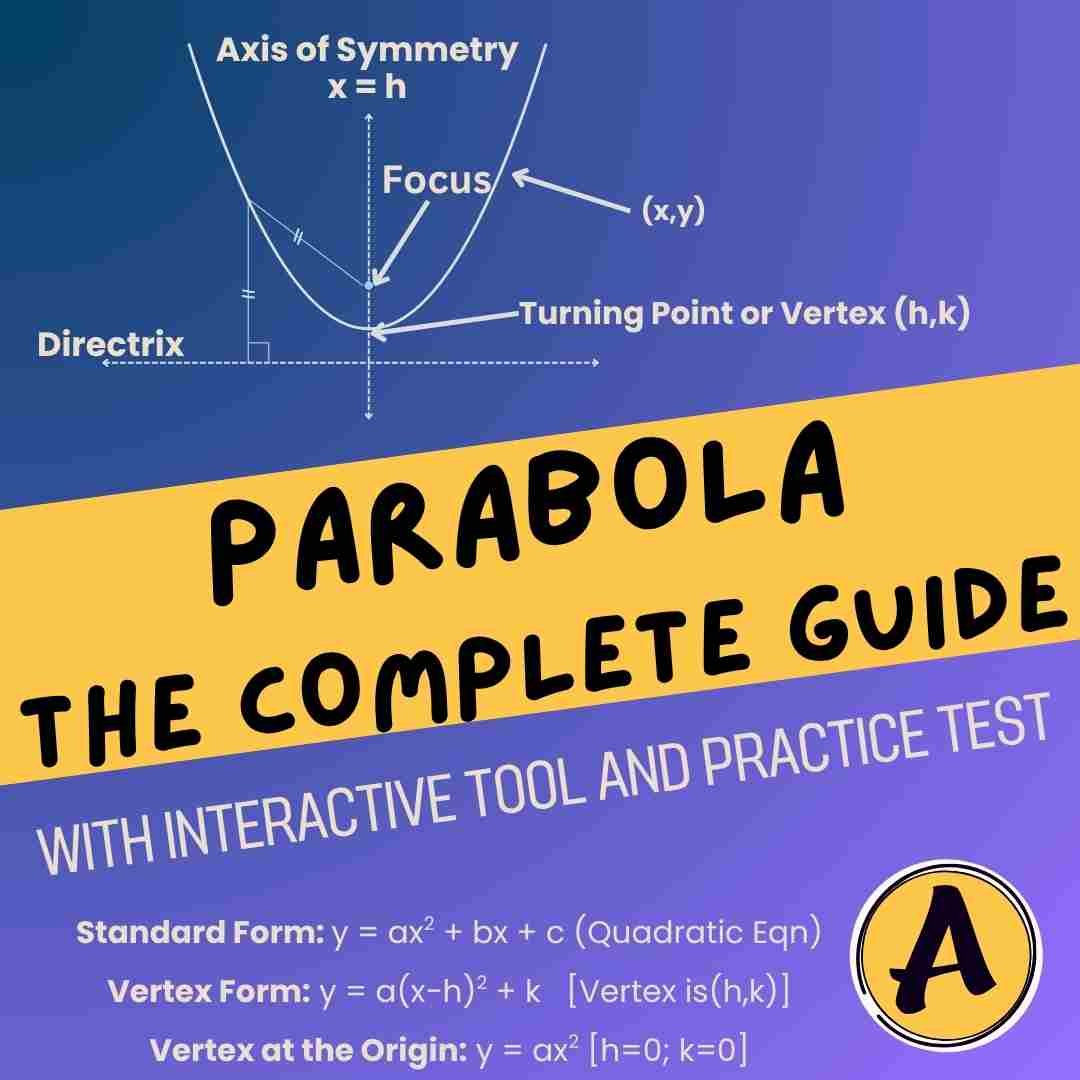
Illustrated parabola guide cover image showing a parabola graph labelled with axis of symmetry, focus, directrix and turning point or vertex.

Table of Contents

Interactive maths practice

Parabolas Practice Questions: NSW Years 9–10

Master the main parabola skills taught in Years 9 and 10. Each section contains 10 questions with instant checking, helpful hints and complete worked solutions.

  • Intercepts: find roots, zeros, x-intercepts and y-intercepts
  • Turning points: identify vertices, maximum points and minimum points
  • Parabola equations: use factorised form or vertex form with given points
  • Intersections: solve where a line and a parabola meet
  • Sketching: identify concavity, symmetry, vertices and intercepts
  • 8 focused levels
  • 80 practice questions
  • Instant answer checks
  • Hints and full working
0Attempted
0Correct
80Total questions
Overall progress0 of 80 correct
0 of 80 correct

Common equivalent forms and reversed root or intersection orders are accepted. Your answers and checked results are saved automatically in this browser.

Level 1 Finding x-Intercepts, Roots and Zeros 10 questions · Solving quadratics 0/10

Tip: Set y = 0 and solve the quadratic. You may enter roots as x = 2 or x = 3, or as the intercepts (2, 0) and (3, 0).
  1. Find the x-intercepts of y = x2 - 5x + 6.

    View hint and full working

    Hint: Set y = 0, then solve the quadratic.

    Working
    0 = x2 - 5x + 6
    0 = (x - 2)(x - 3)
    x = 2 or x = 3
    So the x-intercepts are (2, 0) and (3, 0).
    Answer: (2,0) and (3,0)
  2. Find the roots of y = x2 + 7x + 10.

    View hint and full working

    Hint: Roots are the x-values when y = 0.

    Working
    0 = x2 + 7x + 10
    0 = (x + 5)(x + 2)
    x = -5 or x = -2.
    Answer: (-5,0) and (-2,0)
  3. Solve x2 - 9 = 0.

    View hint and full working

    Hint: This is a difference of two squares.

    Working
    x2 - 9 = 0
    (x - 3)(x + 3) = 0
    x = 3 or x = -3.
    Answer: x=3 or x=-3
  4. Find the zeros of y = x2 - 8x + 15.

    View hint and full working

    Hint: Set y = 0 and factorise.

    Working
    0 = x2 - 8x + 15
    0 = (x - 3)(x - 5)
    x = 3 or x = 5.
    Answer: x=3 or x=5
  5. Find the x-intercepts of y = x2 + x - 12.

    View hint and full working

    Hint: Find two numbers that multiply to -12 and add to 1.

    Working
    0 = x2 + x - 12
    0 = (x + 4)(x - 3)
    x = -4 or x = 3.
    Answer: x=3 or x=-4
  6. Solve 2x2 - 8x = 0.

    View hint and full working

    Hint: Take out the common factor first.

    Working
    2x2 - 8x = 0
    2x(x - 4) = 0
    x = 0 or x = 4.
    Answer: x=0 or x=4
  7. Find the roots of y = x2 - 2x - 8.

    View hint and full working

    Hint: Set y = 0 and factorise.

    Working
    0 = x2 - 2x - 8
    0 = (x - 4)(x + 2)
    x = 4 or x = -2.
    Answer: x=4 or x=-2
  8. Find the zeros of y = x2 + 6x + 9.

    View hint and full working

    Hint: This is a perfect square trinomial.

    Working
    0 = x2 + 6x + 9
    0 = (x + 3)2
    x = -3.
    Answer: x=-3
  9. Solve 3x2 - 12 = 0.

    View hint and full working

    Hint: Move the constant, divide, then square root.

    Working
    3x2 - 12 = 0
    3x2 = 12
    x2 = 4
    x = 2 or x = -2.
    Answer: x=2 or x=-2
  10. Find the x-intercepts of y = 2x2 + 5x - 3.

    View hint and full working

    Hint: Factorise using two brackets.

    Working
    0 = 2x2 + 5x - 3
    0 = (2x - 1)(x + 3)
    x = 1/2 or x = -3.
    Answer: x=1/2 or x=-3

Level 2 Finding the y-Intercept 10 questions · Substitution 0/10

Tip: Set x = 0. You may enter the coordinate, such as (0, 6), or the y-value, such as 6.
  1. Find the y-intercept of y = x2 - 5x + 6.

    View hint and full working

    Hint: Set x = 0.

    Working
    y = 02 - 5(0) + 6
    y = 6
    So the y-intercept is (0, 6).
    Answer: (0,6)
  2. Find the y-intercept of y = 2x2 + 3x - 4.

    View hint and full working

    Hint: The y-intercept is the value of c in standard form.

    Working
    y = 2(0)2 + 3(0) - 4
    y = -4
    So the y-intercept is (0, -4).
    Answer: (0,-4)
  3. Find the y-intercept of y = -x2 + 7x + 8.

    View hint and full working

    Hint: Set x = 0 and calculate y.

    Working
    y = -(0)2 + 7(0) + 8
    y = 8.
    Answer: (0,8)
  4. Find the y-intercept of y = 3x2 - 12x.

    View hint and full working

    Hint: Set x = 0.

    Working
    y = 3(0)2 - 12(0)
    y = 0
    So the y-intercept is (0, 0).
    Answer: (0,0)
  5. Find the y-intercept of y = (x - 2)(x + 5).

    View hint and full working

    Hint: Substitute x = 0 into the factorised form.

    Working
    y = (0 - 2)(0 + 5)
    y = (-2)(5)
    y = -10.
    Answer: (0,-10)
  6. Find the y-intercept of y = 2(x - 3)2 + 1.

    View hint and full working

    Hint: Substitute x = 0 into vertex form.

    Working
    y = 2(0 - 3)2 + 1
    y = 2(9) + 1
    y = 19.
    Answer: (0,19)
  7. Find the y-intercept of y = -3(x + 1)2 + 5.

    View hint and full working

    Hint: Substitute x = 0.

    Working
    y = -3(0 + 1)2 + 5
    y = -3 + 5
    y = 2.
    Answer: (0,2)
  8. Find the y-intercept of y = 4x2 - 1.

    View hint and full working

    Hint: Set x = 0.

    Working
    y = 4(0)2 - 1
    y = -1.
    Answer: (0,-1)
  9. Find the y-intercept of y = -2x2 + x + 9.

    View hint and full working

    Hint: Set x = 0.

    Working
    y = -2(0)2 + 0 + 9
    y = 9.
    Answer: (0,9)
  10. Find the y-intercept of y = 5(x - 1)(x + 2).

    View hint and full working

    Hint: Substitute x = 0.

    Working
    y = 5(0 - 1)(0 + 2)
    y = 5(-1)(2)
    y = -10.
    Answer: (0,-10)

Level 3 Finding the Vertex or Turning Point 10 questions · Maximum and minimum 0/10

Tip: For y = ax² + bx + c, use x = −b/(2a), then substitute to find y. In vertex form y = a(x − h)² + k, the vertex is (h, k).
  1. Find the vertex of y = x2 - 4x + 3.

    View hint and full working

    Hint: Use x = -b / 2a, then substitute back.

    Working
    a = 1, b = -4
    x = -(-4) / 2(1) = 2
    y = 22 - 4(2) + 3 = -1
    Vertex = (2, -1).
    Answer: (2,-1)
  2. Find the turning point of y = x2 + 6x + 5.

    View hint and full working

    Hint: Use x = -b / 2a.

    Working
    a = 1, b = 6
    x = -6 / 2 = -3
    y = (-3)2 + 6(-3) + 5 = -4
    Turning point = (-3, -4).
    Answer: (-3,-4)
  3. Find the vertex of y = 2x2 - 8x + 1.

    View hint and full working

    Hint: Use x = -b / 2a.

    Working
    a = 2, b = -8
    x = -(-8) / 2(2) = 8/4 = 2
    y = 2(2)2 - 8(2) + 1 = -7
    Vertex = (2, -7).
    Answer: (2,-7)
  4. Find the vertex of y = -x2 + 4x + 5.

    View hint and full working

    Hint: Because a is negative, this vertex is a maximum point.

    Working
    a = -1, b = 4
    x = -4 / 2(-1) = 2
    y = -(2)2 + 4(2) + 5 = 9
    Vertex = (2, 9).
    Answer: (2,9)
  5. Find the vertex of y = 3(x - 2)2 + 4.

    View hint and full working

    Hint: This is already in vertex form y = a(x - h)2 + k.

    Working
    y = 3(x - 2)2 + 4
    h = 2, k = 4
    Vertex = (2, 4).
    Answer: (2,4)
  6. Find the turning point of y = -2(x + 3)2 - 1.

    View hint and full working

    Hint: Remember: x + 3 means h = -3.

    Working
    y = -2(x + 3)2 - 1
    y = -2(x - (-3))2 - 1
    Vertex = (-3, -1).
    Answer: (-3,-1)
  7. Find the maximum point of y = -x2 - 6x + 2.

    View hint and full working

    Hint: Use x = -b / 2a. Since a < 0, the vertex is a maximum.

    Working
    a = -1, b = -6
    x = -(-6) / 2(-1) = -3
    y = -(-3)2 - 6(-3) + 2 = 11
    Maximum point = (-3, 11).
    Answer: (-3,11)
  8. Find the minimum point of y = x2 + 2x - 8.

    View hint and full working

    Hint: Since a > 0, the vertex is a minimum.

    Working
    a = 1, b = 2
    x = -2 / 2 = -1
    y = (-1)2 + 2(-1) - 8 = -9
    Minimum point = (-1, -9).
    Answer: (-1,-9)
  9. Find the vertex of y = 4(x - 1)2 - 7.

    View hint and full working

    Hint: Read h and k directly from vertex form.

    Working
    y = 4(x - 1)2 - 7
    h = 1, k = -7
    Vertex = (1, -7).
    Answer: (1,-7)
  10. Find the vertex of y = -3(x + 2)2 + 6.

    View hint and full working

    Hint: x + 2 means h = -2.

    Working
    y = -3(x + 2)2 + 6
    y = -3(x - (-2))2 + 6
    Vertex = (-2, 6).
    Answer: (-2,6)

Level 4 Equation From Two x-Intercepts and Another Point 10 questions · Factorised form 0/10

Tip: Begin with y = a(x − r₁)(x − r₂), then substitute the additional point to calculate a.
  1. A parabola has x-intercepts 1 and 4, and passes through (2, -6). Find the equation.

    View hint and full working

    Hint: Use y = a(x - r1)(x - r2), then substitute the point.

    Working
    y = a(x - 1)(x - 4)
    Use (2, -6):
    -6 = a(2 - 1)(2 - 4)
    -6 = -2a
    a = 3
    Equation: y = 3(x - 1)(x - 4).
    Answer: y=3(x-1)(x-4)
  2. A parabola has x-intercepts -2 and 3, and passes through (1, -12). Find the equation.

    View hint and full working

    Hint: Use the two roots in factorised form.

    Working
    y = a(x + 2)(x - 3)
    Use (1, -12):
    -12 = a(3)(-2)
    -12 = -6a
    a = 2
    Equation: y = 2(x + 2)(x - 3).
    Answer: y=2(x+2)(x-3)
  3. A parabola has x-intercepts -1 and 5, and passes through (1, -16). Find the equation.

    View hint and full working

    Hint: Substitute the point to find a.

    Working
    y = a(x + 1)(x - 5)
    Use (1, -16):
    -16 = a(2)(-4)
    -16 = -8a
    a = 2
    Equation: y = 2(x + 1)(x - 5).
    Answer: y=2(x+1)(x-5)
  4. A parabola has x-intercepts 0 and 6, and passes through (2, -8). Find the equation.

    View hint and full working

    Hint: One x-intercept is 0, so one factor is x.

    Working
    y = a(x)(x - 6)
    Use (2, -8):
    -8 = a(2)(-4)
    -8 = -8a
    a = 1
    Equation: y = x(x - 6).
    Answer: y=x(x-6)
  5. A parabola has x-intercepts -3 and 1, and passes through (0, 6). Find the equation.

    View hint and full working

    Hint: Use the point (0, 6) to find a.

    Working
    y = a(x + 3)(x - 1)
    Use (0, 6):
    6 = a(3)(-1)
    6 = -3a
    a = -2
    Equation: y = -2(x + 3)(x - 1).
    Answer: y=-2(x+3)(x-1)
  6. A parabola has x-intercepts 2 and 7, and passes through (3, -8). Find the equation.

    View hint and full working

    Hint: Start with the two x-intercepts.

    Working
    y = a(x - 2)(x - 7)
    Use (3, -8):
    -8 = a(1)(-4)
    -8 = -4a
    a = 2
    Equation: y = 2(x - 2)(x - 7).
    Answer: y=2(x-2)(x-7)
  7. A parabola has x-intercepts -4 and 2, and passes through (-1, 9). Find the equation.

    View hint and full working

    Hint: Substitute (-1, 9) after writing factorised form.

    Working
    y = a(x + 4)(x - 2)
    Use (-1, 9):
    9 = a(3)(-3)
    9 = -9a
    a = -1
    Equation: y = -(x + 4)(x - 2).
    Answer: y=-(x+4)(x-2)
  8. A parabola has x-intercepts 3 and 5, and passes through (4, -3). Find the equation.

    View hint and full working

    Hint: The point lies between the roots, so y is negative if a is positive.

    Working
    y = a(x - 3)(x - 5)
    Use (4, -3):
    -3 = a(1)(-1)
    -3 = -a
    a = 3
    Equation: y = 3(x - 3)(x - 5).
    Answer: y=3(x-3)(x-5)
  9. A parabola has x-intercepts -5 and -1, and passes through (-3, 8). Find the equation.

    View hint and full working

    Hint: Use x + 5 and x + 1 as factors.

    Working
    y = a(x + 5)(x + 1)
    Use (-3, 8):
    8 = a(2)(-2)
    8 = -4a
    a = -2
    Equation: y = -2(x + 5)(x + 1).
    Answer: y=-2(x+5)(x+1)
  10. A parabola has x-intercepts -2 and 6, and passes through (2, -16). Find the equation.

    View hint and full working

    Hint: Substitute the point (2, -16).

    Working
    y = a(x + 2)(x - 6)
    Use (2, -16):
    -16 = a(4)(-4)
    -16 = -16a
    a = 1
    Equation: y = (x + 2)(x - 6).
    Answer: y=(x+2)(x-6)

Level 5 Equation From Two x-Intercepts and the y-Intercept 10 questions · Factorised form 0/10

Tip: Write y = a(x − r₁)(x − r₂), then use the y-intercept point (0, y) to find a.
  1. A parabola has x-intercepts -2 and 4, and y-intercept -16. Find the equation.

    View hint and full working

    Hint: Use the y-intercept point (0, -16).

    Working
    y = a(x + 2)(x - 4)
    Use (0, -16):
    -16 = a(2)(-4)
    -16 = -8a
    a = 2
    Equation: y = 2(x + 2)(x - 4).
    Answer: y=2(x+2)(x-4)
  2. A parabola has x-intercepts 1 and 5, and y-intercept 10. Find the equation.

    View hint and full working

    Hint: Substitute (0, 10).

    Working
    y = a(x - 1)(x - 5)
    10 = a(-1)(-5)
    10 = 5a
    a = 2
    Equation: y = 2(x - 1)(x - 5).
    Answer: y=2(x-1)(x-5)
  3. A parabola has x-intercepts -3 and 2, and y-intercept 12. Find the equation.

    View hint and full working

    Hint: Use (0, 12).

    Working
    y = a(x + 3)(x - 2)
    12 = a(3)(-2)
    12 = -6a
    a = -2
    Equation: y = -2(x + 3)(x - 2).
    Answer: y=-2(x+3)(x-2)
  4. A parabola has x-intercepts 2 and 6, and y-intercept 24. Find the equation.

    View hint and full working

    Hint: Substitute the y-intercept point.

    Working
    y = a(x - 2)(x - 6)
    24 = a(-2)(-6)
    24 = 12a
    a = 2
    Equation: y = 2(x - 2)(x - 6).
    Answer: y=2(x-2)(x-6)
  5. A parabola has x-intercepts -1 and 4, and y-intercept -8. Find the equation.

    View hint and full working

    Hint: Use (0, -8).

    Working
    y = a(x + 1)(x - 4)
    -8 = a(1)(-4)
    -8 = -4a
    a = 2
    Equation: y = 2(x + 1)(x - 4).
    Answer: y=2(x+1)(x-4)
  6. A parabola has x-intercepts -4 and 1, and y-intercept 8. Find the equation.

    View hint and full working

    Hint: Use the y-intercept point (0, 8).

    Working
    y = a(x + 4)(x - 1)
    8 = a(4)(-1)
    8 = -4a
    a = -2
    Equation: y = -2(x + 4)(x - 1).
    Answer: y=-2(x+4)(x-1)
  7. A parabola has x-intercepts 3 and 7, and y-intercept 21. Find the equation.

    View hint and full working

    Hint: If a = 1, the y-intercept will be 21.

    Working
    y = a(x - 3)(x - 7)
    21 = a(-3)(-7)
    21 = 21a
    a = 1
    Equation: y = (x - 3)(x - 7).
    Answer: y=(x-3)(x-7)
  8. A parabola has x-intercepts -5 and -2, and y-intercept -20. Find the equation.

    View hint and full working

    Hint: Substitute (0, -20).

    Working
    y = a(x + 5)(x + 2)
    -20 = a(5)(2)
    -20 = 10a
    a = -2
    Equation: y = -2(x + 5)(x + 2).
    Answer: y=-2(x+5)(x+2)
  9. A parabola has x-intercepts -6 and 2, and y-intercept -24. Find the equation.

    View hint and full working

    Hint: Use (0, -24).

    Working
    y = a(x + 6)(x - 2)
    -24 = a(6)(-2)
    -24 = -12a
    a = 2
    Equation: y = 2(x + 6)(x - 2).
    Answer: y=2(x+6)(x-2)
  10. A parabola has x-intercepts -2 and 5, and y-intercept 30. Find the equation.

    View hint and full working

    Hint: Substitute the y-intercept point.

    Working
    y = a(x + 2)(x - 5)
    30 = a(2)(-5)
    30 = -10a
    a = -3
    Equation: y = -3(x + 2)(x - 5).
    Answer: y=-3(x+2)(x-5)

Level 6 Equation From the Vertex and Another Point 10 questions · Vertex form 0/10

Tip: Use y = a(x − h)² + k, where (h, k) is the vertex. Substitute the additional point to find a.
  1. A parabola has vertex (3, 2) and passes through (5, 10). Find the equation.

    View hint and full working

    Hint: Use y = a(x - h)2 + k.

    Working
    Vertex (3, 2): y = a(x - 3)2 + 2
    Use (5, 10):
    10 = a(2)2 + 2
    8 = 4a
    a = 2
    Equation: y = 2(x - 3)2 + 2.
    Answer: y=2(x-3)2+2
  2. A parabola has vertex (1, -4) and passes through (3, 4). Find the equation.

    View hint and full working

    Hint: Substitute the vertex first.

    Working
    y = a(x - 1)2 - 4
    Use (3, 4):
    4 = a(2)2 - 4
    8 = 4a
    a = 2
    Equation: y = 2(x - 1)2 - 4.
    Answer: y=2(x-1)2-4
  3. A parabola has vertex (-2, 5) and passes through (0, 1). Find the equation.

    View hint and full working

    Hint: x - h becomes x + 2 when h = -2.

    Working
    y = a(x + 2)2 + 5
    Use (0, 1):
    1 = a(2)2 + 5
    -4 = 4a
    a = -1
    Equation: y = -(x + 2)2 + 5.
    Answer: y=-(x+2)2+5
  4. A parabola has vertex (4, -1) and passes through (6, 7). Find the equation.

    View hint and full working

    Hint: Use vertex form.

    Working
    y = a(x - 4)2 - 1
    Use (6, 7):
    7 = a(2)2 - 1
    8 = 4a
    a = 2
    Equation: y = 2(x - 4)2 - 1.
    Answer: y=2(x-4)2-1
  5. A parabola has vertex (-1, -3) and passes through (1, 5). Find the equation.

    View hint and full working

    Hint: Substitute the point after placing the vertex.

    Working
    y = a(x + 1)2 - 3
    Use (1, 5):
    5 = a(2)2 - 3
    8 = 4a
    a = 2
    Equation: y = 2(x + 1)2 - 3.
    Answer: y=2(x+1)2-3
  6. A parabola has vertex (0, 2) and passes through (3, -7). Find the equation.

    View hint and full working

    Hint: When h = 0, the equation is y = ax2 + k.

    Working
    y = ax2 + 2
    Use (3, -7):
    -7 = 9a + 2
    -9 = 9a
    a = -1
    Equation: y = -x2 + 2.
    Answer: y=-(x)2+2
  7. A parabola has vertex (2, 0) and passes through (4, 12). Find the equation.

    View hint and full working

    Hint: Since k = 0, the +0 is not needed.

    Working
    y = a(x - 2)2
    Use (4, 12):
    12 = a(2)2
    12 = 4a
    a = 3
    Equation: y = 3(x - 2)2.
    Answer: y=3(x-2)2
  8. A parabola has vertex (-3, 4) and passes through (-1, 0). Find the equation.

    View hint and full working

    Hint: Use vertex form and substitute (-1, 0).

    Working
    y = a(x + 3)2 + 4
    Use (-1, 0):
    0 = a(2)2 + 4
    -4 = 4a
    a = -1
    Equation: y = -(x + 3)2 + 4.
    Answer: y=-(x+3)2+4
  9. A parabola has vertex (5, 1) and passes through (3, 9). Find the equation.

    View hint and full working

    Hint: The point is 2 units from the vertex in the x-direction.

    Working
    y = a(x - 5)2 + 1
    Use (3, 9):
    9 = a(-2)2 + 1
    8 = 4a
    a = 2
    Equation: y = 2(x - 5)2 + 1.
    Answer: y=2(x-5)2+1
  10. A parabola has vertex (-4, -2) and passes through (-2, 6). Find the equation.

    View hint and full working

    Hint: x - (-4) becomes x + 4.

    Working
    y = a(x + 4)2 - 2
    Use (-2, 6):
    6 = a(2)2 - 2
    8 = 4a
    a = 2
    Equation: y = 2(x + 4)2 - 2.
    Answer: y=2(x+4)2-2

Level 7 Intersections of a Line and a Parabola 10 questions · Simultaneous equations 0/10

Tip: Set the line and parabola equations equal, solve for x, then substitute each x-value to find the matching y-value.
  1. Find where y = x2 - 2x + 1 and y = x + 1 meet.

    View hint and full working

    Hint: Make the two equations equal.

    Working
    x2 - 2x + 1 = x + 1
    x2 - 3x = 0
    x(x - 3) = 0
    x = 0 or x = 3
    Using y = x + 1, y = 1 or 4
    Points: (0, 1) and (3, 4).
    Answer: (0,1) and (3,4)
  2. Find where y = x2 and y = 2x + 3 meet.

    View hint and full working

    Hint: Set x2 = 2x + 3.

    Working
    x2 = 2x + 3
    x2 - 2x - 3 = 0
    (x - 3)(x + 1) = 0
    x = 3 or x = -1
    Using y = x2, points are (3, 9) and (-1, 1).
    Answer: (-1,1) and (3,9)
  3. Find where y = x2 - 4 and y = x + 2 meet.

    View hint and full working

    Hint: Make the equations equal.

    Working
    x2 - 4 = x + 2
    x2 - x - 6 = 0
    (x - 3)(x + 2) = 0
    x = 3 or x = -2
    Using y = x + 2, points are (3, 5) and (-2, 0).
    Answer: (-2,0) and (3,5)
  4. Find where y = x2 + 2x and y = 3x meet.

    View hint and full working

    Hint: Set the equations equal and solve.

    Working
    x2 + 2x = 3x
    x2 - x = 0
    x(x - 1) = 0
    x = 0 or x = 1
    Using y = 3x, points are (0, 0) and (1, 3).
    Answer: (0,0) and (1,3)
  5. Find where y = x2 - 6x + 5 and y = -3 meet.

    View hint and full working

    Hint: A horizontal line still works the same way.

    Working
    x2 - 6x + 5 = -3
    x2 - 6x + 8 = 0
    (x - 2)(x - 4) = 0
    x = 2 or x = 4
    Points: (2, -3) and (4, -3).
    Answer: (2,-3) and (4,-3)
  6. Find where y = -x2 + 4x and y = x meet.

    View hint and full working

    Hint: Make the equations equal.

    Working
    -x2 + 4x = x
    -x2 + 3x = 0
    -x(x - 3) = 0
    x = 0 or x = 3
    Using y = x, points are (0, 0) and (3, 3).
    Answer: (0,0) and (3,3)
  7. Find where y = x2 + x - 2 and y = 4 meet.

    View hint and full working

    Hint: Set the parabola equal to 4.

    Working
    x2 + x - 2 = 4
    x2 + x - 6 = 0
    (x + 3)(x - 2) = 0
    x = -3 or x = 2
    Points: (-3, 4) and (2, 4).
    Answer: (-3,4) and (2,4)
  8. Find where y = x2 - 1 and y = -x + 5 meet.

    View hint and full working

    Hint: Set x2 - 1 = -x + 5.

    Working
    x2 - 1 = -x + 5
    x2 + x - 6 = 0
    (x + 3)(x - 2) = 0
    x = -3 or x = 2
    Using y = -x + 5, points are (-3, 8) and (2, 3).
    Answer: (-3,8) and (2,3)
  9. Find where y = 2x2 and y = 8x meet.

    View hint and full working

    Hint: Set 2x2 = 8x.

    Working
    2x2 = 8x
    2x2 - 8x = 0
    2x(x - 4) = 0
    x = 0 or x = 4
    Using y = 8x, points are (0, 0) and (4, 32).
    Answer: (0,0) and (4,32)
  10. Find where y = x2 - 5x + 6 and y = 0 meet.

    View hint and full working

    Hint: This is the same as finding x-intercepts.

    Working
    x2 - 5x + 6 = 0
    (x - 2)(x - 3) = 0
    x = 2 or x = 3
    Points: (2, 0) and (3, 0).
    Answer: (2,0) and (3,0)

Level 8 Key Features for Sketching a Parabola 10 questions · Graph features 0/10

Tip: List the features in the requested order: concavity, axis of symmetry, vertex, y-intercept and x-intercepts.
  1. For y = x2 - 4x + 3, list the concavity, axis, vertex, y-intercept and x-intercepts.

    View hint and full working

    Hint: Find a, axis, vertex and intercepts.

    Working
    a = 1, so it opens up.
    Axis: x = -b/2a = 2
    Vertex: (2, -1)
    y-intercept: (0, 3)
    x-intercepts: (1, 0) and (3, 0).
    Answer: opens up; x=2; (2,-1); (0,3); (1,0) and (3,0)
  2. For y = x2 + 6x + 5, list the concavity, axis, vertex, y-intercept and x-intercepts.

    View hint and full working

    Hint: Use x = -b/2a.

    Working
    a = 1, so it opens up.
    Axis: x = -3
    Vertex: (-3, -4)
    y-intercept: (0, 5)
    x-intercepts from (x + 5)(x + 1) = 0: (-5, 0) and (-1, 0).
    Answer: opens up; x=-3; (-3,-4); (0,5); (-5,0) and (-1,0)
  3. For y = -x2 + 4x + 5, list the concavity, axis, vertex, y-intercept and x-intercepts.

    View hint and full working

    Hint: Since a < 0, it opens down.

    Working
    a = -1, so it opens down.
    Axis: x = 2
    Vertex: (2, 9)
    y-intercept: (0, 5)
    x-intercepts: (-1, 0) and (5, 0).
    Answer: opens down; x=2; (2,9); (0,5); (-1,0) and (5,0)
  4. For y = x2 - 9, list the concavity, axis, vertex, y-intercept and x-intercepts.

    View hint and full working

    Hint: This graph is symmetrical about the y-axis.

    Working
    a = 1, so it opens up.
    Axis: x = 0
    Vertex: (0, -9)
    y-intercept: (0, -9)
    x-intercepts: (-3, 0) and (3, 0).
    Answer: opens up; x=0; (0,-9); (0,-9); (-3,0) and (3,0)
  5. For y = 2x2 - 8x + 6, list the concavity, axis, vertex, y-intercept and x-intercepts.

    View hint and full working

    Hint: Factorise after setting y = 0.

    Working
    a = 2, so it opens up.
    Axis: x = -(-8)/2(2) = 2
    Vertex: (2, -2)
    y-intercept: (0, 6)
    x-intercepts: solve 2x2 - 8x + 6 = 0 -> x = 1 or 3.
    Answer: opens up; x=2; (2,-2); (0,6); (1,0) and (3,0)
  6. For y = -2x2 + 8x - 6, list the concavity, axis, vertex, y-intercept and x-intercepts.

    View hint and full working

    Hint: The negative a-value means it opens down.

    Working
    a = -2, so it opens down.
    Axis: x = -8 / 2(-2) = 2
    Vertex: (2, 2)
    y-intercept: (0, -6)
    x-intercepts: x = 1 or x = 3.
    Answer: opens down; x=2; (2,2); (0,-6); (1,0) and (3,0)
  7. For y = (x - 2)2 - 4, list the concavity, axis, vertex, y-intercept and x-intercepts.

    View hint and full working

    Hint: Use vertex form first.

    Working
    a = 1, so it opens up.
    Vertex: (2, -4)
    Axis: x = 2
    y-intercept: y = (0 - 2)2 - 4 = 0, so (0, 0)
    x-intercepts: (x - 2)2 - 4 = 0 -> x = 0 or 4.
    Answer: opens up; x=2; (2,-4); (0,0); (0,0) and (4,0)
  8. For y = -(x + 1)2 + 9, list the concavity, axis, vertex, y-intercept and x-intercepts.

    View hint and full working

    Hint: x + 1 means the vertex x-value is -1.

    Working
    a = -1, so it opens down.
    Vertex: (-1, 9)
    Axis: x = -1
    y-intercept: y = -(1)2 + 9 = 8, so (0, 8)
    x-intercepts: -(x + 1)2 + 9 = 0 -> (x + 1)2 = 9 -> x = -4 or 2.
    Answer: opens down; x=-1; (-1,9); (0,8); (-4,0) and (2,0)
  9. For y = x2 + 2x - 8, list the concavity, axis, vertex, y-intercept and x-intercepts.

    View hint and full working

    Hint: Find the vertex and factorise for x-intercepts.

    Working
    a = 1, so it opens up.
    Axis: x = -2/2 = -1
    Vertex: (-1, -9)
    y-intercept: (0, -8)
    x-intercepts: (x + 4)(x - 2) = 0 -> (-4, 0) and (2, 0).
    Answer: opens up; x=-1; (-1,-9); (0,-8); (-4,0) and (2,0)
  10. For y = -x2 - 6x - 5, list the concavity, axis, vertex, y-intercept and x-intercepts.

    View hint and full working

    Hint: Since a < 0, it opens down.

    Working
    a = -1, so it opens down.
    Axis: x = -(-6)/2(-1) = -3
    Vertex: (-3, 4)
    y-intercept: (0, -5)
    x-intercepts: -x2 - 6x - 5 = 0 -> x2 + 6x + 5 = 0 -> x = -5 or -1.
    Answer: opens down; x=-3; (-3,4); (0,-5); (-5,0) and (-1,0)

What is a Parabola? Understanding Quadratic Functions

Simply put, a parabola is the graph of a quadratic equation. It forms a symmetrical, U-shaped curve where every point is defined by its distance from a fixed point (the focus) and a fixed line (the directrix).

Aligned with the NSW NESA curriculum, our study of parabolas covers the essential skills required for success in Year 9 and 10. From calculating the vertex and axis of symmetry to sketching graphs using standard, factorised, and turning point forms, we break down everything you need to confidently tackle your school assessments.

Key Features of a Parabola: NESA-Defined Vertex, Intercepts, and Symmetry

To succeed in your Year 9 and 10 NESA assessments, you must move beyond simply sketching curves and develop a deep understanding of the algebraic mechanics behind them. This guide breaks down the essential skills you need to master:

Key features of a Parabola are

  • Standard Form of the Equation: ax² + bx + c = 0, where a ≠ 0
  • Vertex Form of the Quadratic Equation: a(x-h)² + k = 0, where a ≠ 0 and (h,k) is the turning point.
  • Factorized form: y = a (x−r1​) (x−r2​); where r1 and r2 are the x-intercepts.
  • Turning point or Vertex: Point where the parabola changes direction.
  • Maximum: If a < 0, the parabola opens downward, so the vertex is the maximum point.
  • Minimum: If a > 0, the parabola opens upward, so the vertex is the minimum point.
  • Axis of Symmetry: The vertical line that cuts the parabola into two equal mirror-image halves. Formula: x= -b/2a
  • x -intercepts: These are the points where the parabola crosses the x-axis (Substitute y = 0).
  • y -intercept: These are the points where the parabola crosses the y-axis (Substitute x = 0)

Different types of Standard Equations of a Parabola
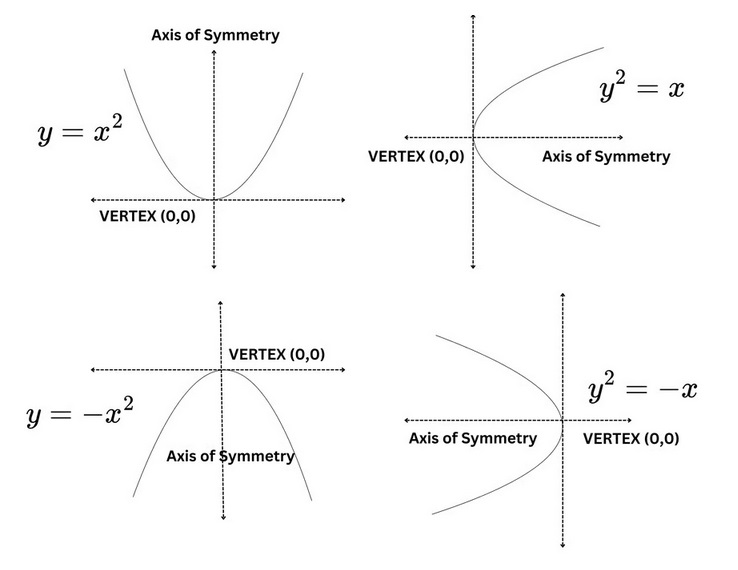
Different Types of Parabola with Standard Equations


Interactive Parabola Explorer

y = 1x² + 0x - 4
Quadratic form: Change a, b and c in y = ax² + bx + c.
1
0
-4
Vertex form: Change a, h and k in y = a(x − h)² + k. The vertex is (h, k).
1
0
-4

Decision Tree: Mastering Parabolas in the Year 9 & 10 NESA Curriculum

Use this quick guide to decide what to do first in a parabola question. Match the question type, then apply the correct step.

1. Find x-intercepts, roots, zeros, or solve

Do this: Set y = 0 and solve.

0 = ax² + bx + c

Example: For y = x² - 5x + 6, set 0 = x² - 5x + 6.

2. Find the y-intercept

Do this: Set x = 0 and find y.

Example: For y = x² - 5x + 6, when x = 0, y = 6.

3. Find the vertex or turning point

For standard form:

y = ax² + bx + c

Use x = -b / 2a, then substitute back to find y.

For vertex form:

y = a(x - h)² + k

The vertex is (h, k).

4. Given x-intercepts and another point

Use factorised form:

y = a(x - r₁)(x - r₂)

Then substitute the other point (x, y) to find a.

If x-intercepts are 1 and 4, start with y = a(x - 1)(x - 4).

5. Given two x-intercepts and the y-intercept

Use:

y = a(x - r₁)(x - r₂)

Then substitute the y-intercept point (0, y) to find a.

Note: One x-intercept and one y-intercept is usually not enough.

6. Given the vertex and another point

Use vertex form:

y = a(x - h)² + k

Substitute the vertex (h, k), then use the other point to find a.

Vertex (3, 2) gives y = a(x - 3)² + 2.

7. Given a line and a parabola

Do this: Make the equations equal, then solve the quadratic.

Example: If y = x² - 2x + 1 and y = x + 1, set them equal.

8. Sketch the parabola

Find these first:

  • Concavity: opens up or down
  • Axis of symmetry
  • Vertex
  • y-intercept
  • x-intercepts

What is a Dilation in a Parabola?

In the dilation of a parabola, the larger the constant ‘a’, the narrower the parabola; and the smaller the constant ‘a’, the wider the parabola.
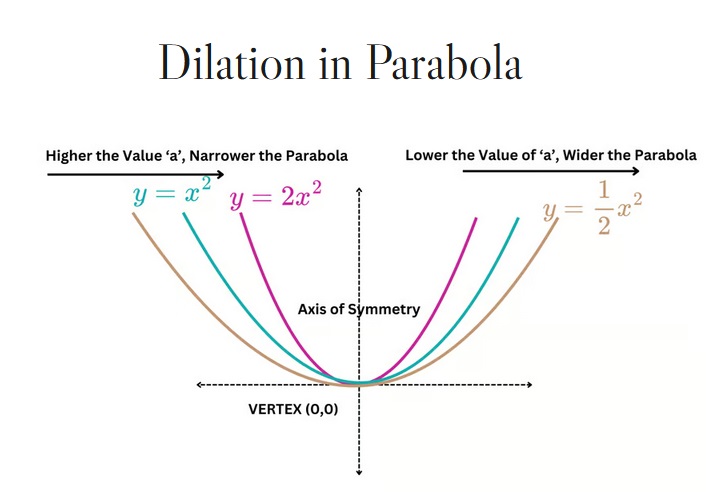
Dilation in a Parabola

How to Sketch a Parabola?

In order to sketch a Parabola, follow these steps:

Step 1: Determine the kind of U-shaped curve is the Parabola. Refer to the Standard Equations of the Parabola.

  • If a>0, the parabola opens upwards (U-shaped).

  • If a<0, the parabola downwards (inverted U-shaped).

Step 2: Find the y-intercept/s for the equation by substituting x=0 in the given equation. If there are two different solutions of y, it means that the equation intercepts the Y-axis at two different points. There may not be any solution as the Parabola may not intercept the Y-axis.

Step 3: Find the x-intercept/s for the equation by substituting y=0 in the given equation. If there are two different solutions of y, it means that the equation intercepts the Y-axis at two different points. There may not be any solution as the Parabola may not intercept the X-axis.

Step 4: If there are two solutions of y, find the mid-point to determine the Axis of Symmetry. Else find the mid-point from the two solutions of x. This is one of the vertex point as the vertex lies on the axis of symmetry.

Step 5: Using the midpoint in Step No. 4, substitute that value in the main equation to find the other co-ordinate of the Vertex.

Example on how to Sketch a Parabola?

Draw the Parabola for the equation:  y= x2 – 2

In order to sketch a Parabola, follow these steps:

Step 1: Determine the kind of U-shaped curve is the Parabola. Here, a=1 > 0. Hence, the parabola opens upwards (U-shaped).

Step 2: Find the y-intercept/s for the equation by substituting x=0 in the given equation.

Hence, y=x – 2; y= (0) – 2 = -2.

So, the y-intercept is at the point (0, -2). Since there’s only one solution for y, the parabola intersects the y-axis at one point.

Step 3: Find the x-intercept/s for the equation by substituting y=0 in the given equation.

Hence, y=x – 2 ; 0=x – 2; x = 2; There fore x= +-sqrt(2)

Therefore, There are parabola intercepts the parabola at two points: (+sqrt(2), 0) and ( -sqrt(2),0).

Step 4: Since there are two solutions of y, we find the mid-point to determine the Axis of Symmetry.

Hence, [sqrt(2) – sqrt(-2)]/2 = 0/2 = 0. Therefore, x=0, which is the equation for the Y-axis, is the Axis of Symmetry.

Step 5: Substitute x=2 in the main equation, we get y=-2. Hence, the Vertex is at (0,-2). Using the point, we will therefore plot the Parabola which is as follows:
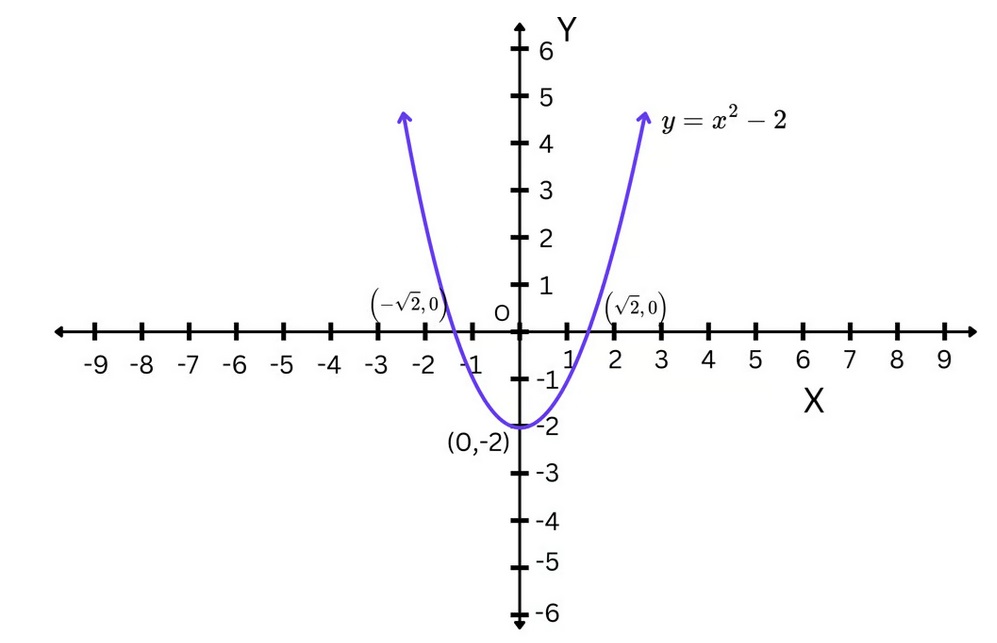

Example on How to Sketch a Parabola

A math tutor guiding a student during a lesson, with the question ‘Is Private Tutoring Really Needed? The Truth Sydney Parents Should Know,’ and the Aussie Math Tutor NSW logo displayed.

Is Private Tutoring Really Needed? The Truth Sydney Parents Should Know

Many Sydney parents ask — “Is private tutoring really necessary?”

With increasing academic pressure, intense NAPLAN competition, selective school ambitions, and gaps in school teaching, tutoring has become an essential support system. In suburbs such as Telopea, Dundas, Oatlands, Eastwood, and Carlingford, students rely on private maths tutoring to build confidence, close learning gaps, and achieve their best results.

Read More »
Student giving thumbs up beside Casio calculator with text “NESA Approved Calculators Which Top Students Use” — Aussie Math Tutor NSW educational post.

Which Are the Best NESA Approved Calculators (2026)?

Choosing the right NESA approved calculator can make a big difference in your maths exams. This 2026 guide reviews the best models — Casio, Sharp, HP, and Texas Instruments — trusted by NSW students and schools. Compare features, prices, and find the perfect calculator for your course level.

Read More »
Year 4 Math Practice Test in Sydney

NSW Parents Love This Year 4 Math Practice Test

Year 4 NSW Math Practice Tests (Stage 2) cover expanded number concepts (place value, fractions), geometry, and real-life applications. Expect easy (basic arithmetic), medium (intermediate arithmetic), and hard (advanced place value, fractions, area, problem-solving) tests.

Read More »
Math Geometry Pie
Math Symbols
Maths tutor helping a student with schoolwork during a one-on-one tutoring session

Not sure whether maths tutoring is right for your child?

Book a free initial maths assessment to discuss your child’s current level, learning gaps and suitable next steps.

Years 1–10 • NSW syllabus-aligned • Face-to-face and online tutoring