Pythagoras’ Theorem Practice Questions
Practise identifying the hypotenuse, finding a missing side and applying Pythagoras’ theorem to real-life problems. Every question includes a labelled diagram, an instant answer check and complete working.
- Identify the sides: locate the right angle and the hypotenuse
- Find the hypotenuse: add the squares of the two shorter sides
- Find a shorter side: subtract the known shorter-side square from the hypotenuse square
- Apply the theorem: solve ladder, ramp, rectangle, road and rope problems
- Check reasonableness: the hypotenuse must be longer than either shorter side
- 3 progressive levels
- 15 illustrated questions
- Instant answer checks
- Hints and full working
Enter the number only or include the correct unit. Your answers and checked results are saved automatically in this browser.
Level 1
Finding the Hypotenuse
5 questions · Foundation
0/5
Level 2
Finding a Missing Shorter Side
5 questions · Rearranging
0/5
Level 3
Applying Pythagoras’ Theorem
5 questions · Word problems
0/5
Pythagoras’ Theorem Explained Step by Step
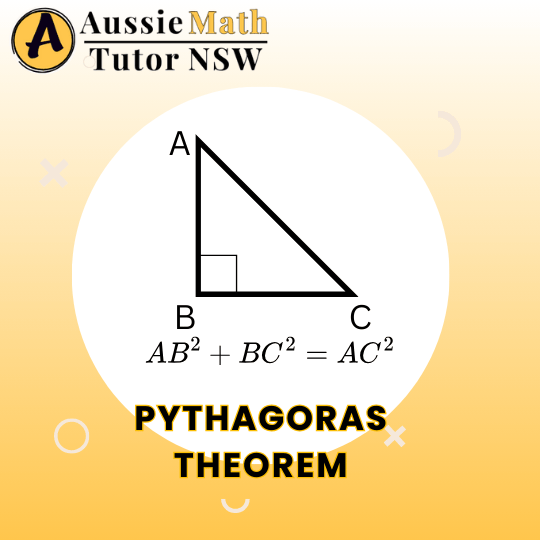
Pythagoras’ theorem connects the three side lengths of a right-angled triangle. When two sides are known, the third side can be calculated. The rule applies only when the triangle contains a 90° angle, and the hypotenuse is always the longest side opposite that angle.
Pythagoras’ Theorem in NSW Year 8 and Year 9 Maths
The NSW Mathematics 7–10 syllabus includes Pythagoras and trigonometry as a core focus area. Schools organise content through their own scope and sequence, so the exact term can differ. In my tutoring experience, students around Telopea, Dundas, Oatlands, Ermington, Rydalmere and Carlingford most commonly meet Pythagoras’ theorem in Year 8, while Year 9 students often use it for revision and more applied questions.
What I notice in local tutoring sessions
Most students can identify the hypotenuse and complete the squaring, addition or subtraction. The two recurring difficulties are more specific:
- They calculate a value such as c² = 25 but forget to take the final square root.
- They become unsure when the question asks for a shorter side and subtraction is required.
Older students are usually comfortable with the calculation itself. Their main challenge is recognising that an unfamiliar diagram, map or word problem contains a right-angled triangle and may require Pythagoras’ theorem.
The Pythagoras Rule and the Hypotenuse
For a right-angled triangle, let a and b be the two shorter sides and let c be the hypotenuse.
c must represent the hypotenuse. The letters a and b can be swapped, but c cannot be assigned to a shorter side when using this standard form.
The hypotenuse
The longest side of the right-angled triangle. It sits directly opposite the 90° angle.
The two shorter sides
These sides meet to form the right angle. They are sometimes called the legs of the triangle.
How to Find the Hypotenuse
When the unknown side is the hypotenuse, square the two shorter sides, add them and take the positive square root.
Answer: The hypotenuse is 5 cm.
The answer should be longer than either shorter side:
How to Find a Missing Shorter Side
This is the form that causes the most confusion. The longest side is already known, so subtract the square of the known shorter side from the square of the hypotenuse.
Answer: The missing shorter side is 12 cm.
The Step Students Most Often Forget: Take the Square Root
When the working reaches c² = 25, the value 25 is the square of the length. It is not the final side length.
Correct final step
A side length is positive, so use the positive square root. Writing the square-root line separately makes the final step harder to miss.
How to Recognise a Pythagoras Word Problem
A question may not use the word “Pythagoras”. Look for a hidden right-angled triangle created by perpendicular directions, a rectangle diagonal, a wall and the ground, or horizontal and vertical distances.
Find or draw the right angle
Look for a 90° marker, perpendicular lines, north–east movement, a rectangle corner, a vertical wall or level ground.
Identify the hypotenuse
It is opposite the right angle and is usually the diagonal or direct straight-line distance.
Decide between addition and subtraction
Add when the hypotenuse is missing. Subtract when a shorter side is missing.
Finish with the square root and unit
Round only when the question requests it, and state cm, m, km or the relevant unit.
A person travels 6 km east and then 8 km north. The east and north directions are perpendicular, so the direct distance back to the starting point forms the hypotenuse.
Direct distance: 10 km.
This same structure appears in questions involving ladders, ramps, television screens, sports fields, building diagonals and the shortest distance between two locations.
Square Roots, Surds and Rounding
Not every right-angled triangle has a whole-number answer. When the square root does not simplify to an integer, the answer may be left as an exact surd or written as a decimal, depending on the instruction.
The exact length is √130 cm. Correct to 1 decimal place, it is 11.4 cm.
- Keep the calculator value unrounded during the working.
- Round only the final answer.
- Use the number of decimal places or significant figures stated in the question.
- Include the unit after the rounded answer.
Pythagorean Triples: Useful, but Not a Memorisation Test
A Pythagorean triple is a set of three whole numbers that satisfies the theorem. Common examples include:
Recognising a familiar triple can make checking faster, and multiples also work—for example, 6, 8 and 10 are double 3, 4 and 5. However, students do not need to memorise a long list. Understanding how to apply the theorem is more reliable than depending on memory.
The Converse of Pythagoras’ Theorem
The converse works in the reverse direction. If the square of the longest side equals the sum of the squares of the other two sides, the triangle is right-angled.
Therefore, the triangle is right-angled.
Always test the longest side as c.
How Pythagoras Connects to Number Planes and Trigonometry
Pythagoras’ theorem becomes part of later topics rather than disappearing after Year 8.
Distance on a number plane
The horizontal and vertical coordinate changes form the shorter sides of a right-angled triangle. This produces the distance formula:
Right-angled trigonometry
Trigonometric ratios use opposite, adjacent and hypotenuse. Pythagoras may be used first to find a missing side before applying sine, cosine or tangent.
Explore the number plane and distance guide or continue to the NSW trigonometry guide.
A Reliable Exam Method
| Step | What to do | Quick check |
|---|---|---|
| 1. Recognise | Confirm that the triangle is right-angled. | Can you identify a 90° angle? |
| 2. Label | Mark the hypotenuse as c. | Is c opposite the right angle? |
| 3. Choose | Add for a missing hypotenuse; subtract for a missing shorter side. | Which side is unknown? |
| 4. Calculate | Square, add or subtract, then take the positive square root. | Did you include the final √ step? |
| 5. Present | Round as requested and include units. | Is the hypotenuse the longest side? |
Pythagoras Revision Checklist
- I use the theorem only with a right-angled triangle.
- I identify the hypotenuse before substituting numbers.
- I add squares when finding the hypotenuse.
- I subtract from the hypotenuse square when finding a shorter side.
- I take the positive square root at the end.
- I round only when instructed and include the unit.
- I check whether my answer is reasonable.
Frequently Asked Questions
When can Pythagoras’ theorem be used?
It can be used when a triangle is right-angled, two side lengths are known and the third side is required.
Why must I take a square root at the end?
The formula first produces the square of the unknown length. Taking the positive square root converts that squared value into the actual side length.
How do I know whether to add or subtract?
Add the two shorter-side squares when the hypotenuse is unknown. Subtract the known shorter-side square from the hypotenuse square when a shorter side is unknown.
Does the hypotenuse always have to be called c?
No. A diagram may use any letter. However, in the standard formula a² + b² = c², c represents the hypotenuse. Identify the side first rather than relying only on its letter.
Do students need to memorise Pythagorean triples?
Recognising common triples can save time, but understanding the formula is more important. The theorem works even when the side lengths are unfamiliar or the answer is a decimal.
Related Aussie Math Tutor NSW Resources
Trusted external references
For official curriculum information, see the NSW Mathematics K–10 syllabus overview and the NSW Mathematics glossary. Additional explanations and practice are available through Khan Academy’s Pythagorean theorem unit and Maths Is Fun.
Still Unsure When to Use Pythagoras?
Some students can follow a familiar example but become stuck when the missing side changes or the right-angled triangle is hidden inside a word problem. Patient, step-by-step support can strengthen the method and the recognition skills needed for school assessments.
View Free Assessment Times